Wednesday, April 30, 2014

Day 148: Math in the Rain


Warning: This post contains a photo at the end with profanity.

Today was Act 2 of my lesson on angles, perception and distance.

On Monday, we talked about how the eyes work in terms of depth perception.  We didn't talk much about the calculation, but more about the concepts.  The discussion was excellent and I was VERY excited for today.

When students showed up to school today, they saw this:

Once we got started, I asked them about a problem we did last week that used angle measurements at two points to determine the height of Ayers Rock.  It was a complicated problem and required them to move out of their comfort zones.  I asked them to identify exactly how much information we were given in the problem.

S: "The angle from the one point, the angle from the other and the distance between the two points."
Me: "Ok, so if we had that information, we could, in theory, find the distance to an object, right?  It may be a complicated set-up, but we could do it."
S: "Yeah we could."

We talked about ways that you could create depth perception if you only had one eye.  One student suggested that you could move back and forth, looking at the angles that changes.

Me: "If I were going to do that, should I move a little bit, or a lot?"
S: "The more you move, the bigger the difference will be and it will be easier to calculate the distance."
Me: "So if I wanted to calculate the distance to something far away, should I use two points that are close together, like my eyes?"
S: "No, you should pick ones that are farther apart because the angle will be bigger and easier to see."

We did some extensions of this through diagrams, without numbers, on the board.

Me: "What if I wanted to actually do this? What if I wanted to find the distance of something far away.  What should I do?  What would I need?"
S: "I guess you would need two points, like your eyes, but further apart, the distance between them and the angles from the sticks to whatever you're going to measure."

So we did it!

I gave each pair of students a protractor and two sticks and we went outside.  I had brought my mallet so I could pound the sticks into the ground, but it was wet and soft enough that they were able to push the sticks in.

The directions were:

You're to pick two objects in the middle distance (further than your thumb, but closer than downtown Pittsburgh).  Find a good place to plant your dowels and measure the angles to one object at a time.  I will come around and measure the distances between the sticks for you while you measure the angles.


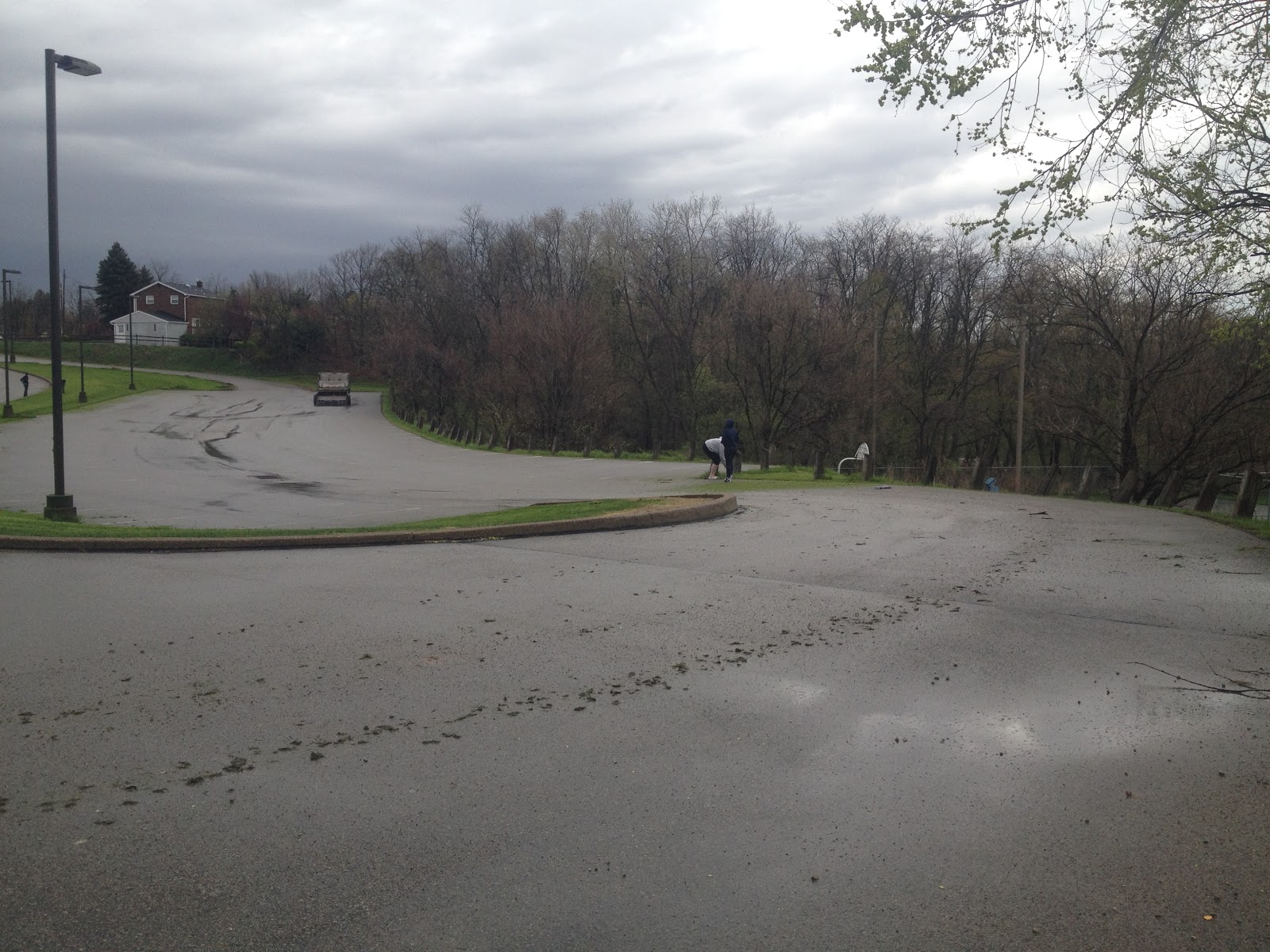
They were awesome!  There were a few groups who didn't quite get that they could leave the sticks in the ground for both objects as long as the object wasn't in the same line as the sticks, but overall, it went VERY well.  In 20 minutes, 28 students had gone outside, planted dowels, taken measurements, gathered data and returned to the classroom.

Did I mention that it was raining almost the entire time?

Me: "Great! Now show me how far away those objects were.  I want to see everything! Diagrams you used, calculations you made, everything.  If you're not sure how to set it up, talk to your partner and look at the Ayers Rock problem."
S: "I don't know how to set this up! What do I do?"
Me: "This is a problem solving activity. We talked about what you needed and that it would be enough information.  Use the resources you have to determine the distance.  Check your notes, experiment with different triangle set-ups.  It's a puzzle and you can do it!"

It was an amazing activity.  If I think about it, maybe I'll write it up all professional-like and charge the people a dollar and a half to see it.  Then I'll be rolling in dough!

Period 4/5 worked very well on the word problems with percent change.  Volunteers walked us through the problems step-by-step.  We had a very good back and forth discussions and had friendly interactions.

Period 8/9 came in rowdy and destructive.  Within 20 seconds of the start of the period, they had done this:

And they seemed genuinely confused as to why I was upset.  I assigned them to work independently on the next topic, simple interest.  While the introduction to this happened through discussion and examples in the other class, I wasn't able to push my annoyance and frustration away to stomach a conversation in this class.

The student who complained that I don't grade enough items once again did not complete his homework.


I'm going to take deep breaths and swim through the joy that my successful lesson brought me this morning and not let my pre-algebra class drag down my spirits.  Tomorrow is another day.


Warning: The following picture contains profanity and has been rated "Dull" by the Education Association of America

The following was written on my classroom door.  The paper is list of school-wide expectations.  Instead of taking the graffiti down, I decided to respond in an educational way.

Tuesday, April 29, 2014

Day 147: Testing...again


These tests never seem to end! At some point, I should put in the effort to calculate exactly how much instructional time is lost to standardized testing that provide no immediate feedback for students or teachers.  I know that I have missed my geometry class about 8% of the school year for testing and various activities.


Along those same lines, I just found out that a large portion of my Geometry class will not be in class on Thursday for a field trip.  I have yet to receive a list of how many and who will be attending. "They (the students) were supposed to tell you."

In pre-algebra, I asked a student to do a problem on the board and he insisted that he had no idea how and didn't want to.  I patiently egged him on and, once he realized I wasn't moving on, let me drag the answers out of him.  It was an interesting moment because he fought it every step of the way, but he clearly knew what was happening.

I wonder how much of student reluctance to do the work is laziness and how much is lack of confidence.  We frequently see students who are quite good at mathematical thinking and calculation who claim that they are terrible at it.  One of the girls in my class says that she hates math and she's terrible at it, but when she decides to put the effort in, she produces amazing results.

It's so frustrating to watch that happen, watch her do great work and at the same time say that she's terrible at it.  It's not modesty.  She honestly thinks that she's bad at math.

Yesterday in period 8/9, a student started yelling at me about how he wanted more graded items.  He wanted credit for the homework and classwork that he claimed he was doing.  So I gave them an assignment to work on for a grade.  When I checked it today, he hadn't done it.  When I asked him about it, he said that he had completed part of it and he should get full credit.

I just looked at him and he started yelling about how he didn't care.

I don't have any idea how to take them out of their situation and have them examine it as an outside observer.  I know that if it were someone else with this same problem, this student (and others) would recognize the fault and tell the other student that he or she was wrong.  I know this because it happens daily.  When this student started complaining, those around him told him he was wrong.

How do I get them to understand?  When he failed to complete the assignment for today, he yelled that it was my fault and that, again, he didn't care.


When you have toddlers, they will ask you to make something for lunch.  The conversation usually goes as follows:

Parent: "What would you like for lunch?"
Child: "I want peanut butter and jelly."
P: "Sounds good! I'll make you some peanut butter and jelly."

**A few minutes later**

P: "Here's your peanut butter and jelly!"
C: "I don't want that! I hate peanut butter and jelly and I hate you!"

Some days, teaching is this conversation writ large.

Perhaps this is normal for the age group, but it seems to me that the maturity of the students has been declining over the years.  I don't have idea how to combat this thinking.

Monday, April 28, 2014

Day 146: Perception and Perception


I spent the last week or so figuring out how I wanted to do the culminating lesson for the chapter on right triangles.  I received a TON of help from various math teachers around the internet, including Jen Silverman, Wendy MenardAudrey McLaren and Megan Schmidt for which I am extremely grateful.

I have the basic outline available for anyone who wants it.  This was a lesson in three parts, Act 1 of which was today.

My lead-in was my whiteboard drawing.  I told the geometry students that I wanted to talk about eyes.  I asked them about the different kinds of eyes they could think of.

Eventually, we were able to put them into two categories: side-facing and front-facing eyes.  We then started listing animals of each type and I asked them what those animals had in common, other than eye placement.  The students (faster than I had hoped) identified that, for the most part, animals with front-facing eyes were predators which those with side-facing eyes were prey.

We had a discussion about the advantages to each of these types.  The side-facing provided a view almost entirely around the animal, allowing it to see danger no matter where it originated.  But what are the advantages of front-facing?

S: "Depth perception!"

Sweet!  The discussion moved in to why predators need depth perception, but prey might not.  We talked about lions pouncing on prey and how, if they missed, they would go hungry.  Prey, however, only need to see danger and don't care much how far away it is.

Me: "What about people?  How are our eyes set?  Are we predators or prey?"

I had student hold up their thumbs in front of their faces and look at objects further away as they opened their eyes, one at a time.  We talked about what they saw and why.

S: "Each eye is seeing something slightly different so it looks like your thumb is moving when it isn't."

I had them hold up their thumbs and focus on a far away object, noticing that their image of their thumb was doubled and transparent.

After having them talk about their observations and theories, I asked them to draw diagrams of what each eye was seeing.  Then I told them about my weekend.

After doing a fair amount of yard work, building a raised bed for a garden, raking soil, moving rocks, I collapsed into a chair and began looking over my yard.  I noticed a tree stump at the top of my property.  I closed one eye and covered the stump with my thumb.  Then I opened that eye and closed the other, noting the movement of my thumb.  I estimated the angle between the stump and my thumb to be about 3.5 degrees (in reality, it was about 5.5).  Knowing the distance between my eyes and the distance from my face to my thumb, I was able to calculate the distance to the stump.

I told them about this, but it would be effective to show them.

Thanks to the brilliance and patience of Jen Silverman taking the time to show me how to use GeoGebra, we were able to develop an applet to demonstrate exactly this!

When I got to school this morning, I realized that GeoGebra wasn't installed on my laptop and I had forgotten to upload my applet to GeoGebratube, so I had to recreate it before the kids got there.

Jen is an amazing teacher and I am SUPER excited to learn more from her this coming Saturday!

I explained that in my messing around with the numbers, I discovered that my angle measurement was WAY off and, in order to accurately determine distance, it needed to be very precise, as in to the nearest 1/10 of a degree, not something that can be done without proper instrumentation.  As a result, I opted for this demonstration rather than a hands-on activity.

The students were deeply engaged and I could tell that they weren't sure where we were going with it to bring it back to math.  THAT will be in Act 2.  They will driving stakes into the ground and using those stakes (a much larger, further-spaced version of their eyes) to determine distances of objects outside (weather permitting.)

The original plan was for that to be tomorrow, but we have yet another round of standardized testing that will take up my entire geometry class.

Act 1 went VERY well and I'm glad that I at least made a basic list of the questions I wanted to ask.


Pre-algebra, however,...

Remember the AWESOME activity that we did on Friday? The one where all of the students were engaged and doing work?

In both classes, one group turned in a finished product.  Two other groups tried to turn something in, but it wasn't even half finished and I wouldn't accept it.

I talked to both classes about my frustration and, much to my exasperation, the students who are the most disruptive, least on task, least prepared, were the ones who claimed that I had a bad attitude.  I asked if they thought there might be a correlation between their behavior and my attitude towards them.  I asked them about specific times when they were on task, or at least not disturbing other students and they acknowledged that I never "get an attitude" with them at those times, but I still "get smart" with them.

I asked students who put in great, or even good effort and they thought that I didn't have an attitude.

Even as I'm typing this, I know I've written it before.

I told them how badly I didn't want to give up on them.  How much I didn't want to hand them worksheets and have them work silently.

I was interrupted by a girl who had been talking over me the entire time.  She asked me if I would please just teach.

It feels very much like watching my children playing roughly.  The older one will hit the younger one who will, of course, hit her back.  The older daughter then comes crying to me about her sister hit her.
"You hit her first."
"SHE STILL HIT ME!"

Students come into my room being disruptive, rude, unprepared and unwilling to control themselves.  Then they are confused about why they are treated as though they are disruptive, rude, unprepared, and unwilling to control themselves.

I think period 4/5 understood where I was coming from, but I think it missed period 8/9 completely.


We have less than 35 days left and I want to make the best out of them.  I'm not sure that having these heart-to-hearts is the best use of my time.  The kids that are attentive to them always are and the ones who aren't are the ones who need it the most.

All in all, a great day in Geometry, a frustrating and tiring day in Per-algebra.

Friday, April 25, 2014

Day 145: A Great Week


A stray comment at the beginning of geometry about students smelling bad lead into an hour and a half long discussion about rape culture, gender roles and double standards.  I had been noticing more and more the way that the boys in my school treat the girls and vice versa and I don't like it.  We talked about, not individual biases or individual behavior, but how we view men and women as a society.  What we see as standards for beauty, manliness, appropriate conduct, objectification, etc. were all dissected and discussed.

I think that some parents and teachers might see the discussion as inappropriate for the age group and the math class, but I disagree on both counts.  My school doesn't have a comprehensive sex education program at the age when studies say it is more necessary.  It's also the age when gender roles are being solidified and emotions run high.

It was an excellent discussion and they asked great questions.  I felt that they were very receptive, joking when things were funny and serious when they were not.  I caught looks of agreement and even relief from several of the female students.

I have more thoughts about this, but they aren't fully formed yet.  I shall think on it some more.

When I covered an English class later in the day, several of my students told me how much they appreciate my class and how they really enjoy going (or at least aren't excited to leave.)  They said how I'm not like other teachers because I care about them and I'm interesting.

This was a class that is known for being rowdy and loud and unproductive.  During the time that I was watching them, they worked hard and well.  They didn't disrupt each other and they were kind.  I attribute this to the fact that I was the one covering the class and that I have spent the year building respectful and caring relationships with them.

Relationships are everything...

My pre-algebra class knocked it out of the park today and I will give all of the credit to Fawn Nguyen for the amazing activity that kept them engaged.  We are finishing up our unit on percent change with discount and mark-ups in stores.  I brought in the class set of iPads (upon the cart of which I would never ride down the hall, boogie board-style) and had them look up the prices of items at Target.  I told them that the person who got closest to $500 (after discount and tax) without going over would get a bunch of jelly beans.

In the 144 prior days, I have NEVER seen them work as hard or ask as great questions as they did today.

They worked SO hard, in fact, that I did something I almost never do: I extended the deadline.  Instead of being due at the end of the period, I let them take it home.  I made it very clear that it would be counted as a quiz grade and if they didn't think they could remember to bring it in, that maybe they should finish it.

I had one group hunt me down later in the day to turn their in.

They used the iPads responsibly and well.  I didn't have to ask a single kid to get off of games or music.  They were on task and engaged for the entire class.  Conversation may have wandered a bit into the realm of which gaming system was better, but it didn't hinder the work.  They were so engaged that half of the students didn't utilize the break at the halfway point.  They worked right through.

It was fantastic, except that half of period 8/9 left them on their desks and so will get a zero on Monday...

Clearly I need to hire Fawn to design all of my activities.

It always seems so random to try to figure out which activities will engage students and which will flop.  I think it's 100% possible that this exact activity would have failed horribly on another day.  So much of what we do is a reflection of things beyond our control.

I am incredibly grateful to Fawn for this amazing lesson that my kids loved.  I am grateful to my students for having an "on" day and being engaged.

This was a great week.  Now I'm REALLY going to buy a lottery ticket!

Thursday, April 24, 2014

Day 144: Buy A Lottery Ticket!

Why, yes! Math DOES own bunny slippers. You wanna fight about it??

I was really scared to come to school today.  I am wary when lessons go well because I'm always waiting for the other shoe to drop.  It's an awful feeling and I wish I could kick it.

I want to wake up in the morning and think "Man! Yesterday was awesome! I can't wait to push it forward today into something even better! I'm going to ride that momentum as far as it goes!"

I hate that I wake up and think "Man! Yesterday was awesome! I wish I could continue that momentum."

I deeply worry that many of my students think "I worked super hard yesterday! I'm done for the week."

I worry that they think this because I've heard them say it.

So today, riding on my own energy high from yesterday, and capitalizing on a large number of students out for various events, I kept my energy up and pushed forward.

And it worked!!

Geometry ended up being another stand-up comedy routine with some trig thrown in here and there.  I do feel badly about not covering as much content, but I think it's vital to build relationships with students and making my classroom a positive place for them to be a huge step in that direction.

There was a track meet at a neighboring school district today, so a large portion of my pre-algebra students were gone, making the class a very manageable size.  There were two students hitting each other right from the beginning and I had them both step outside the room until they calmed down. Once they returned, they were fairly productive.  I had to remove one of them again for instigating with other students, but another couple of minutes outside to think about his behavior and he was back to being awesome.  I need a time-out space...

Once we got into the lesson, we continued from where we were yesterday and talked more about percent of change.  I asked if any students had jobs and how much they made.  Donald works with his dad and gets paid $100 a week.

I set up the scenario that after a hard week of working, Donald gets his $100 and goes to McDonald's. He orders $4 worth of food.  A homeless man, after a day of begging, has made $10 and orders the same food as Donald.  Who is more effected by the amount of money spent?

We were able to draw back on the example yesterday where I took 1 jellybean from a student with 10 and 1 from a student with 2. We talked about how, even though Donald and the homeless man spent the same amount of money, that money had different value to each person.

I extended the example where, with his $100, Donald could choose between the $1 cheeseburger or the $2 double cheeseburger.  The students agreed that the burger he chose would have little or nothing to do with the price because how small a piece of his total it was, but for the homeless man, the piece would be much bigger and he would almost always make a decision based on price.  It was an excellent discussion and I was incredibly proud of the logical progress than many of the students displayed.

In period 8/9, however, I got about 15-20 minutes into the lesson before I had to remove several disruptive students and the ones remaining began arguing with me about the price of the burgers and the color ink I was using on the board.

When I said that the student was going to McDonald's, they started yelling about how they don't like McDonald's and they would rather go to Wendy's and they would order a chicken sandwich instead of a burger.

It annoyed me so greatly that I put myself in time-out.  When I cooled down and re-entered the learning space, I pulled up the practice problems that we got to in the last 5 minutes of the other class.  We spent the next 40 minutes working on those, grinding through the calculations and not having any application or higher purpose.

They were engaged.  They asked good procedural questions and I was able to branch out a little bit with multiple approaches to the problems.

I was disappointed at the lack of higher-level thinking, but satisfied with their level of engagement.  I will be content with what I was able to get out of them, regroup and attack again tomorrow.

I think they were able to sense that I was done messing around with them.  When I had brought myself back from time out, I was polite, kind and understanding, but not friendly.  They knew they had pushed me too far and they were excellent for the rest of the class.

I'll thank them tomorrow for their hard work and ask if maybe we could start that way instead of getting there after I get too pissed off to teach.  I think they will be receptive.


Bonus: Here is yesterday's picture that I forgot to take...

Wednesday, April 23, 2014

Day 143: Pointed Questions and Jelly Beans

Somehow, I forgot to take a picture of my whiteboard...

I HAD A VISITOR TODAY!!!!  My good friend, Jami, came to observe my classes!

In geometry, we continued our work of angles of depression and elevation.  I gave them a critical thinking problem that will be the lead-in to the astronomy project I want to do next week.

Kwan-Yong measures the angle of elevation from the ground to the top of Ayers Rock to be 15.85 degrees.  He walks 500 meters closer and measures the angle again, finding it to be 25.6 degrees.  How tall is the mountain?

I LOVE this problem because of the extensions we will use with it next week.  It was also a MUCH more difficult problem than we've done in that class.  It requires some lateral thinking and playing around with the numbers and trig functions.  Students need to be ok working with multiple equations at once and not getting an answer immediately.

I love this problem.

The pre-algebra classes started by going over the homework word problems (which no one did).  I sat in the back while I had students put the work and answers on the board.  I battered them with questions about why they set up the problems in the manner that they did and what each number represented in the problem.  When they finally got the end, my standard statement is "Great! Tell me what that answer means in the context of this problem."

S: "So X is equal to 7.1"
Me: "Great! Tell me what that means in the context of the problem. In a complete sentence, please."
S: "On a bill of $35.50, a 20% tip would be $7.10."

After we finished up the word problems, we started talking about percent error and percent change.

I put up an #Estimation180 problem from earlier in the year and asked the students to estimate the number of cheese balls in 6 containers.  I wrote my estimate of 4200 on board.  Then we looked at the answer, which was 4416.

Me: "Aw man! How far off was I?"
S: "216 off."
Me: "Would you say that's pretty close, or no?"
S: "Yeah, that's pretty close."

Then we looked at the one from today and made the estimate that the roll of quarters contained $226.  It actually had $10.

Me: "Aw man! How far off was I?"
S: "216 off."
Me: "Would you say that was pretty or no?"
S: "NO! That's SUPER far off!"
Me: "But wait! You just told me that being 216 off wasn't that far off?  Why was is close for the cheese balls but not for the quarters?"

When they didn't quite get where I wanted, I brought out my giant bag of jelly beans.

Me: "I've given 2 jelly beans to Anton and 10 to AJ.  I don't think that's fair, so I'll take some back."
**I ate one jelly bean from each kid**
Me: "So, I've taken 1 jelly bean from each of them.  That's fair, right?"
S: "No! You didn't take the same amount!"
Me: "But I did! I took one from each of them.  Isn't 1 jelly bean the same as 1 jelly bean? Why isn't that fair?"

We continued along this conversation until I got the response I wanted.

S: "1 jelly bean to Anton is worth more because you took half his jelly beans! It was a bigger percentage."

I was incredibly pleased with how this example worked to get them to understand the idea.  We continued it with the idea of grades.

Me: "In the first marking period, Niya got a 50% and Malik got a 70%.  In the second marking period, they both worked harder.  Niya brought her grade up to a 70% and Malik earned a 90%.  Who had the bigger improvement?"

There was an excellent discussion about how they both went up 20% and how that means they should have equal improvement.  So I asked about the jelly beans again.  This lead into a talk about percent of change.

The additional example that I used in period 8/9 was that if you were to give $1 to a homeless man and $1 to Bill Gates, who would appreciate it more.  I think more than the others, this extreme example helped to solidify the point I was trying to convey.

Period 4/5 was ON THE BALL today! They rocked every aspect of today's class and the participation was excellent.  Right before period 8/9, however, there was a huge fight right outside my room.  A situation that had been bubbling all day finally spilled over and I ended up dragging some girls apart.  It was very difficult to keep that last class where I needed them to be after that, but overall, they did very well, especially when I brought out the jelly beans.


My lesson from today: Teach Like You're At Seaworld!  Bribery will get you everywhere.

Knowing that there was the possibility of jelly beans, my students were much more likely to participate and do what I asked of them.  I was temped to dangle some jelly beans and see if they would balance a ball on their noses.


After we completed the 8 word problems, I asked a simple question:
Me: "What did I not see in any of these problems? What tactic was not used?"
S: "Cross-multiplication."
Me: "Did anyone even think to use it?"
S: **silence**

YES!!! One trick nixed! Tina would be so proud of me and I had Jami as a witness!


It was a great day with lessons that went well and interactions that I enjoyed.  It's a shame that it had to end with a fight...

Regardless, I'm so happy that Jami was able to join me and I look forward to hearing her reactions and thoughts.

Seriously, if you can get someone to spend a day in your class, watching what you do and being a part of your environment, do it.  Do it ASAP!

Tuesday, April 22, 2014

Day 142: Back To It!


My geometry class ended up being a talk about history that covered thousands of years and multiple civilizations.  We discussed the advances that the Japanese have made since the 1800's, the allegory of Godzilla, why the situation in the Ukraine is happening, and many other topics.

We did actually talk about geometry a bit, discussing angles of depression and elevation and how they relate to the activity that we completed on Wednesday.  They were highly engaged and asking good and important questions.

I frequently feel bad about the number of tangents that I take in this class.  Part of me is deeply concerned about the content and making sure it's all covered.  I worry that someone will walk into my class and fire me on the spot.  As absurd as that may be, I worry about it.  I worry that my students will go home, full of energy and enthusiasm and, in talking about class, give the impression that we aren't "doing math."

Being an "at-risk" district, everything we do focuses around test scores.  As a result, there is constant pressure to be covering content rather than skills.  I have justified my approach to the parents on multiple occasions and they have been on-board.

But I think something in my personality makes me constantly in fear of being fired.


Well, we hit content AND skills in pre-algebra.  I gave them a 4-question open-ended quiz on Wednesday.  I "graded" it on Sunday and it ruined my day.

After my initial upset about the lack of progress on the tests, I took a few hours to think and analyze the answers.  I discovered something interesting.

The calculations that they were doing seemed ok.  Not great, but acceptable and level appropriate.

The reason that all of the answers were wrong fell squarely into two categories:  They either didn't know how to set up the problem correctly, or they didn't answer the question that was being asked.

For example, in a question about price mark-ups, they were asked to find the new price and 75% of the students found the mark-up (correctly).

So today, I handed back the tests with my comments and feedback and we did them again.  I re-wrote the questions in an attempt to make them more relevant (percentage of jellybeans rather than survey respondents.)  I put one question at a time on the board and set up a timer.  I had someone read each question out loud before they worked on it.

One girl sat in the back and shredded her re-test.  Two boys stared at the wall.  One claimed he didn't have a pencil, so I gave him one, he refused to sharpen it and sat there.

But the rest worked very well.  Before they got started, we talked about how to organize an open-ended test so that they made sure they hit every part and answered every question.  I was very pleased with the majority of the work that I saw.

In period 8/9, 15% of the students didn't bother redoing their quizzes, even knowing that failing to do so would result in a zero.

It will take a lot more practice to get there where I want them to be and we only have about 7 weeks left, but I'll keep at it.


Apparently, our new web filter thinks that Estimation 180 is WAY too entertaining...


Related Posts Plugin for WordPress, Blogger...