Tuesday, September 9, 2014

Day 11: Digging and Filling Holes

One of the things I find most frustrating about teaching 8th grade is how uncomfortable and unfamiliar the students are with negative numbers.  They have tremendous difficulty with subtracting negatives.  No matter how much I get them to talk about the properties of negatives and subtraction, they have a mental block against what to do when they are together.

This is probably why math teachers have a tendency to ignore the underlying concepts and jump straight to "two negatives in a row make a positive."  **cough cough Nix the Tricks cough Section 2.3 cough**

As a result, I try to use analogies to explain this concept.  Normally, I use money.  My students over the last few years responded very well to the idea that positive numbers represent money that you have while negative numbers represent money that you owe.  This usually works pretty well until we get to the idea of subtracting a negative.  Then the analogy falls apart because I end up using phrases like "If you have 5 dollars and you take away a debt of 4 dollars..."  Then I'm trying to get that sentence to make sense and it's an issue of confusion and grammar and monetary policy.

Today, we digged holes!
"You digged holes... Well, now you're going to fill them."
The discussion went something like:

Me: "Imagine a pile of dirt that's 1 foot high. What would be the opposite of that?"
S: "A hole?"
Me: "How deep would the hole have to be for it to be an opposite?
S: "1 foot, if the pile is 1 foot."
Me: "Alright, so let's say you have a hole that's 1 foot deep and a pile that's 1 foot high.  What could you do with them?"
S: "I guess you could put them together."
Me: "And if you did? What would happen?"
S: "The hole would fill up and you'd get nothing."
Me: "So let's say you have a bunch of holes and a bunch of piles."
S: "You should fill the holes with the piles and see what's left."

So we looked at the expression -14 - (-18).

Me: "What does that negative 14 mean?"
S: "That we have 14 holes.  The minus is the middle means 'take-away'."
Me: "So what are we "taking away from our 14 holes?"
S: "We're gonna take away 18 holes.  But we don't have enough holes to take away, we only have 14."
Me: "So, is there another way to get rid of holes?"
S: "We could add piles."
Me: "What are you saying?"
S: "Adding a pile would be the same as taking away a hole because to take away a hole, you need a pile.  So if we start with 14 holes and then have 18 piles, 14 of those piles will fill in the holes."
Me: "Keep going."
S: "Then we will be left with 4 piles."


The idea of difference in heights (What's the difference between a mountain that 10,000 ft tall and a valley that's 500 ft deep?) was a bit more elusive, but we worked on it.

By the time 8th period came around, it occurred to me that mountains are just very big piles and valleys are just very deep holes.

Of course, I had to draw someone falling from a mountain into a valley...


In 8th period, a group of very loud boys gathered together and were arguing about who the one kid liked and how that girl used to go with this other guy and ...

I was listening to their conversation, getting more frustrated with them being off task when their discussion suddenly was on task and they were arguing about the math in their assignment.

It was an important reminder for me to see that students are able to multitask.  Just because they work in different ways than I do that doesn't mean they aren't working.

I was very proud of them and I made sure to tell them so.

Monday, September 8, 2014

Day 10: On Testing and Feedback

"What is the purpose of this test?"

I am becoming a firm believer that every teacher NEEDS to ask themselves this question before every test or quiz.  Doctors run tests to determine the state of health of their patient.  They use the results of that test to form a plan to improve that state, either through diet, exercise, medicine, or therapy.

I want my tests and quizzes to serve the same purpose as tests in the medical or scientific domains.  I want my tests and quizzes to be a diagnosis of mathematical skill and knowledge.

I don't ever want my tests or quizzes to be a punishment.  I don't want them to be a vehicle for my students to feel poorly about themselves, or about math.

Math is portrayed as the enemy in TV and movies all the time!  In The Neverending Story, when Bastian is late to school, he decides that it would be better to hide in the school attic for an entire day than to go to class and take a math test.
"Math test! Oh no....!"


In a perfect world, I want my students to be excited about tests and quizzes.  I want them to think "Awesome! A chance to show off what I know!" or, even better, "Awesome! A chance to demonstrate my productive struggle!"
"I LOVE DEMONSTRATING KNOWLEDGE!!!"

In my current reality, I would like my students to see tests as a road map for their next steps.  When I hand the test out, I want the students to say "Awesome! A chance to know where I am!"

That will never happen with the traditional way that I've been grading my tests and quizzes.  Students, especially ones in lower-level classes, have a tendency to look at the grade and throw the test away, never to think of it again.  With traditional grading of tests, there's no need to look at it again.  The scores indicate one of three things.

1) A or B: You know most of the stuff. Keep up the good work.
2) C or D: You don't know enough stuff. Study more.
3) F: You know nothing. Give up. Go play in traffic.


I believe that these grades and lack of meaningful feedback are what lead many students (and the people) to the idea that they are "bad at math."

And so I am changing how I grade my tests.

My district "strongly encourages" the use of multiple choice tests to "prepare them for the standardized testing that they will receive."  I don't disagree with this, but just because I'm giving multiple choice tests, doesn't mean I have to give binary feedback.

When a student gets a test back with items marked right or wrong and nothing else, they learn nothing except which problems they got right or wrong.

I am no expert at giving meaningful feedback, but I would like to be.  To this end, I came up with a tw-part plan.

Part 1: I spent an absurd amount of time grading my 21 questions quizzes.  Instead of just marking the answers right or wrong, I did something else.

On the questions that were right, I left smiley faces!

On the ones that weren't, I tried to see why the student got the answer and left them encouraging comments on their strategies as well as hints on where they made their mistakes.


 Part 2: Today's assignment was to take the feedback that I gave and correct the mistakes.  I didn't just want corrections though, so for each problem, they needed to write two lines explaining why they got the questions wrong ("What was my mistake?") and then give them correct answer while showing all of their work.


A large portion of the students did not use this time wisely.  They looked at it as an opportunity to sit and talk about the weekend.  When I asked them about their work, the typical reply was "I don't know what I did wrong."  It took much of my patience and questioning abilities to keep them on track.  I will admit that I didn't put as much into this as I could have or should have.  I allowed myself to think "these are the choices they are making. I can encourage them to work, but I can't force them."

I fully believe in the efficacy of this tactic over time.  Even if the majority of the students didn't do the revisions well, it was the first time that they were asked to complete such a task.  They were given a good amount of freedom and responsibility and many did not use it well, but it was their choice.  Tomorrow, we are going to talk about how those choices impact their knowledge and grades.

I believe that as I get better at providing them feedback, they will be better at knowing what I'm looking for and expecting of them.  Hopefully, that will translate to knowing what they should expect of themselves.


I have to keep reminding myself of my purpose here.  I have to remind myself that they don't automatically know what I want them to do and how I want them to do it.  I have to remember that it will take time.

I also have to remember that if I want them to improve with their work, I need to improve with my feedback.  I'm not sure how to do it since I'm incredibly lazy and this takes an insane amount of time, but I think it's worth it.  I'm asking them to do something that they've never done before.  And my asking is something that I'VE never done before.

I'm looking forward to learning with them.

Friday, September 5, 2014

Day 9: The Downeaster Alexa

As my students would say, "I ain't feelin' it."

As I sat in the library today, talking with our amazing literacy coach about how I'm feeling about the year so far, desperately trying to keep from crying, I asked myself "What's going on here?"

This has not been a bad year so far.


There have been years where the sound of my alarm clock sent me into a spiral of dread that would last until the final chime of the bell at the end of the day.  I would toss off the blanket, put my feet on the floor, my head into my hands and say "I'm going to go to work.  I'm going because my kids need the insurance that is provided by my working."

I would drag myself to work, give lipservice to my lessons while watching the clock and hoping that certain kids wouldn't walk through my door.


Last year was a very good year.

I had fresh ideas (stolen from better teachers than myself) and I was excited to try them.  I had days when I woke up and didn't want to go, but for the most part, I was excited to see my students and was excited to explore the world with them.

This year, I feel none of that.  It's not a bad year.  Nothing has gone horribly wrong.

I'm just not excited to be here.  I don't dread it, I don't fear it, I don't look forward to it.


The kids this year are really nice.  I truly like them.

But I'm not inspired.


I blame myself.

The district is the same that it has always been.  When I think about the things that I don't like or agree with, they are no different than in previous years.

I may have set my expectations too high.  I may have come into this school year expecting my students to be where last years students ended.  I may have been too high on my summer professional development last year to remember the struggle that I had to get them there.

I have spent a ton of time over the last 16 months working with and talking to educators from around the world.  I truly feel that know more now than I did two years ago.  I think that in that time, I've seen enough and learned enough to make certain judgements that may or may not be fair.  Those judgements make it much more difficult to work in the situation and conditions in which I find myself.


With all of that said, I can't let it destroy what I want to do with my students.  I need to provide them with the best education I can every day.

Several members of the faculty here are fond of saying things like "sometimes you just have to play the game" and "this is the hand we are dealt."

All of that is true, but that doesn't make it any easier.

The day got slightly better as it went on.  I had a mild fight with my 8th period about the constant complaining about the heat, but after that they enthusiastically reviewed the homework.  I need to find a way to work with this more rambunctious group without getting so frustrated with them.

In geometry, we did a few explorations with compass and straightedge.  Instead of just showing them how to do the constructions, we had a discussion where I had them tease out how to copy a segment, find the midpoint of a segment, copy and angle and find an angle bisector.  I asked pointed questions and managed to get them to discover the constructions on their own.  It took a little longer than I had hoped, but they did well with them.

Upon even further reflection, I'm starting to question if my existential crisis and misery is in any way related to the fact that my room has not dropped below 80 degrees in the last two weeks and, for most part, has been hovering around 87.
The class on the right is where my students go to cool off.

I hope the weekend will give me some more perspective and help me to realign my goals and strategies.

Thursday, September 4, 2014

Day 8: A Tale of Three Groups

I'm starting to become concerned over my lack of excitement.  I'm reading lots of blogs with lots of posts about how excited other teachers are for a new school year.  There are fresh faces and fresh lessons.

But my excitement is minimal to non-existent.  I hate that.  I want to be excited.  I want to feel the joy of exploration that I felt last year.

But I don't.

I feel bored.  I'm not truly bored in my teaching, but in the planning.  I have minimal interest in finding or developing new and exciting activities.

Once my homeroom starts, that boredom subsides because I like the students.  My students seem to fall into three categories.


1) High-energy, high-volume, high-engagement students.  These are the kids who can be heard from halfway down the hallway.  They usually do good work when given specific tasks  and love showing off when they get things right.  They love to answer questions and get upset when other kids are called on.


2) Low-energy, low-volume, low-engagement students.  These kids quietly sit and wait to be given instructions.  Sometimes they work, but usually spend the period drawing, or doing homework for other classes.  Occasionally, they put their heads down and pretend they are elsewhere.  In the clamor and attention-demanding volume of the first group, they are often overlooked or ignored.  In my district, this group is the majority, but is often forgotten because they aren't the immediate crisis that must be addressed.


3) Low-energy, low-volume, high-engagement students.  This group is also frequently overlooked for the same reasons as the previous group.  This is also the smallest group that I've seen in my time at my current district.  These are the students who worry me.  I'm concerned that without the attention they want and need, but don't ask for, they will slip into the second group.

I, like many teachers, am guilty of spending too much of my time on the first group and not nearly enough on the other two.

In previous years, the second group was, by far, the most numerous.  There were, of course, kids in the other two, but usually only one or two LE-LV-HE students per class.

This year, I'm noticing that the low-energy, low-volume, high-engagement students DRASTICALLY outnumber the others.  In my homeroom of 26 students, the breakdown of the groups looks something like:

HE-HV-HE: 5
LE-LV-HE: 20
LE-LV-LE: 1

It's an interesting experience and I'm trying very hard to find a way to keep that majority engaged so they don't slip into the last group.

I think I hit on something today.  As the period ended, I overheard several of that group mention how they never understand how my class goes so quickly, even though they are there for 90 minutes.  It made me feel good.

We started by going over the assignment from yesterday, with me paying special attention on the 4-Steps.  While I found the activity boring, that second group was making constant eye contact and asking good questions.  The students in the first group started getting louder and louder as I wasn't catering to their constant needs, so it was time to switch activities.

I handed out a grid covered in numbers and basic operations.  The students got into pairs and used two different colored pens or pencils to make "snakes" of numbers and operations that could be manipulated to create 16.  They were to race each other, finding the snakes faster than their partner.

They went to town on this!  I planned to give them 5 minutes, but 20 minutes in, they were were still going!  They found great combinations and were having arguments about whether certain snakes counted.

When they found out that the winners were getting marshmallows, they worked even harder!


In geometry, we talked about the importance of being able to sift through superfluous information to find the important bits.  I talked about a good Tineye is not one who hears or sees well, but one who can shut out what they don't want to hear or see.
Why yes, I did make a Mistborn reference in class!
One of my goals for them, and all of my students, is to improve their skills at identifying what's important and how to shut out the rest.

As someone who teaches by anecdote and rambles, I should find someone else to teach this part of my class.

Wednesday, September 3, 2014

Day 7: Self-Evaluations and Headaches

In pre-algebra, I was at a bit of a loss for an activity.  I wanted to do something content based, but more than just "here's a worksheet."  I'm already worried that I'm talking to them too much and the fact that a few groups continue to talk over me seems to indicate that I'm right.  As I said before, I don't want to be spending time working on skills they should already know, like addition, subtraction and order of operations, so I'm integrating them into the lessons.

Today, I gave the students a worksheet with 12 word problems on it.  I told them again to use the 4 problem solving steps that we've been talking about, that I have left on my side board for almost a week.  I handed out whiteboards and markers and told them to go!

It worked out great!  I was able to walk around the room, helping the students who needed it while allowing the more independent students to be on their own.  I wasn't constantly waiting for kids to stop talking so I could answer questions.  Students also discovered that since there was only one of me and many of them, that they could ask each other for help and that was alright.

When they DID ask me, I made them explain what they were doing and how they got their answers.  I didn't tell them yes or no.  I simply asked them questions.

At one point, a group of girls put their whiteboard on the floor and were working on their problem there.  When they asked for my help, I laid down on the floor with them (so gross! I have no idea when the last time the carpets were cleaned) and talked with them.

As colleagues of mine from Minnesota can attest, the floor is the best place to do math!
Seriously, we were doing math. We were totally NOT checking the fan forum for "The Babysitters Club"
When students ask me questions, I try very hard to get to their physical level or below.  I think it signals that I value what they are saying and that I am engaged in the conversation, instead of keeping an eye out for other people who need help.  While lying on the floor, one girl was lying in the same position, but the other was sitting, which put me lower than they were, forcing me to look up at them.

My theory may be unfounded, but I seem to have success with it.

I asked the question "Why, when we multiply a number by itself, do we call it 'squaring'?"

A brief discussion culminated in this.  They all had lights of understanding go on and I hope they stay on.


The other thing I did was to give them stickers.  I know that Julie and several others do this, so I thought I would try it out.  Each student was given a green, yellow and red sticker.  They were told that, once they completed the assignment, they were to attach the sticker that corresponded to their confidence level.  If they thought it was super easy, the should put a green sticker on the paper, yellow if they ad a bit of trouble, and red if they were totally lost.

These were the results of the first class.


After looking at the answers they put down, I was distressed at the number of kids who put green stickers on papers that were completely wrong.  Tomorrow, when I hand these back, we will have a discussion about the stickers and why they chose the sticker that they did.  I'm curious to see if it's because they really understood the concepts, or if they just rushed through.

I know it's early in the year and they are out of the habit of doing things like "reading the question" and "checking their answers."  I know it's going to take time to bring them back into the fold of learning, but I'm always depressed at how far behind my students seem after a summer away from learning.

One of the most frustrating parts of teaching for me is the starting over.  I feel as though I made so much progress with last years students in terms of academics, behavioral expectations and progress of critical thinking skills.  Then, to start all over with a fresh group, it's very difficult not to think, or say, "I ALREADY WENT OVER THIS!!"

Even though I DID go over it, it was with a different group of students.

I wonder what it would be like to travel with a class.  Start with them in 7th or 8th grade and stay with them until they graduate, moving up as they do.  I love getting to know new kids, but I think about the amazing progress that could be made if I didn't have to spend time every year by going over and reinforcing my expectations.

If, on day one, all of my students already knew what to expect from me, what we might accomplish, even if I had the same class for only 2 years.  I wonder how many of my students would willingly stay in my class for multiple years if I moved content with them.

Then the other side pops in.  What if I would be traveling for 6 years with a class that didn't work for me.  How quickly would I start to hate every moment of it, instead of trying to find a way to make it better.


Geometry focused on problem solving today.  Due to their inability to not talk over me as I was trying to explain directions, I assigned groups.  As I anticipated from the quality of work on the puzzle yesterday, most of them were unable to solve the homework.  That meant whiteboards again!  They worked very well in their new groups.


We had a discussion about the nature of learning that was sparked by a student complaining that the puzzle made her head hurt.

She said that she goes to the gym and does squats.  I asked what it meant when her legs hurt while she was squatting.
Her: "It means I'm building muscles."
Me: "When your head hurts in here, that means the same thing about your brain. You're building your muscles.  I want you to leave my class every day with a bit of a headache."


My own headache comes from getting my pre-algebra students to move beyond "I don't get it" to asking a specific question.

Again, the class at the end of the day was much less productive.  I'm wondering if this will change when the room is no longer in the 80's, or if this is a direct result of those students being in school for 7 hours without any significant break.

I would kill to have recess back...

Tuesday, September 2, 2014

Day 6: That Nerd Flag and Feedback

There is one teacher other than myself who teaches pre-algebra.  This other teacher was given specific instructions about what he needed to teach in terms of curriculum, content and timelines.

I was given that same information as a suggestion.  I'm not sure what to make of that, but he and I are working on keeping the kids on the same page, regardless of teacher.  He, according to the module that he was given, skipped over the basics of addition and subtraction.

To be honest, I'm relieved by this because it gives me a pass to do the same.  I HATE starting the year by re-teaching addition and subtraction of integers.  I think it sets a terrible precident.

It first signals to the students low expectations of their abilities and recall from previous years.  It next signals to the students that it's ok to be WAY behind the grade level content.

It also wastes an insane amount of time.

Instead, I'm taking the advice of countless brilliant educators and simply incorporating those skills into my tasks.

On Friday, we talked about 4 steps to solve problems and their homework was 10 problems, fairly simple, but they were expected to use those steps.  When they came in this morning, after our Estimation 180 warm-up, I handed out dry-erase board and assigned a problem to each group.  They were asked to use the four steps to solve the problem and be ready to present their findings and methods to the class.

I REALLY liked the activity because it got them writing, thinking and working as a group, but I think I gave too much time for the work.  They had, in theory, completed the problems for homework, so it should have been a simple matter to translate those problems to the whiteboards for presentation.  The fault was mine and I need to be better about setting specific times for each task.

The other issue was that students were a bit rude to each other.  There was talking over other groups and, period 1 in particular, has several very soft-spoken students.  I need to work with them more about manners during presentations.

Other than constantly saying "please stop talking, you are being rude" I'm not sure how to convey this.

I call on random students to restate what was just said, and I ask students to please stop talking.  I use proximity and light shoulder touches to get attention, but it doesn't seem to be enough.

I don't sense any intentional rudeness.  It's more a typical 13-year-old attitude of "I'm not interrupting and it's not my turn yet."


This is something that I need to work on.


In the second half of the class, we played a game with integrated subtraction, probability and strategy. This weekend, @VeganMathBeagle pointed me in the direction of this great NRich task!

Students were put in groups pairs (and one group of 3) and were given a 10-sided die.  The groups rolled the die once and had to choose where to place the number they rolled in a 4-digit number.  After both players had placed the digit where they wanted, they rolled the die again for a new number.  This process repeated until all digits are filled.  At that point, the student with the largest number wins the round.

In the demo round that I did with the students, we decided that the winner would get the number of points equal to the difference between their answer and their partners answer.


I love this activity for several reasons.  It has students using physical objects, which is great for kinesthetic learners.  It allows them to work at their own pace, with faster students getting to play more rounds, but not giving any sort of penalty for slower students.  There are several ways to modify the game, including building the smallest number or trying to get that is as close as possible to an arbitrary number. (Use the digits to get as close as possible to 5721)

It creates the opportunity to talk about strategies!

Me: "How did you decide where to put the numbers?"
S: "I tried to put the big ones in the front."
Me: "So if you rolled an 8 for your first digit, where would you put it?"
S: "In the first spot."
Me: "Can you tell me why?"
S: "The only number bigger is 9 and there are lots smaller, so I probably won't get a 9 to go in that first spot."
Me: "What if you rolled a 6 for the first digit, where you would put it?"
S: "I'd put it in the second spot because there's a good chance that I could get a 7, 8 or 9 and that would make the number bigger."

These are great starter discussions to talk about probability and I want to remember to play this game again when we get to that point in the year.

The real reason that I love this activity is because it allows me to showcase my humble collection of d10's without the students knowing what a huge RPG nerd I am.


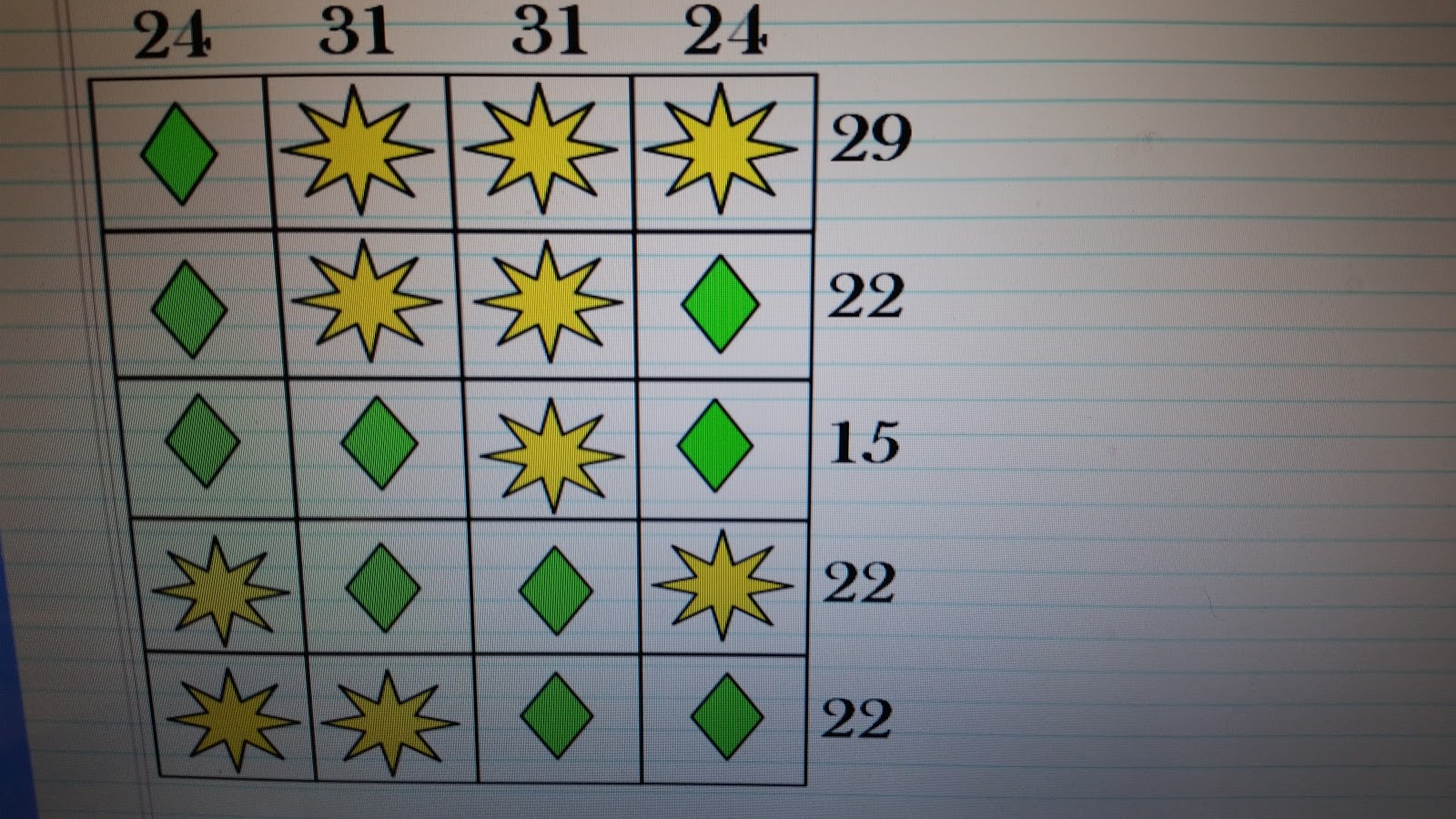
This year, the science teacher and I have decided to give the geometry students an extra period each week for extended labs.  The schedule that we worked out is that every Tuesday, I will send my students to the science teacher one period early to give them that extra period.

Today was the first time that we did this, so I only had them for a single period.  As a result, I quickly answered any questions that they had about the homework and then put a logic problem up on the board.


We spent a few minutes doing "I Notice, I Wonder" until one of my students wondered "I wonder how much each star is worth and how much each diamond is worth."

"That's a great thing to wonder about!  In your groups, see if you can find out."

After several minutes, I stopped them and we discussed.  I was disappointed to see that there were no methods used other than guess and check.  As a group, I prodded them to come up with better reasons and, just before the end of the class, someone came up with a great one.

I handed out 5 more logic problems.  Their assignment was to not only solve the puzzles, but to pick 3 and be able to explain their reasoning.  These problems are more complicated than the first one so guess and check will be a wildly inefficient method.  I'm curious how it will turn out.


I had been thinking about the impact of last year on my students. I know that we do what we can and hope for the best.

Then two things happened.

First, I got this tweet.

In the ensuing conversation, we talked about how each teacher has a different style and different things to offer.  I am glad that they miss me and I hope they can find success with their current and future teachers.


Second, a student from last year came to visit at the end of the day.  I was surprised to see her and I only just managed to stop myself from wrapping her up in a hug.  Since my room was 85 degrees again all day, I consider it a kindness to her that I restrained myself.

We talked about how her classes are going and I had almost exactly the same conversation with her as with Trevor.

It warmed my heart (metaphorically, since it was already physically warm enough) to hear from them.  I miss last year's class very much and I'm hoping that I can build relationships with my current students that are just as fulfilling.

Friday, August 29, 2014

Day 5: Problem Solving and Plane Segments

The more I thought about the vocab activity from yesterday, the less I liked it.  Or, more accurately, the less confident I became in the efficacy of the activity and whether it would be worth the investment over time.

Isn't that the true question about deciding which activities to use in class?

Will the activity be worth training the students?

There are activities and projects that the students grasp right off the bat and are able to utilize for higher level purposes, like content and skill development.  There are other activities that require multiple iterations for students to understand how they work before those higher purposes can be achieved.

When you were an economics undergrad, everything is about cost-benefit analysis.


Pre-algebra started talking about problem solving strategies today.  A fairly lengthy conversation ensued in which we talked about the steps that we should take for solving problems and we worked out 4 steps for doing so:


Then we put them to use!

It costs Mr. Brown and his son $13 to go to the movies.  Mrs. Smith took both of her children and it cost $18.  How much will it cost Mrs. Beauregard to take 4 children to the movies?

1) What am I looking for?
S: "We are looking for the cost for Mrs. B and her 4 kids to go the movies?"
Me: "Does it have to be that specific? Can you back it up a bit and talk about general terms?"
S: "We want the cost of 1 adult and 4 kids to go to the movies."

2) What do I need to know?
S: "We need to know the cost for 1 adult and 1 child."
Me: "Why only 1 child?"
S: "If we know the cost of 1, we can find the cost of 4."

3) Do it!
At the direction of the students, I drew the following:


4) Does my answer make sense?
Me: "What were we looking for?"
S: "The price to send that woman and her 4 kids to the movies?"
Me: "And what did we find?"
S: "How much it costs for 1 adult and 4 kids to go to the movies."
Me: "So, did we find what we wanted?"
S: "Yes."
Me: "Does it make sense that it would cost $28 dollars for 1 adult and 4 kids to go to the movies? (Ignoring the absurdly cheap prices.)
S: "Yes!"

Then I gave them a group of other problems to work on.  They worked in groups, moving around the room to get with people who could help them (without my prompting them to do so.)

A student asked if she could use the calculator on her phone.  I stopped the class and we had a quick talk about the cell phone use policy in the school and how they could use their phones for this task, but if I saw them on Facebook, Twitter, Instagram, texting, etc. I would be required to take the phone.  They agreed that it was reasonable and there were no problems.

I was able to circulate through the room, working with students from the rest of the period.  When students got stuck, I directed them back to the 4 steps.  Since they were a bit rusty from summer, I chose problems that were not overly taxing, but also not straight forward.  I heard great conversations from groups with students convincing each other of their reasoning.

"So we have 1 chaperone for every 8 kids, so if we have 8 chaperones, that means we have 3 kids left over."
"If we divide it, we get 8.3 chaperones."
"Look at step 4. That answer doesn't make sense. How can you have .3 chaperones? That's a person, yo! You got to have a whole other chaperone for those 3 kids!"
"So 9 chaperones?"
"Yup!"

I was giddy!

8th period started off poorly with one of my repeating students having to be removed because he couldn't control himself enough to stop talking.  I asked him to stand in the hallway to cool down and when I invited him back in, he refused.

After that, the rest of the class was great! We had the same talk that I had with period 1 and they worked incredibly well on the problems!  Groups formed again on their own and they utilized the "vertical non-permanent surfaces and visible random groupings."  There were, again, great discussions among some of the groups about what answers are reasonable.

I was very impressed with the work and effort that many of the groups were displaying.


In geometry, we had a talk about maturity and how there needs to be a shift in that area.  As "advanced" students, I'm very disappointed in the childish behavior that I'm seeing so far in that class.  We talked about the idea of time and place and I think they understood, but I expect that I'll have to hit it again.

In our discussion about points, lines and planes, I once again talked about An Unstable Chair, which is one of my more popular lessons from geometry last year.  We went back and forth about intersections of lines and planes until one of my students asked me a question that stopped me cold.

"If a piece of a line is a line segment, is there such thing as a plane segment?"

The ensuing discussion didn't last very long, but I can't get the question out of my mind.

This was a good day and I felt good at the end of it.

The cafeteria women made a ham and pineapple pizza just for me!

And I found sunglasses that fit nicely over my regular glasses!  It was a winning day!

Related Posts Plugin for WordPress, Blogger...