Wednesday, September 7, 2016

Day 10: Best Laid Plans

I had planned to spend today doing diagnostic testing.

1st period, all 7th graders had their pictures taken.  My 1st period is 7th graders.

2nd period, 8th graders had their pictures taken.  My 2nd period is 8th graders.

3rd period, students who go to the vocational school in the afternoon had their pictures taken. Half of my 3rd period goes to the vocational school in the afternoon.

When 5th period rolled around, we suddenly discovered that we had to use the Chromebooks (instead of the desktops) to access the software.  Then we discovered that only about half of the laptops have the right software.

I eventually got everyone logged on 5 minutes before the end of the period.

Periods 7 and 8 got on with no problems and worked well.  We will have to continue working on this tomorrow and there is a pep rally at the end of the day on Friday.  So that's my week.

Tuesday, September 6, 2016

Day 9: Being Present

Warning: Emotional Depths Ahead


My mom and her wife came to spend the weekend with us.  With the weather as beautiful as it was, we spent a ton of time outside, going to a state park, a local arts and crafts fair, walking around the neighborhood and riding bikes.

We did some shopping and baking and had a fire in the back yard.  It was an excellent weekend.

Over the last two weeks or so, I've been feeling happy.  I'm not sure that I can trust my emotions, so I've been checking in with my wife to see if she noticed it also.  Normally, the first month of the school year is the worst for me and, therefore, for her as well.  I am difficult to be around, short-tempered and distant.

My attempts to not fall into this pattern in the past have been met with mixed results.  This year, however, my wife has said that I'm MUCH better.  She hasn't noticed the gloom and darkness that I normally carry around with me like the worst bouquet of party balloons ever.

My mother also commented on my attitude and personality this weekend.  She said that her visits are often tempered by my moods and, while she never feels unwelcome, that's not the same as feeling welcome.

She's not wrong.  This time, however, she said it was different.

"You are present. There is a completely different feel to the house and the interactions that everyone has."

My family has a history of emotional destruction.  When we are in bad moods, you can bet that everyone else will be as well.  I have tried to escape this over the years and have done considerable work on myself to that effort.


When I accepted this new job, I was afraid.  So much of my emotional state was tied to where I had been teaching and my feelings about that place.  When I considered changing schools, or even changing careers, I was concerned that I was putting too much of my unhappiness on my job.  The problem with running away is that wherever you go, there you are.

I had no way of knowing what version of me would be waiting when I got there.  What if all of the things that I found upsetting and unbearable about where I WAS working are all of the things that I find upsetting and unbearable about where I WILL BE working?

What if the problem isn't the situation, but the person experiencing it?

Of course, just because I need t work on myself doesn't mean that I can't try it in a new situation.

I had to take the chance.  If the problem is completely me, then I should know fairly quickly and then I'll at least have a fresh start in a new environment.


For the last several years, my Sundays have been mediocre to bad.  This is entirely my fault.  Waking up on Sunday morning reminded me that I needed to go to work the next day.  The stress and anxiety that I felt bordered on existential.

"If I am this upset about going back to school tomorrow, should I even be a teacher?"  I was constantly torn between wanting to go to bed early to be well rested and staying up late to squeeze as much "not work" out of my weekend as possible.

As Sunday moved on, I would get darker and darker, drawing further into myself.

This is no way to live, and yet I lived it and made my family live it.


Since taking this new job, I've been cautiously optimistic.  I haven't wanted what I've been feeling to be a honeymoon period, dropping myself back into old habits of cynicism.  I asked my wife to keep an eye on me.  I have been checking in with her regularly because I don't feel as though I can trust my own emotions.

She tells me that I'm a different person.

No longer am I the emotional black hole, pulling in all those inside my event horizon.
"Oh! You wanted to shine light and energy into the universe? NOPE!"

I am, in no way, foolish enough to think that this change has solved all of my problems.  No matter where I work, no matter what I do, I'm still me.  I have mountains still to move, but I think this has been a step in the right direction.


Yesterday, while not actually Sunday, I felt upset and didn't want to go to work today.

The difference was that this lack of desire was a typical "I don't want the weekend to be over" that most people feel, even those of us who love what we do.

It was the existential dread that has been my constant companion.

I'm feeling more like myself.  I am happy and I am acknowledging it.

I am letting myself be happy.

Friday, September 2, 2016

Day 8: **Yawn**

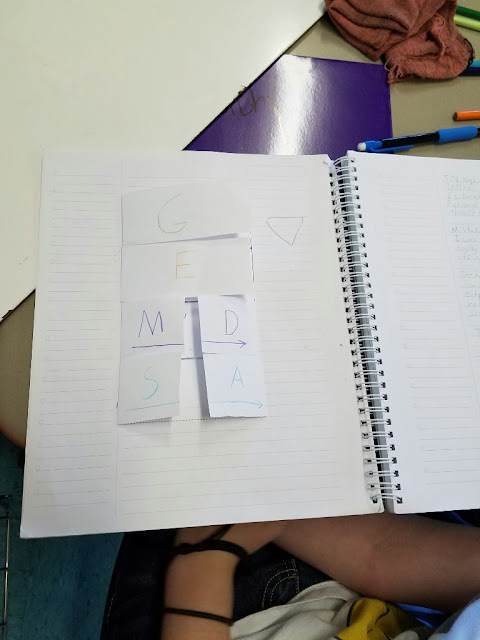
One of the problems with using PEMDAS is that, since the P stands for parentheses, students often miss other grouping symbols in that step.  They also frequently think that multiplication will always come before division and addition always before subtraction.

In order to clarify the order of operations and give students another tool for their belts, the Math 7 and Pre-Algebra classes worked on Julie's GEMS Foldable.


Other than the scissors being thrown, kids arguing over which colored pencils they wanted and not having enough glue sticks, it went fairly well.

As expected, several students were overly excited, cut things that weren't supposed to be cut and had to start over.  I've also noticed an odd phenomenon where the students who write down notes or follow my instructions seem to think that it has to be done EXACTLY how I do it.

One young woman, in folding her paper over, had a minor panic attack because it didn't look exactly like the poorly drawn sketch that I had on the board.  Several others wanted to write down what I had verbatim and had trouble with "write whatever helps you understand it."

One full week down and I'm just starting to see on which skills I'm going to have to focus and against which habits I'm going to have to fight.

I'm going to use the 3 day weekend to catch up on sleep, plan for next week and retrain myself on how to de-escalate 12-year-olds.


Meanwhile, I've been teaching new games to the kids in my study hall each day.  They now come in and ask what they'll be playing.

Thursday, September 1, 2016

Day 7: What To Do

I have an issue to resolve.

I have 2 sections of Math 7 and 3 sections of Pre-Algebra.  One of the sections of Pre-Algebra seems to be missing the skills and content necessary for that course.  They struggle with many basic ideas, such as integer operations and other content that is covered at the beginning of Math 7.

So what do I do with them?

I spoke with my co-teacher for that course and she suggested that I keep them with the Math 7 curriculum for the first few weeks, while pushing them a bit harder.  I think this is a viable solution, since the content between the courses has a considerable amount of overlap.

It does, however, make me uncomfortable.

The traditionalist in me says that the curriculum for a course is there for a reason.  These are the expectations of the course and those students who don't have an understanding of the requisite skills are not being served well by being enrolled.

Last year, my physics course had the prerequisite of a C average in Algebra 2.  There were several students, however, who had not met this requirement, and struggled enormously as a result.  Through no fault of their own, they should not have taken the class.

The newer version of me says that we need to meet the kids where they are.  They are in my class, this is the situation, I need to find the best way to get them to where they need to be by the end.


This year, I'm not sure what the situation is, except that 2 of my classes are ready and one seems significantly behind.

I recognize that some of my reticence to modify the curriculum is out of the laziness of wanting to keep all of the sections at the same place.  I know that my co-teacher will help me with this, but I'm not sure if it's best for them.  There is a high number of students in that class with disabilities, both physical and academic.  The needs are greater than I have dealt with in the past and I'm concerned about not meeting them.

Normally, in a situation such as this one, I would scale back the difficulty and complexity of the problems that I ask, but with 7 days in, I'm not sure that's going to be enough for this group.  It's my largest class and, even with the co-teacher, I don't know if I can provide them with the individual attention that they will need.


Do I push, or do I wait?

This is something that I'll have to think about more.

Wednesday, August 31, 2016

Day 6: No Homework

I'm not a fan of homework for several reasons.

  • Students don't do it
  • Homework, being the least favorite part of school, extends those bad parts into home life
  • If students are confused, there is no one to ask
  • Collaboration requires extra effort


I avoid homework as much as I can.  I know that sometimes it's important to continue a new concept, but that continuation must be meaningful rather than rote.

I discussed this with my classes as a means of explaining why we would be doing more homework-like practice in class.


I made up small packets for my classes, handed them out and unleashed the kids to work.

"Please use the whiteboards! Being up on your feet helps with blood flow and thinking!"


In the Integrated class, I had planned to have them work from the text book, but my planned introduction took a bit longer (read: the whole period).  I think it was worth it, however, since we had an in depth discussion about sampling methods, biases and survey design.  Several of those students are very excited to design surveys and bring their findings forward as policy change proposals.


I'm getting a better idea for the current ability level of my students and am gearing my questions towards where they need to move.  There is lack of familiarity with many requisite concepts.  I'm torn between "you need all of this info, we need to cram it in" and "you need to be able to think better, so we will focus less on content."

I'm leaning towards the latter.  Front-loading skills, rather than concepts, is a better approach for long-term learning.

Tuesday, August 30, 2016

Day 5: Numbers

Over the past 4 days, through the clever use of discussion, I've been avoiding what my students would refer to as "math."  Today I dove in.

My Math 7 and Pre-Algebra classes played the Zero Game from Julie.  It's a great way to help them review integer operations, absolute value as well as consider strategy.

Quick Rules:
     Cards are dealt 1 up, 1 down to each player.
     Black cards are positive, red are negative.
     Players can either get another card (or 2) or stay were they are.
     Player whose total is closest to zero at the end of each round is the winner.

After a couple of hiccups and false starts, the groups seemed to really enjoy the game.  Since my 2nd period only has 4 students in it, I played with them for the period.


It became apparent fairly quickly that my 7th graders are a bit rusty when it comes to number operations.  Thankfully, some brilliant teacher had them attach number lines to their notebooks that were easily accessible.

Even so, we have some work to do.  In the next few days, we will be covering Order of Operations and I have a pretty nice foldable for them to add to their notes.


In the Integrated Algebra class, I took a look at the textbook that they normally use and saw some good stuff and some...not so good.

They begin with a discussion of data interpretation, which I love.  They gave the following chart and question:


Before we got to that question, I asked them to just look at the data.  "What do you notice about it?"

A few kids noticed that the percentage of people using the internet during leisure time drops as age increases.  They noticed how women were more likely to exercise while men were more liked to play or watch sports.

When I asked them what they wondered about and what jumped out at them, a few commented on the slight uptick in playing sports for 65 to 74 year-olds from the previous group.  I asked them to speculate on why they thought that might happen and we talked a bit about retirement and golf.

Then I asked them the marketing question that was in the book.  The majority of students gave the answer that the book was expecting (18 to 24 and 25 to 34) because these groups had the highest percentage of users who exercise during their leisure time.

One girl asked if we could somehow include "Play Sports" in our calculations because those people would also use athletic shoes.  We had a brief conversation about whether or not we could and decided that there was probably overlap already and we didn't have enough information to do anything else.

One student made an interesting observation:

"The percentage of 18-24 year olds is higher, but there aren't as many of them as other groups."

Then the calculations began...

We had a fairly interesting discussion about the results and the implications.  "In addition to the fact that there are, numerically, more people in a different age bracket, why else would you might not want to market athletic shoes to the younger crowd?"

"If I suspend Kate for 5 days and Chris for 2 days, would it be safe to say that girls get suspended at a rate that 2.5 times that of boys? Could I say that boys and girls get suspended at the same rate?  If I suspend Kate for 5 days and Chris for 2 days and then for 2 more, could I say that boys get suspended twice as often as girls? Could I say that girls get suspended 25% more than boys?"

I think we are going to have interesting discussions in this class.

Monday, August 29, 2016

Day 4: Mistakes and Glue

I've decided I don't have enough to do, what with adjusting to a new school, new classes and new kids.  After years of watching other teachers do amazing things with foldables and interactive notebooks, I've decided to start that too.  I'm not going to go all out because I know how burned out I would get, but I plan to incorporate some elements.

I'm starting to creep on Julie, Sarah and Anna because they are brilliant and have a ton of resources and tips.

My integrated class doesn't really have a curriculum or standards, but it does have a text book, which I will be using for a sequence.  We will be starting the year with data analysis.  I plan for them to do projects as much as possible.

Since both Math 7 and Pre-Algebra start the year with a review of real numbers and their properties, I thought it would be a great time to introduce the Vertical Number Line.

Before we did that, however, we initiated #MistakeMonday.  I talked a bit about growth mindset and the value of learning from our mistakes.  In later classes (after I thought about it) I showed the music video for Shakira's song "Try Everything" from Zootopia.

Have you see Zootopia? No??  Stop reading this and go see it now!


I asked the students to take 5 minutes and write about a mistake they made in the past week and how they can learn from it this week.  As the year progresses, I'll ask them to make them academic mistakes, but for now, it was anything.

I wrote about how I made my wife feel bad this weekend when there was no need.  It served no purpose except to make me feel better.  I should never try to improve my mood at the expense of someone else's feelings, especially someone I love.

I asked the students to share, if they felt comfortable doing so and many of them did.  Several mistakes were about leaving ice cream out or not putting away the dishes, but a few dealt with heavier issues, such as one girl making fun of her sister when she didn't need to.

My hope is that over time, students will feel more and more comfortable sharing their mistakes in class and we can, at least in some small part, do away with the stigma against mistakes.


The classes continue to get more squirrelly and challenging as the day goes on. There are a high number of students with IEPs in my last 2 classes and even with my co-teacher, it's becoming difficult to keep them on track.

It's still difficult for me to tell the difference between age-appropriate behavior and what needs to be addressed.

I didn't get enough sleep last night.
Related Posts Plugin for WordPress, Blogger...