Friday, August 26, 2016

Day 3: Divergence

Over the last three days, all of my classes worked on the same activities.  Yesterday and Wednesday, the results were very similar.

Today, they were not.

As we progress, the current ability levels of my students are starting to become more apparent.  The activity for today was as follows:

Jack and Beth go to their grandfather's farm.  He raises ducks and sheep and currently has 9 total animals.  In the winter, he puts shoes on their cold little animal feet.  He has 26 shoes total.  How many of each animal does he have? 
Work with your group to SHOW how you found your answer.

I explained to them that I was much less concerned about the answer than I was about the method and their ability to share it.  (I can explain my thinking and try to understand others.)

The first thing that I noticed was the differences in method.

The Math 7 students took to the problem like ducks to water.  They dove in and really enjoyed drawing pictures to illustrate their methods.


The students in Integrated started with equations.  They knew that in math you're supposed to use equations, but were unsure of how.  Several of the groups found the right answer "in their heads" but had difficulty explaining their thinking. Even if they couldn't explain how, all of the groups found the correct answer and were able to talk about the method that they used, even if it was in vague terms.

The pre-algebra students seemed to really struggle.  Some of them struggled with the problem itself, but most struggled with the explanation.

Them: "There were 5 ducks and 4 sheep."
Me: "How did you come up with those numbers?"
Them: "That's how many you need to have the right number of shoes."
Me: "I get that, but my question is how did you KNOW that those were the right numbers? How did you get to them?"
Them: "They are the ones that work."
Me: "How do you know that other ones don't? Did you try other combinations? Did you guess and check? Was 5 ducks and 4 sheep your first try?"
Them: "Those were the numbers that worked. We checked them and they worked."

This conversation occurred with several groups in several classes.  It seems fairly clear to me that they are not used to having to explain their answers or reasoning.  This is actually expected and helps me to focus were I need to put my energy this year.

Interestingly, the younger kids were better at explaining their reasoning than the older ones.  I'm not sure if this is because the older students have been conditioned that their answers are more important, or some other factor, but it doesn't really matter.

I have my work cut out for me if I want them to be explaining.  I wrote out my own explanation and method, modeling the kind of work I wanted to see.  I made it very clear that it wasn't my particular method that I was looking for, but rather the fact that it was clear, ordered and logical.


The mother of one of my students told me that her daughter LOVES my class.  She's been thinking about sandwiches for 2 days now.

One of the other faculty members told me that she just loved how positive and upbeat I was, how it was a breath of fresh air.

Seriously.

I'm not kidding.

This year is off to a pretty good start.  I plan to take this weekend to sleep, plan, run, sleep and sleep.

Thursday, August 25, 2016

Day 2: I'm Funny!

I always forget how much discomfort I have during the first two weeks of school.  The majority of it has to do with momentum.  This year, I'm teaching a class that I've never taught before and another that I haven't taught in 2 years.  I have no idea how to get started.

I was fortunate enough to get in touch with some teachers on the internet who gave me their course sequences, so I have a basic outline from which to work.  I also have a vast professional network through Twitter and my various conferences from which to gather resources.

I just need to actually do that.

Momentum.
"Proofreading" is also important.


Yesterday went so well, that I put a ton of pressure on myself to top it today.

We did our Estimation 180 warm-up and our Pledge to Improved Mathematics.  I'm making a conscious effort to model the kind of thinking that I'm looking and giving lots of opportunity for them to demonstrate theirs.  Then I asked them to tell me about bees.


This was a warm-up from a few years ago, but I extended it into a deeper conversation about patterns.  I had students work in groups on the whiteboards and was amazed by the work that they were doing.  I spoke about Growth Mindset and how I expect them to make and share their mistakes.  I'm prepping them for Monday when we will begin with Mistake Monday.


These kids are nice.  The youngest students that I've taught have been at the start of 8th grade. This year, I have those, but also ones who are considerably younger.  This difference is causing me to notice many things about younger students.

They are adorable!  I'm having to make a conscious effort not to constantly tell them so.  They are excited to learn and to show off what they know.  There's none of the cynicism that I have found in older kids.  Part of that could also be that they don't come from backgrounds that are nearly as rough as many of my former students.

I also had to talk to several classes today about how I call on students.  I explained that I don't always call on the first hand I see.  I want to give everyone in the room a chance to develop their thinking and I want to hear from everyone.  I pulled a girl aside this morning to tell her that I saw her hand up every time, but wanted to hear from others.  I didn't want her to get discouraged and I thanked her for her willingness to volunteer answers.

So far, the greatest discovery has been unexpected: they find me funny!

I get to be my normal goofy self, making jokes and using funny voices.  I get to dance and pretend to cry out of happiness.  Instead of rolling their eyes, they laugh.  Unfortunately, their age means that they don't understand many of the references I make, but  they laugh anyway.

In 10 years, they'll come back and visit me to tell me that they finally understand my jokes.

Wednesday, August 24, 2016

Day 1: A New Sandwich

After the first year of this blog, I had momentum going and continued to the second year.

After the second year, I was moved from middle school math to high school science and felt that it was important to continue writing about that change.

This year, I have changed districts and moved back to teaching middle school math and again feel that it's important to continue.  So here we are!  Daily reflection...Year 4... Day 1...


Day one as a proud faculty member at a new district found me happy, excited and terrified.  I clearly took for granted all of the comforts of NOT being a first year teacher in my previous district.  There are new systems to learn, new procedures, new faculty and staff, new students, new curriculum, new commute and new cultural norms.

I am incredibly excited about these challenges!  More importantly, I am hopeful.

My schedule this year is mostly Math 7 and Pre-Algebra with 1 section of seniors for Integrated Math.  I also have 7 students on my roster who are coming up from the 6th grade for my class.

My room isn't even close to set up but it's good enough to function and do what I want.


I began my classes today by introducing myself and talking a little bit about my background and goals.  I had them recite the Pledge to Improved Mathematics and began a Warm-Up from Estimation 180.

I reiterated to them the value and importance of the ability to "explain my reasoning and understand others" and then set off on our Day 1 Task.


"I'm going to write a question on the board.  It's an incredibly important question.  I'd like you to think about the answer silently for a minute and then we'll get together in groups and discuss it.  Are you ready?  It's an incredibly important question!"
One of the 6th graders wanted to call him "Frank."  Frank is confused.

The conversations that ensued were excellent.  The group of seniors came to a screaming match.  I was told later "I hated him before I came in" and while that may be true, they were making sound arguments and articulating their points well, if loudly.

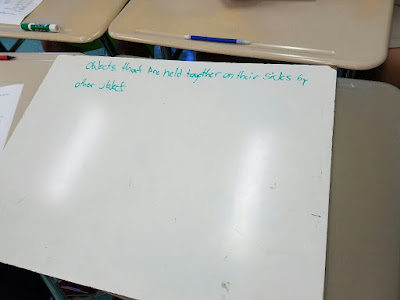
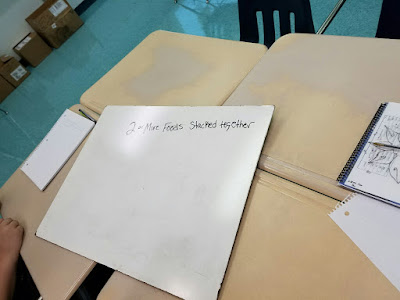
The discussions were incredible!  One group argued that orientation mattered.  Their claim was that a folded piece of bread with peanut butter and jelly was a sandwich, but as soon as you hold it open side up, it becomes a taco, which is not a sandwich.


A small portion of the younger students thought it was a trick question and went WAY deeper than I wanted them to go.
I call this one "Sandwich as Allegory!"


Several of the 7th and 8th graders complained laughingly of mind-blowage!


The kids got a bit more rambunctious and squirrelly as the day went on, but nothing I couldn't handle with grace and aplomb.


While I very much miss my students from the last few years, I'm really looking forward to getting to know the new ones.  The faculty, staff and administration have been incredibly welcoming and supportive.  I think this will be an excellent year.

Saturday, August 13, 2016

#MistakeMonday

Teachers are often expected to be perfect.  From their first day in the classroom on their first year, they are supposed to have as much knowledge and expertise as someone who has been teaching for 30 years.

Yes, there are student teaching positions where you work under the supervision of a veteran teacher for a few months, but that's often the extent of the formal mentoring that teachers receive.  Over the last few years, I've had numerous discussions with other educators about the various short-comings of education programs.

The reality is that teaching is incredibly difficult.  It's difficult in a way that no one can fully explain and can only truly be experienced. According the National Education Association, an estimated 50% of new teachers quit the profession within the first 5 years.  There are multiple reasons cited for this, including geographic concerns and shrinking school budgets unable keep salaries competitive, but you would be hard pressed to find a teacher who didn't acknowledge that their first few years were insane.

During my first year in my current district, I went home crying at least 3 nights a week for about 2 months.

One of the major issues contributing to how difficult it is to teach is our inability to make mistakes.  On a conscious level, everyone knows that no one is perfect.  Everyone makes mistakes and we recognize that we should admit those mistakes when make them.

But teachers are often held to a different standard, and understandably.  No one wants another person making mistakes with their children.  We are entrusted with the future, the custodianship and the care of children. During the school year, kids spend more time with teachers than they do with their families.  No, we aren't given the nuclear launch codes, but it sometimes feels that way to a parent.

As teachers, especially those of us who espouse the virtues of the growth mindset, we know that mistakes are not only a basic fact of life, but are crucial to the learning process.  Without mistakes, we don't grow, we don't learn, we don't advance.

Making the mistakes, however, isn't enough.  We need to be able to examine them, see WHY we made them and reflect on how things can be done better the next time.

How can we expect our students to do this if we don't show them how and if are unwilling to do it ourselves?

One of the major reasons for this blog has been to shine light on the (many, MANY) mistakes that I make as an educator and as a person, for the purpose of reflection and growth.  I feel as though that process has greatly helped me along the path to becoming the teacher that I want to be and that my students need.


So where is this all going?

Last year, I undertook two major school initiatives.  The theme for the year was Go Forth and Be Human.  I dismissed my classes every day with that statement, reminding my students and myself that they are, above all else, people.  They are more than test scores, more than students, more than children. They are human beings.

The second, and arguably more successful, was #HighFiveFriday.  This started by accident around Thanksgiving and took off like a shot!  After 2 weeks, students began seeking me out for high fives.  It helped to build a community and good feelings.

This year, I will continue both of those, while adding a new one.  I want my students to be willing to make mistakes and learn from them.  I want them to learn that those mistakes, when reflected upon, can lead to growth.  I want to remember this myself and be more willing to make, admit and learn from my mistakes.

This year, we will doing #MistakeMonday!

Every Monday, we will begin class with a basic writing assignment consisting of two questions:

  1. What is a mistake that you made in the past week?
  2. How do you plan to learn from that mistake this week?
I will also partake in this assignment and share mine.  As students feel comfortable, I will ask them to share theirs as well.  We are a community of learners and will utilize every resource we have to achieve our goals, including each other.  There will be times when a student may not know how to learn from a particular mistake, but there will be advice that others can offer.

I also plan to have a #MistakeMonday wall where students (who wish to) can post their mistakes and learning plans for all to see.

We share mistakes to demonstrate our vulnerability, the build empathy and grow as citizens.

It will be a long journey with (hopefully) many mistakes made along the way.

We are human beings.  We are not perfect and need to stop pretending that we should be.

I wish you all a great year, full of productive mistakes!

Wednesday, August 3, 2016

Review: Ghostbusters

Last night, I went to see Ghostbusters.


To be honest, I was dubious. I think the majority of the roles that Melissa McCarthy has has have not done justice to her abilities. As a larger woman, she is often cast is roles that could be described as sloppy and gross. Her part on Mike & Molly was a notable exception to this.

As much as I enjoy her and Kristen Wiig, I didn't like Bridesmaids. It's hard for me to pinpoint exactly why, but it may have been simply the type of humor was just not my style. I'm not a fan of slapstick comedy or fart and poop jokes.

If I'm being completely honest with myself, I also have to say that I was dubious about a remake of the such an incredible film. I want to say that it had nothing to do with putting with women in the lead roles where giants of 80's comedy (and therefore, my childhood) forged their paths, but I can't be certain that's true.

There are WAY too many Ghostbusters fanboys complaining about the remake as a way to mask their thinly veiled misogyny. As a vocal feminist, I knew that I was going to have to see it before I could mount a review that didn't sound like "you can't fight ghosts with vaginas!"
"When I write 'they are ruining a classic', I TOTALLY don't mean 'having women do this drives a spike into my mediocre, fragile white male ego.'"

Before the movie started, the previews were for either teen romance movies, or animated children's movies. I couldn't help but wonder if there would have been different trailers if the headliners in the movie had been men.

From the very opening scene, I was impressed. There were subtle and clever jokes inserted into the script with such regularity that it would have been easy to miss many simply by laughing at the previous ones.

While I didn't find the movie to be emasculating, or as some basement dwellers have said "a castration festival", I did notice that all of the female characters were strong and smart while all of the male characters (with the notable exception of the antagonist) were foolish, useless, arrogant, immature, vapid or downright stupid.
"Which picture makes me look more like a doctor? Me playing saxophone, or me listening to saxophone?"

The Dean of the college where Abby Yates and Jillian Holtzmann (McCarthy and McKinnon) work is the definition of up-jumped incompetence, as underscored by Yates' line "you only got to be the Dean because the last Dean went to jail." He then proceeds to flip off the 2 female doctors and the female engineer in various ways for a full 30 seconds before donning his crocs and chasing them out.

I found this switch of traditional gender roles in movies to be amazing. The female characters can be seen eating (gasp) regularly and aren't anything close to caricatures of females. They were rich, deep, complicated and interesting. They had real problems that evoked empathy, many of which were issues that women deal with on a regular basis. Primary among these being the lack of faith from their male counterparts.

Dr. Hiess (Bill Murray), a famous debunker, comes to their office after a VERY public display of ghost hunting and blatantly asks them "Why are you pretending to hunt ghosts?"

This misogyny is even mentioned in a very meta way when the women are reading YouTube comments about their first ghostbusting enterprise and encounter the comment "Ain't no bitches gonna hunt no ghosts!"

The gender roles of traditional movies are also delightfully flipped when they hire Kevin (Chris Hemsworth) to be their receptionist in spite of his complete lack of qualifications and brains simply because they need a receptionist and he's gorgeous.

Wiig herself takes on the role of objectifier by constantly remarking on how attractive Kevin is (in spite of his clearly having the intelligence of a jar of mayonnaise), all the while being told to stop by McCarthy because they don't need a lawsuit.

In addition, none of this even touches the brilliance of the character of Jillian Holtzmann who is a brilliant, weird and hilarious character and is played insanely well by Kate McKinnon. It could easily be argued that she was, by far, the greatest part of this movie and worthy of a post all by herself.
Really, they should be salty hyperboloids, but tomAto, potahtoe!

If you take the objections to this movie at face value, pretending that they have nothing to do with putting white men in a subordinate role to women, it is still an excellent movie. It is full of cameos from the original cast. Weaver, Murray, Aykroyd, Potts (Janine), Hudson and others all show their faces. There is even a bust of the late, great Harold Ramis.

While there are clear homages to the original, including the firehouse, Ecto-1 and the idea of being thrown out of a college for being crazy, this movie stands on its own merits. It provides excellent writing, believable characters (the women, not the men) and shows solid and deep role models for girls and women.

There is a level of emotional intimacy and friendship among Wiig, McCarthy, McKinnon and Jones that simply didn't exist in the original and is severely lacking from movies in general. Males fears of being perceived as gay often keep that from existing in other action movies, or limit it to slapping bro-hugs and fist bumps.

My only objection was the fact that the 3 white women were scientists while the black woman was an MTA worker, but even that could be seen as an homage to the original. In addition, for all of the horrific racism that Leslie Jones took on Twitter last week, she did an brilliant job and I loved every moment that she was on screen.

Women and girls need these movies to see what strong women can accomplish.
This is everything

Men and boys need these movies even more.

Saturday, July 23, 2016

Pipeline

Warning: This post contains spoilers for season 3 of Orange Is The New Black.  I talk about characters in season 4, but not specific plot points.

In the final episode of Season 3 of Orange Is The New Black, there is a hole in the fence at Litchfield Federal Correctional Facility and the inmates escape through the hole to enjoy a brief moment of humanity by swimming in a lake.  In the mean time, the guards have walked off their posts to protest their working conditions, benefits and salaries.

Since a prison cannot be without guards, the warden, Joe Caputo receives replacement guards from a men's maximum security prison.

This new crop of guards have very different attitudes and views about their roles in the system and are lead by the commanding, confident and authoritarian Desi Piscatella.
This introduction of the new guards drastically changes the dynamic for everyone in the prison environment, with that new tone being very strongly set by Piscatella.

Overall, I found Season 4 to be heart-wrenching in ways I haven't felt since Season 1, but what truly stuck with me was the stark differences between the old guards and the new guards in general, and between Caputo and Piscatella specifically.


Caputo believes that it is the job of the prison system to make sure that the inmates are safe and will be productive members of society when they are released.  He spends the season advocating for the inmates and attempting to get vocational activities into the prison.  He believes in rehabilitation.  It has taken him a while to get to this place, but there are flashes of it as early as Season 2, when he tells Healy "the least we should do is keep these women safe and clean."

Piscatella, on the other hand, sees his job as one of keeping order in a chaotic world. "It's my job to clear the path so you can do your job."  He frequently refers to the inmates as criminals and even thanks Red for reminding him of this fact when things start to get a little friendly.  While he begins the season with professional detachment (for the most part), Piscatella quickly throws up a wall of machismo and power, reasserting his dominance over the inmates time and time again.


As I seem to do with everything recently, I watched much of this season, and the dynamic between these two characters specially, through the lens of an educator.  Over the last year or two I've been struggling to answer the question of why we send kids to school.  It often appears that no matter how many people you ask, you'll get a different answer, but I think most fall somewhere on the spectrum between individual benefit and societal benefit.


This season pushed me more directly towards the idea of defining the role of the teacher within the educational system.  Again, I believe that every teacher will give a different answer to this, as would every parent, administrator, politician, student or man-on-the-street.

Is the role of the teacher to give specific information?  Is it to encourage students to form their own opinions?  Is it to enforce compliance to societal norms? Is our job to write the programs in their minds today that will be executed in their jobs tomorrow?  Are we supposed to be encouraging them to push beyond, or to be willing/able to do what needs to be done regardless of their passion for it?  Does being friendly preclude us from giving kids what they need?  Does giving them what need require that we be friendly?
Is it our job to shield our students from the horrors of life, or to prepare them for it?


I think there is merit to all of these to a great or lesser degree, and I in no way wish to be implying that one is a better goal than another.  I know what I see as my role, but I know amazing teachers who very strongly believe something else.

This connection came into stark focus for me at the end of June when I attended the University of Pittsburgh's Center for Urban Education's Summer Educator Forum.  The keynote speaker on the first day was Dr. David Kirkland.

Dr. Kirkland spoke at length about the role of education for students of color and students of low socioeconomic status.  He said something that has been rolling around in my head for a month now.

"I no longer believe in the school-to-prison pipeline. It's all prison." -Dr. David Kirkland

In light of this quote and the post I wrote at the beginning of June, I'm now asking myself the following question:

If my students view school as prison, what kind is my role as guard?

I don't want to be a prison guard. I want to be a teacher, but my desires mean nothing if my student perceptions don't change. I need to do everything I can to keep them safe, to help them achieve their goals.

I don't want to be Piscatella.

Read more at: http://transcripts.foreverdreaming.org/viewtopic.php?f=157&t=

Sunday, July 17, 2016

Is A Tuna Melt Actually A Pizza?

This weekend is the fifth annual Twitter Math Camp.  It is a gathering of educators from around the country who come together to share, discuss and debate mathematics education in order to become better teachers.  The sessions are varied and valuable, but as a friend of mine has said, many of the most important discussions and conferences happen over meals and drinks.

Last night, the amazing Glenn Waddell organized a dinner for TMC newbies and veterans.  40+ educators went out into the streets of Minneapolis and took over an excellent pizza joint, the rule being that there had to be people at each table with different levels of TMC experience.

I was honored to spend my dinner with James Cleveland (5th timer), Stephanie Bowyer (2nd timer) and Henri Picciotto (1st timer).  Over the course of dinner, our discussion filtered down to a very important question:

Is a hot dog a sandwich?

The argument made by my esteemed colleague, James, was that it was not because if the meat is removed from the hot dog, that meat is still called a hot dog, making bun the additive identity of the food.

Cheese + Bread = Cheese Sandwich
Ham + Bread = Ham Sandwich

Hot dog + Bun = Hot dog


This, of course, begs the question: Is a hamburger a sandwich?

Hamburger + Bun = Hamburger

This seemed to be more a question of semantics.  Without the bun, can it be called a hamburger, or must it be called a hamburger patty?
Other questions concerned whether there needed to be bread at all.  Colonel Sanders has already weighed in on that point.
Even without bread, this sandwich brings the pain!

The discussion moved on from here, expressing the idea that a taco may also be a sandwich.  If the argument is made that a taco is a distinct food type with a rule about being open on one side, then a hoagie could also be considered a taco, provided the bread is not cut all the way through.

At the moment, James, who is from New York, picked up a slice of his pizza, folded it in half and took a bite.  I asked him how his taco tasted.

And then the fight began anew.

Our boisterous debate, in an already boisterous crowd, filtered over to other tables, many of whom thought we were insane.

They weren't wrong.

While insane, the discussion was far from pointless.  We developed a way to incorporate this debate into class.


Many teachers have interesting opening-day activities.  In the past, I've done the Marshmallow Tower and the Noah's Ark problem from Fawn.

In this activity, students are broken into groups of 4.  Each group works to develop a definition for the word "sandwich."  After a designated amount of time, the groups trade definitions, determine the validity of those from other groups, developing examples and counter examples.

The definitions are then passed back to the original groups to revise.

Eventually, the class is brought back together to come up with a consensus definition, with the teacher working to find counter examples.

This leads pretty nicely into necessary and sufficient conditions.


Standard of Mathematical Practice #3: Construct viable arguments and critique the reasoning of others.

At TMC14, Steve Leinwand argued that SMP3 was the most important of all of the standards, and I agree with him because Steve Leinwand.


So why sandwiches?  A sandwich is something on which no one has an opinion until you ask them about it, at which point they will murder your family to defend their definition of sandwich.

I know I'm late to this party because Christopher Danielson has written about this exact question before.

Stephanie has volunteered to use (was bullied by me into using) this activity in her classes this year and blog about the follow-up.  I hypothesize that students will be arguing about what constitutes a sandwich.

I am excited to try this question with my students as well.


Follow-up: I had this discussion with a teacher on my way to breakfast this morning and then again on my way to my morning sessions.  The following are some great questions that are pushing my brain is crazy directions:

Is pizza an open-faced sandwich?
Is an open-faced sandwich a sandwich?
Is an open-faced sandwich a pizza?
Is a calzone/stromboli a taco?
Is a salad an open-faced sandwich (with lettuce instead of bread)?
What is a salad?
Is a salad a soup?

Related Posts Plugin for WordPress, Blogger...