Tuesday, September 4, 2018

Day 4: Lesson Plans

Due to concerns about heat, our district, as well as many of the surrounding districts, closed school early today and will do so again tomorrow.

As much as I'm disappointed to be losing some of my classes so early in the year, my intense desire to fall asleep in front of an open refrigerator tells me that it's a good idea.


In spite of the heat and humidity, my students worked very hard for me today.  I've been scouring various curricula and picking the things that I like in order to try to organize these classes that I haven't taught in many a moon.  I'm also making a concerted effort to be more organized than I normally am.  This is helped along by our new mandate to have lesson plans available for the next week should someone ask for them.

The plans themselves don't have to be anything absurd, just a basic outline and topic list so someone could grab the folder and teach the class in case of emergency.

This is the 12th year full time classroom teacher.  Including the two years that I spent working on my Master's Degree, this is the first time when I have been told to make lesson plans that meet the needs that I set out for myself.

In all previous years, when lesson plans have been mandated, a specific format was chosen and implemented district-wide, regardless of whether aspects of it were useful to individual teachers.

Anyone who has attended an education program can attest to the fact that the required lesson plans would make Tolstoy say "that's a bit much."

As a result of this, I have almost never taken lesson plans seriously.  I would spend hours on a format that was filled with information that I didn't find helpful and would only confuse me further.  In addition to that, they were almost never checked.

A former colleague went a year without changing the plans, only modifying the date before they were submitted.  She was told that her attention lesson plan submission was exemplary.

She even turned in several plans that were laced with profanity, or contained excerpts cut from fiction articles.

No one noticed.


I am not opposed to lesson plans.  I am, however, deeply opposed to assignments that serve no purpose except to check a box.

When we were told that we would be required to have lesson plans on hand in the classroom, I'll admit that I grumbled and planned to look for the old plans from years ago.

This weekend, I actually started doing just that and quickly realized it was a mistake.

Lesson plans in the past have not been helpful to me, but this was a chance to make them so.  With the ability to choose the format, I was able to make it what I wanted.  It is very minimalist, but contains what I'll need to keep my classes moving at a good pace.

I need structure.  I need time tables and check lists and to-do's.  I wander off task in my content, hitting things that are interesting, but not necessarily helpful to my students' learning.

I am glad to be writing lesson plans again.


Education programs, instead of forcing students to write 35 page lesson plans, should be teaching them how to develop their own planning style, selecting the items that are important and productive for them.

I stuck with my lesson plans today and will continue to do so.


At least until I see something shiny.

Friday, August 31, 2018

Day 3: FRIDAY!!!

Well, I'm exhausted...

We only had 3 days of class this week, but I've been going full blast! In addition to getting up before 5 am, being in an 85 degree (and up) classroom for 8 and a half hours, getting home to take care of my own kids, and running a 5k each day, I've been pouring on the high energy during my classes.

It was so important to me to make this first week a good one, not only for me, but for my students.  Knowing that the room was going to be a bit toasty, and that math would be happening in it, I knew many of the kids would be coming to me with some ... demeanor concerns.  I don't blame them.

I will get them up and moving around when it cools off a bit, but for now, I wanted to create an air of fun and interest in my room, demonstrating the beauty that is mathematics.

I THINK I've done that.  It's hard to tell, simply because the nature of high school students is so different than that of middle school students.  It will take me a bit of time to relearn how to read my audience, but so far I think I'm heading in the right direction.

What you do during the first few days will set a tone. What kind of tone do you want to set? Do you want the students to be in charge? Do you want them to be afraid of you? To love you? Do you set a tone of cooperation, or one of domination?

I'm making a conscious effort to use names of everyone I address and to keep a smile on my face as much as possible.
WELCOME TO MATH!!!

I managed to write back to every student this week on all of their name tents.  It has been time consuming, but very worth it.

We are babysitting for a friend tonight, so I need to run before that happens and then I plan to sleep until school starts up again on Tuesday.


Thursday, August 30, 2018

Day 2: Still Hot, Still Cool

It hit 90 in my room again, but it was another great day!

We began looking at procedures with our daily warm-ups and recitation of the 8 Standards of Mathematical Practices. I gave a brief explanation of the Standards-Based Grading system that I use and answered any questions that they happen to think of right then.

Then we were off into content!

I explained to both classes (Algebra II and Geometry) that mathematics is a language.  It's insanely hard to learn a language by simply reading the dictionary.  Those who wish to become fluent regularly engage in conversation with native speakers, learning the conjugations and idioms.

Math is no different.  In order to learn math, we have to engage with it beyond simply using the operations.

We need common language.

In Algebra II, we started a card sort activity that was..ahem...appropriated from Jonathan Claydon.

Student groups were given 24 cards, consisting of 8 terms, 8 equations and 8 graphs.  With no help from me, they were asked to put them into 8 piles of 3 cards each, matching term to equation to graph.

I reminded them that it has been a few months and so they shouldn't panic if they don't know it right away. 90% of the groups ROCKED it! They dove in, using different strategies, pulling out the ones they knew (linear, absolute value), picking ones that seemed to go together (f(x)=log(x) and "logarithm") and using process of elimination to find others.


After about 10 minutes, we stopped to talk about how they could figure out which graphs went to which equations if they didn't remember what they looked like.  None of the groups had built a table of values, but when I asked this question directly, they almost all said that you could plug in numbers and graph it.  We did some examples on the board before the bell rang.


In Geometry, we worked on defining terms and notation that we will be using throughout the year. I gave them a check list to try, knowing that most of the notation was beyond what they had covered yet.  Several students asked "what's notation?"

When it became clear that I wasn't going to give them the answers, that I wanted them to struggle, most stopped asking me anything more than clarifying questions. They worked in groups for a bit and when I began to sense the frustration level getting too high, I stopped them.  We looked at the board and built the beginning of our vocabulary notes as a group.

Even in the heat, the kids were engaged and working hard!

I had them fill out the second day of their Name Tents (Ask me a question) and I managed to respond to all of them before I left school!

They were great questions, but a few stuck out to me.

It's a shame that no one will be able to read my response.

I think this is going to be a pretty darn good year!

Wednesday, August 29, 2018

Day 1: Chill Out!

My alarm went off at 4:45.

By 5:30, I was in my car driving to the first student day of my 12th year as a teacher.

I honestly can't reconcile that fact in my mind. I still feel as though I'm in my first few years as a teacher and, in a way, I am. This is only my third year in my current district and those have been full of transition and change.

I took a break from blogging last year and I think there were unintended consequences in terms of my own perspective on my teaching, so I'm going to start up again.

Today was...

GREAT!

Like, for realz!

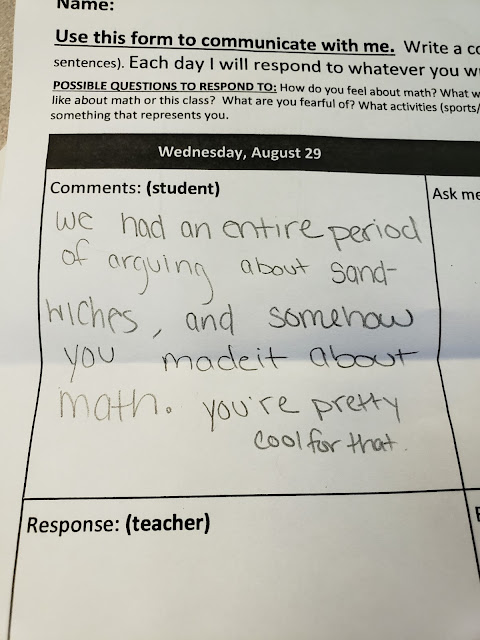
I began this year, not by introducing the syllabus and classroom rules and grading policies, but by having my students write.

My typical Day 1 activity has been asking students to define a "sandwich."  I always get groans and laughs and GREAT discussions and today was no exception.

In an effort to make it more rigorous and mature, since I'm teaching older kids this year, I took a page from the playbook of my kindred teaching spirit, Brian Cerullo (Give him a follow!)

I asked them to write silently for 5 minutes followed by a discussion. In a few cases, I kept having to propose "whatabouts" to challenge their definitions, but by and large, the other students did that.  I was able to sit and watch them interact, keeping track of points I wanted to hit and asking certain students to answer the concerns made by others.

Many of the students left the room with their heads hurting and frustrated in a good way. All day, I only had one student yell out "just tell us what a sandwich is!"

"What do YOU think it is?" the teacher asked socratically. 

"Socratically isn't a word, Justin" you say.

"How do you know?" I respond socratically.


The other first day change this year was that I used the Name Tents from the brilliant and incomparable Sara Van Der Werf.

I asked students to write a sentence or two at the end of class, reflecting on the class, making comments and giving me their thoughts, and I promised to respond to each one!  Out of 75+ kids, only 3 left them blank.  The comments that I got from them were so interesting and I was glad to hear and be able to respond to each one.


No one told me that I smelled bad, even though it hit 90 in my room today!

I'm looking forward to an interesting (in a good way) year.


I'm going to go crawl inside the refrigerator now.
...show off...

Friday, July 20, 2018

Developing My Grading

Warning: If you already know the basics of Standards-Based Grading and how I've been trying to work it into my class, or if you don't care about my exposition, skip down to the baby shark below.

At the beginning of the 2016 school year, I changed school districts. Over the previous few years, I had been reading quite a bit about Standards-Based Grading systems and the change of district seemed like the perfect time to implement a change in grading that I knew was going to be daunting and massive.

Under a standards-based system, students receive grades based on their progress and proficiency through a set of clearly defined standards and objectives.  Since I was going to be teaching 7th and 8th grade students, I was using the curriculum standards for those content areas as laid out by the National Council of Teachers of Mathematics and the Pennsylvania Department of Education. Then, I took each standard and converted it into an actionable statement in student friendly language, such as "I can solve linear equations that have rational coefficients."

During the first year that I worked with SBG, I used a 4 point scale, assessing student performance on tasks and assessments based on the approximate following rubric:

4: I GOT this! I can teach it to someone else!
3: I get this, but I need to be more careful with my work or explanations
2: I kind of get it, but we should go over it again
1: What are we talking about again?
0: I didn't assess this skill

My personal grade book looked like this:

So many Christmas! Much jolly!

Since I was teaching in a traditional grading system (one where all student grades and feedback are boiled down to a single number at the end of the semester/year), I needed a way to convert the 4-point scale into a 100-point scale.

4->100%
3->85%
2->70%
1->50%
0->0%

Changing all of those to percentages was super fun!

Last summer, I attended a session on SBG at Twitter Math Camp and, after speaking with several other teachers, decided to switch from a 4-point scale to a 10-point scale!

This let me add a bit more subtlety to the grades and provide more accurate feedback to the students.

This past year, I implemented the new scale and my students seemed to like and appreciate the change.

My grade book this past year looked like this:


One of the philosophical components of SBG is that students are not assessed on their behavior or habits, but only on their progress and demonstration of the content standards.  This meant that I didn't have homework or participation grades.  Another important tenet of the system is the understanding that students learn at different paces.  Since we want growth and want students to learn from their mistakes, I offered reassessments on any skill in which a student felt they could do better.

In order to do the reassessment, however, students needed to show that they put in the effort to learn the material.  This meant doing practice problems and correcting their assessment errors.

After a conversation with my principal, I added homework and participation grades back into the mix, but I wasn't happy with how I did so.  I wanted/needed to make some changes, but wasn't sure how to do it.

Doo doo doo doo doo doo!

Fast forward to today.

I woke up this morning trying to figure out how to modify my system to maximize the benefit to my students while retaining emphasis on the things I wished to...emphasize. **looks for thesaurus**

I attended an afternoon session at Twitter Math Camp today that was run by the brilliant Bob Janes.  He has been doing this work for a few years and the conversations that we had as a group pushed on some of the issues that I wanted to fix.

My first major take away (see what I did there? Take-away? Get it???) was another change in the scale. I had already been thinking about this after a conversation with the amazing Anna Vance, who happens to have a post about this exact idea at the top of her blog right now! (ANNA! Write more! The world needs your brilliance!)

Instead of having the scale be 1-10, Anna has moved to a scale that is 5-10.  Bob goes a slight step further, having the scale be as follows:

10: WOW!   - Above Mastery
9: Yes!          - Mastery
8: Yes, but... - Some procedural errors
7: Kinda...    - Some conceptual errors
5: Not Yet    - Weak understanding
0: Yeah, no.  - No understanding/blank

I VERY much like these idea because it allows for the subtlety and differentiation in feedback, but lumps the varying degrees of what we traditionally call "failing grades" into the category of "not yet" while still giving them credit for their work and thinking.

The other huge piece with which I've been struggling for a while is about the Standards of Mathematical Practice and how to integrate them into the assessments. I also need to integrate homework and participation grades into the overall scores.  Bob talked to us about what he referred to as "Scholarship Standards."  These are the skills that are transferable to other learning environments and are not content based.

He writes it up MUCH better than I could, so you should read more about it on his blog.

My favorite part of this was the re-framing of homework, study skills, participation, preparation, etc. as Standards of Scholarship.

When I re-write my syllabi this fall, I will be changing the section on grading to talk about "Content Standards" and "Scholarship Standards." This reframing also gave me a way to work with my students on assessing their development of the Standards of Mathematical Practice.  They know what they are, but I don't spend enough time working with them in a formal way on what they should look like.


There is much to process.


In addition, I began this year's Twitter Math Camp by meeting someone with whom I've been interacting online for a few years.  She told me that my blog has made such a huge impact on her life (now that I think about it, I didn't ask if it was a positive impact...) and that reminded me of something important.

I began this blog to share my struggle and to help other teachers see that they are not alone.  In her keynote today, Julie spoke about how many of us look online, see the amazing things that other re doing and feel that we can't live up to those examples.

She was making the point that we are all amazing just by doing what we do.  She even gave out stickers to everyone (Oprah-style) that read "You are not an imposter. You are enough."

For me, I think the converse of her message is also true. Even those people online who are sharing amazing things and appear to be amazing teachers have days that are terrible.  When we only share the good, it can be scary to those of us who (frequently) have bad days.

There are lots of things that I don't do well, such as dance, plan lessons, eat healthy food, contact parents as much as I should, organize my desk, speak at a reasonable volume, dress myself, or finish a sentence without rambling incoherently about how much I like Doctor Who and Dungeons & Dragons and how I'd love if someone would make an RPG for Doctor Who and yes, I know there is one but it isn't very good and what was I talking about?

One of the things that I think I do fairly well is reflect on my teaching practice.

I plan to keep this blog again this year.  This profession is too important, and too hard, to do alone. We are in this together and I will share what I can.


TIME FOR TRIVIA NIGHT!

Wednesday, March 21, 2018

Mr. Aion: Student/Teacher

During my first semester as an undergraduate mathematics education major, I was told by one of my professors that I should change my major.  After meeting 18-year old me for a total of 7 times, she determined that I wouldn't be a good teacher.  While I can't necessarily say that she was wrong at the time, thinking back, I'm amazed that someone so ensconced in education would be willing to give up on a student.  She dismissed me from the start, rather than helping me to see what I needed to.

While I did change my major, I didn't give up on being a teacher. After graduating, I moved to New Jersey and entered an Alternate Route Certification program where I was hired as a full time teacher and enrolled in education courses at night.

As a direct result of this process, I didn't student teach until I moved back to Pennsylvania and enrolled in a Master's of Education program.  I butted heads with several of the professors in the education department over things that I saw as the short-comings of "education" education, many of which I have laid out previously.

I believe that as a result of these differences in personality, I was placed in a student teaching assignment that was meant to be a punishment.  While many of my classmates were placed in affluent districts, I, as well as some of my more vocal associates in the program, were placed in districts deemed "failing" by the state.

This turned out to be a blessing for me, as I thrived in this environment.  My cooperating teacher was a thorn in the side of his administration, but an excellent teacher.  He and I were of a similar temperament and teaching style, and we hit it off right away.

Since I had already taught my own classes for a few years, he handed over his schedule to me right away and we were off to the races.  The experience of teaching in someone else's class was amazing and, for the first time, I realized what I had missed by not doing student teaching the first time around.

Having another, more experienced teacher in the room who knew the kids and the system was excellent.  He never interfered with my lessons or class management, but we had several conversations of reflection afterwards, the function of which was replaced by this blog for many years.

It may not have been at that point that I realized I wanted to be a mentor teacher, but it was very soon afterwards.  In my previous district, I never had that opportunity, but now I do.

Last Monday, my very first student teacher showed up.  She is eager, energetic and ready to go!  She comes to my class so late in the semester because she spent the first half in an elementary placement.  My 7th and 8th graders are the oldest students that she has taught and, while she admitted she was nervous, she has taken to it admirably.

But this post isn't about her.

It's about me.

Because everything is about me.


Last week, she was observing me teach, learning the kids' names, interacting with them, writing lessons and getting ready to take over.  We had several conversations about what role she wanted me to play as her co-operating teacher; silent observer, class participant, co-teacher, etc.  I want this experience to be as valuable for her as possible, and that means giving her what she's looking for, rather than just checking the boxes handed out by her program.  Her previous co-op was more reluctant to hand over the classes, being worried about upcoming standardized tests.

I have no such concerns.

On Monday, I handed over my Math 7 class, giving her free reign over 25 7th graders at the end of the school day, all of which come to us from gym class.

I took my seat in the back of the room and immediately realized my error.

Folks, being a cooperating teacher is HARD.

Teaching is a strange profession for many reasons, but one of them is that we come to see our classroom as our domain.  This room is my space.  When I am in it, I expect certain things to happen and things to go a certain way.  When they don't, I usually know why.

When you observe another teacher, you are forced to notice things that you wouldn't normally notice.  You go into their kingdom, taking stock of similarities and differences. You note how they interact with students in a different environment.

Being an observer in your OWN kingdom is WAY strange.

I had decided I wasn't going to do any discipline or interacting with the students.  I was going to let her teach and interact the way she wanted to and let the chips fall where they may.  I sat in the back, blank expression, watching a lesson happen in my classroom, biting my tongue.  As my mouth slowly filled up with blood from biting my tongue, I wrote notes for her based on what I saw, and what I didn't see.

It was overwhelmingly positive.  I loved the way she interacted with the kids, the way she presented the lesson, and many, many other aspects of her teaching.

The biting of my tongue had absolutely nothing to do with her and everything to do with the difficulty I having giving up control in the first place and resisting the urge to helpfully jump in.

Upon reflection of my reaction, several things occurred to me, all of which boiled down to a single statement:

I need to be a better teacher.


Saying this isn't a statement of self degradation, but merely an observation.  I am a teacher. I think I'm a fairly good teacher, but I am by no means a master teacher.

I have so much to learn.

In the 7 days that she has been in my room, I have been more reflective on my own practice than I have been in months.  I have thought of better ways to present content, more encouraging ways to interact with the students and my coworkers, and better classroom environmental structures. Having a room full of students who are supposed to be learning from you is a very different experience than having one adult in your room who is looking for you to be a mentor.

Introspection is, once again, becoming my most common partner.


It has been almost 15 years since I have been on the dating market, but I do remember that during the first few weeks and months of dating a new person, people become the best versions of themselves.  We want to impress our new partner.  We do all of the things that we know we should do, many of which fall off of the wagon of complacency that comes from the comfort and familiarity of a long-term relationship.

We have more patience for the faults and more appreciation for the strengths of the person we are dating.  Everything they do is amazing and we go above and beyond in order to make the relationship work.


Having this future educator in my classroom is rekindling many of my own feelings about education that I had no realized needed to be stoked again, blowing new oxygen on the embers until they blaze.


I have been complacent.  I have been lazy.  I talk a good game, but my follow-through has been lacking.  I have not been the better educator that I want to be.  My student teacher, simply by being present in the room and asking me to help her to become a better educator, is doing the same for me.  I am already grateful for her.

I am invigorated.  The next six and a half weeks will be so fascinating.

Saturday, March 10, 2018

Preparing the Future of Teaching

My student teacher starts on Monday, so I've been doing some informal research. I've been asking new teachers about their experiences and what I can do to make this one as valuable as possible for my student teacher. I'm hearing consistency across the board:

Education programs do not prepare teachers for the reality of teaching.
Actual footage of a 1st-year teacher
They focus very heavily on lesson preparation, content knowledge and organization, which is all important. Unfortunately, they skip or miss the most important aspect: Kids are kids


My own grad program did an excellent job helping us to develop cool lessons and understand the history of educational policy. Unfortunately, they gave the impression that a solid lesson will make everything great. Yeah, no.

I see this philosophy all throughout my educational interactions with people who are not classroom teachers. The idea of "if the kids aren't engaged, you need to a better lesson" is pervasive, foolish, misguided and dangerous. When teachers complain about how their students are not doing what we ask, the go-to response is (infuriatingly) that we should make the lessons more interesting.


Teaching is about interacting with students. A good lesson is the first step of a marathon. The rest is student interaction, knowing your kids, empathy, knowing your kids, improvisation, building a culture of safety, and knowing your kids.

My education program required 7-10 page lesson plans for each lesson, citing educational research, state standards, scripting interactions with students and multiple avenues of follow-up. Each plan took me 2-3 hours to write.

At no point in my program, did we have a discussion about what it means to interact with middle school students as though they are people. We talked about them in the abstract way of "clients."
We had long conversations about how kids change all the time, but my professors hadn't been in a classroom in decades.

We talked about the importance of making your lessons engaging, but not HOW to engage unengaged students beyond "make the lesson better."What we didn't do was have discussions about interacting with students beyond the surface.

At no point did we talk about what do when your students can't concentrate because they or their family members have court dates coming up and are worried about going to jail.

At no point did we talk about what to do when you have two kids in your room who simply will not stop throwing things at each other.
At no point were we taught how to interact with unreasonable parents. What to do when a first phone call is to the superintendent. How to survive when administration requires you to do something that YOU know is counterproductive to your students.

What do I do when I've spent weeks building up to a lesson and the day before, the loud, popular girls gets dumped and spends the whole period crying?
We never talked about how to deal with bullying in class. We never talked about what to do when a student dies.


Teacher burnout is a real thing. It's an epidemic and is doing awful things to our education system, to future teachers, and to our students. We need to provide teachers with support, but more so, we need to give pre-service teachers the reality of teaching.

Teaching is about students; first, last, and always. Yes, it deals with lessons, content, activities, self-doubt, homework, plans, stress, seating charts, rosters, and crying yourself to sleep. It deals with those, but it's about the students and their needs as people.

Education programs do observations throughout the programs, but student teaching is always at the end. When you discover the wonderful and horrid realities of what it means to ACTUALLY teach, you've been invested for years. This is a tremendous disservice to new teachers.
This is a metaphor!


So what do I want to do for my student teacher? I want to give her space and support. I want to let her deal with issues of walking the tightrope while remaining the safety net far below. Let her learn, fall, get back up and grow.

I want to remind her that just the way that school isn't a good representation life or learning, education programs are not a good representation of teaching. I want to help her become the amazing teacher that she can be.

I want to speak with more pre-service teachers about the reality of teaching, but I think the first time I did so in an education program, I wouldn't be invited back. Colleges, like any other school, are so invested in their curriculum, that any slight push sending them crashing

There are amazing teacher prep programs out there, but they are few and far between. I've met teachers as college students and watch them leave teaching in less than 3 years because of how unprepared they were.

You will cry regularly during your first year. You will be scared and sad and questioning. You will be angry at your coworkers, your students, your parents and your admin. You will be elated when a lesson goes well and crushed when it doesn't.

Teaching is hard as hell. Anyone who says otherwise is either doing it poorly or works in the recruiting office at a University.


I just hope she can write a good lesson plan, otherwise her classroom management will be up the creek.

Related Posts Plugin for WordPress, Blogger...