Monday, November 17, 2014

Day 56: My Compass

On Friday, Megan Schmidt observed my classes and wrote my blog post.  I am deeply grateful to her for (at least) three reasons.

First, she took the time out of her schedule and away from her family and students to fly over 900 miles to help me become a better teacher.

Second, she wrote the post on Friday so that I didn't have to.  These things sometimes get burdensome.

Finally, her post and our subsequent conversations truly helped to put my teaching, my methods, my goals and my outcomes into perspective.  By providing me with an outside view, not just as someone who teaches different classes, but in a different part of the country, she was able to see what I was doing without having to view it through the lenses of knowing my students.

I worry that same-school observers frequently come into the classroom already having a list of expectations based on the environment and the individual kids.  I frequently see my coworkers either smile or roll their eyes at the mention of a specific student.  While there is value in knowing the environment and the students, what I look for in observations is how I am interacting with students.  I believe that the best way to receive such feedback is to have the observer not have preconceptions about specific students.

I have been worried that I wasn't "doing enough" with my students.  Consciously, I know that relationship building is a major element of education, but it's so difficult to push aside the thought that says "I'll learn about my kids later. Right now, we have content that we HAVE to cover."

For some reason "I haven't covered as much content because I've been developing relationship with my students and making them feel like humans instead of robots" still feels like an excuse.

I know that I have a long journey before I'm the teacher that I want to be, but Megan's observation and feedback made me feel as though I'm on the right path.

I will be sure to bookmark it and read it when I feel that I'm losing my way.

My colleagues on Twitter and throughout the internet are my compass.  I owe Megan, and everyone else, deep thanks for helping to remind me of my journey and my path.

It's all too easy to forget the progress that we've made and focus only on the pain, frustration and struggle.  Having someone unfamiliar with the environment come and see what you're doing provides such an incredible service.

They lift you up above the canopy and let you see how far through the forest you have come.  They also help you to get your bearings, find your path and keep moving.


We need someone to take off the blindfold and show us what we truly have done, and can do.


I try not to give advice to other teachers because I don't feel as though I know enough to help people in a meaningful way.  I offer up my experiences in this blog as a way to allow people to empathize and know that there are other teachers out there who know what they are going through; who struggle with the same or similar problems.

I will, however, break with my stance and offer this piece of advice:

For future teachers, new teachers, old teachers and administrators, I strongly advise you to leave your rooms and go observe another teacher.  I don't mean someone down the hall, although that should be done too.  Find the time to go to another school, another content area, another grade, and watch.  See what you like and what you don't.

Providing meaningful, actionable feedback to another teacher will help you to think about what you are doing in your own practice.  This I promise you.


Megan and I have been talking lately about the importance of time for teachers to collaborate during the school day.  My experience with having her visit my classes, and her experience of visiting, only serves to underscore this point.

Megan, thank you so much for helping me to continue my journey towards being the teacher I want to be.  I am forever in your debt.

The rest of you: Get out there and observe other teachers! And have them observe you! (If you have the chance.)

Friday, November 14, 2014

Day 55: Rush of Cold Minnesota Air

The following is a guest post from Megan Schmidt:

I normally blog over at Mathybeagle, but I have the pleasure of guest blogging at Re-Learning to Teach as I was a guest in Justin Aion's classroom today.  What a tremendous experience it has been.  And complete validation that what teachers need to improve their practice is time during the school day to work with other teachers. 

We arrive very early in the morning.  Justin swears that we are much later than usual, but at 6:30am, I'm not sure how he does that any earlier.  A friendly custodian greets us at the door.  We wander the building a bit, and Justin courteously introduces me to his fellow colleagues.

At 7:30, the students enter the building, the teachers report to their "posts," and the magic begins to happen.  Justin has such a strong, positive presence with those students in the building.  He's charismatic (in the good way) and the kids flock to him and look to him for positive adult interaction.

The first period bell rings, the estimation task is up.  It's fascinating to see students from the other side of the country engage in the same mathematical arguments that my students do over how much soda will fit in the vase.  A few buses are late and with every new student that joins the room, Mr. Aion acknowledges, in a positive way, his desire for them to join the learning environment.
And I can't convey in words how amazing it is to see a group of 14 year olds put their hands on their heads and recite the student-friendly version of the Standards of Mathematical Practice - most from memory.

I got the opportunity to work one on one with a student, we'll call her Stella.  As a struggling math student, Stella is having trouble grasping how to "undo" x^2.  We talked about squares and their sides.  Then I handed her my TI-84.  "Is this an iPad?" she asked.  I showed her a few buttons and then she WENT TO TOWN on figuring out how the square numbers worked.  We had so much fun guessing and checking for square numbers.  I hope she learned half as much from me as I did from her.

6th and 7th periods are geometry, which loyal blog readers may be familiar with.  This class culture is incredible.  There is a real cohesion which allows them to challenge one another respectfully and productively.  I've never witnessed Dance, Dance Transversal, but this was 45 minutes of pure educational joy. 


He's correct, his 8th and 9th periods have more energy than the rest combined but still so much curiosity, life, and creativity.  And a defining feature of this group of kids is their desire to hold each other accountable to standards of good behavior.  The ones who interrupt and act out are quickly hammered with a barrage of "suggestions" to change their behavior. This can be very powerful when kids encourage one another to make better choices.

I realize that some days are tough for Mr. Aion in room 112.  However, what I saw today was a man who has a gift for orchestrating an environment of learning and a passion for creating a community where students voices are valued. Thank you, Justin, for sharing this part of your world with me.  I'm grateful that I was able to take the time out of my school day to have this valuable experience with you. 

Thursday, November 13, 2014

Day 54: Updating Grades

This year (and last year) I have been awful about putting grades into our online gradebook.  This is partially because I have trouble figuring out what I want to be grading and how to grade it.  I don't really want to grade things based on completion because it shows the students that my priority is the work rather than the understanding.

In geometry, they are SO focused on the grades that they will miss the point of an assignment and focus solely on the grade attached to it.

As of tomorrow, I will have 2 grades in the gradebook for pre-algebra and 1 for geometry.  In pre-algebra, they've been working in their workbooks for what they THINK is a completion grade.  I'm giving them a grade based on the number of stamps they have (maximum of 3 per section.)  The catch is that when they come to me for stamps, I can check their work and make sure they are in the right direction.

"This looks really good! Let's talk about number 3. Tell me what's happening here."

Instead of "I'm done! I need my stamp!" we have a conversation about the work, their understanding of the concepts and their pace through the material.  This also allows me to differentiate my requirements for each student.  If a certain student understands the basic ideas of scientific notation, but is struggling with very large or very small numbers, I can address those concerns individually.

Yesterday, I wrote about how engaged they were with what I consider to be a low-level task.  Today, I'm seeing it in a new light.  This is allowing me to differentiate my instruction for each individual.  There have only been 2 major issues so far, one positive and one negative.

My main concern is that if I am not working directly with a student or their group, they have a tendency to be disruptive to the rest.  This may just be a function of the amount of time that they are given and I need to devise stations for them.  This is something that I've been thinking about for a while, but have not done the logistics work for yet.

Someone needs to light a fire under my butt!


Geometry took a quiz that was partner graded  We went over the answers as a group and I never saw the results.  We talked about what they needed to do if they were not happy with their scores.  Even without having the grades entered into the book, several kids were upset for the rest of the period about their performance.

I need to be more focused on the growth mindset for them, the idea that failure only happens when you give up.

Everything else is a learning experience.

Wednesday, November 12, 2014

Day 53: Lower Order Engagement

Get the kids doing higher-order thinking!  Have them engaged in ways that result in amazing products!

My students aren't used to this.  I would venture to say that very few students are.  They are so used to lower-order thinking that they fight the higher level stuff as alien and unfamiliar.

I want mine DOING higher-order thinking tasks, but it's a struggle to get them there.  I go back and forth between wondering whether or not the fight is worth the benefits.  Do I persevere, pushing through the resistance believing that soon they will come around to my way of thinking?  Or do I cut my losses with the idea that the fight will take more time than I am able to commit?

My pre-algebra students have been doing lower-order thinking.  They have been working through workbooks at their own pace, either individually or in small groups.  There are word problems in the books, but they are mostly grinding practice problems.

I hate that I am doing this.

But they are engaged.

I give a quick intro, going over basic concepts and answering questions.  Then I unleash them to do their work.  I walk around the room, helping students who need help, checking off completed work and getting kids back on task.

I hate that I'm doing this.

But they are engaged.

They interrupt my conversations to ask good questions that will help them move on.  They seek me out to check off the work they have completed.  They work together and challenge each other.

It's low-level work.

But they are engaged.

I am torn.  I need to find a way to keep that engagement and vault them into higher tasks.


On a positive note, geometry was AMAZING today!

We did another single problem today, courtesy of Five Triangles and pointed out to me by Julie Wright in the blog comments yesterday. (Thank you so much to both of you!!)

I LOVED today's problem because it was JUST outside of the limits of the covered content.  We haven't really talked about circles or triangles yet so to complete this problem with good justifications, they needed to look up some information (SMP 5).  In addition to this, because they felt that they SHOULD be able to do it, they spent the entire double period working on it (SMP 1).

I hadn't planned for them to take that long, but they were working VERY well.

About an hour in, one group completed the problem with me asking them only a single question: "What do you see here?"  They started talking about radii and isosceles triangles and I walked away.  10 minutes later, I asked them if they thought I should give the rest of the class a slight hint.

"No! They are struggling and the struggle is important!"

 I was so proud of the entire class and spent a good 5 minutes at the end of class telling them so.


I wonder if there is something fundamentally different between the kids in geometry and the kids in pre-algebra.  Is there a single problem that I could give to the pre-algebra students that they would work on for 90 minutes?

Maybe the only difference between the two groups is that one has more persistence and, as a result, has done better playing the game of school.


If I can get that level of persistence from the majority of my pre-algebra students even once this year, I will consider it a good year.

Tuesday, November 11, 2014

Day 52: A Single Problem

I tried a slightly different format for my pre-algebra classes today.  I had moderate success, but I liked it and I think it will just take time.

My students arrived and the Estimation 180 warm-up (or "Do Now" as we are calling it this year) as usual.  I gave them 3 minutes where I was walking around with the stamp to make sure they had it done.  I told them if it wasn't stamped in the first 3 minutes, it wasn't going to be.  I spend WAY too much time warming the class up at the start of class.

They are getting better at the Collins 1 writing that I'm asking of them.  Write 2 lines of explanation, get a stamp!  They love those stamps!

We did a brief review of the topics that they should have been working on, answering any questions that they had.  Then, while they continued to work independently, at their own pace, I walked around, working with small groups and individuals, helping to clarify concepts and checking off completed work.

Halfway through the period, they took their break.  Instead of "Alright! Get back to work!" when they returned, I facilitated a 5-10 minute discussion on scientific notation, the next topic that we will be covering.

In the first class, I made this mistake (good choice) to ask how far away they thought the sun was from the Earth.  The purpose was to talk about the benefits of using scientific notation for very large and very small numbers.

Instead, we had a 20 minute conversation about gravity, the speed of light and a few other physics concepts.

They displayed curiosity and were asking questions faster than could answer them.  I need to find a way to get them to realize that curiosity and use it to explore their interests.


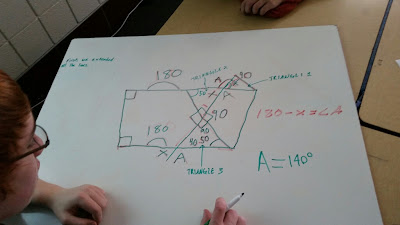
I want the geometry students doing more critical thinking, so I started looking for a good problem that they could do in their groups.  I wanted to find something that related to the content we have been covering, so I starting poking around Five Triangles.  Since we haven't talked about circles and aren't really talking much about triangles yet, I searched for something related to parallel lines.  What I found was this:

I asked the students to find the measure of angle A, justifying all of their steps and then present those to the class.  Of the 6 groups, they were all on the right track, but most were making assumptions that sent them in the wrong direction.  The ideas were great and varied, but the justification was lacking.  We talked a ton about mak9ing assumptions and being able to back up their claims.  We will work on it.


Regardless, I was very pleased with the group work and the persistence.

Monday, November 10, 2014

Day 51: Community

I know that it's unreasonable to expect that I will be excited to go to work every day.  No matter what job someone holds, there are just some days when you would rather stay in bed.

Last night, I had a dream that I was covering in-school suspension.  Our current ISS room has seats for about 12 kids.  The desks face the wall and electronics are banned.  In my dream, there were about 50 kids in the room and all the desks were facing in.  It looked like an out-of-control study hall.  Kids were throwing things all over the place, listening to iPods and having loud conversations across the room.  As I walked in, the exiting teacher (who was not someone in my real school) wished me good luck.

And so I stood, in the middle of what was essentially a recess, but was supposed to be a punishment.

I walked around the room for a bit, telling kids to put their phones away and moving desks to discourage socializing.  The chief complaint that I received was that I was the only one who made them stop.

"The other teachers don't care."

As I finished going around the room, trying to restore the order that I demand in ISS, I noticed that not only was there another teacher in the room, but also a security guard.  Again, neither of these were actual members of our real school staff.  The teacher was sitting at a desk off to the side watching me out of the corner of her eye over the top of her magazine.  When I made contact with the security guard, he gave me a wry smile and shrugged, as if to say "what can you do?"


It doesn't take a psychologist to say that this dream is about how I feel alone in my work.  I'll start by saying that this is a wildly exaggerated feeling.  Yes, there are certainly times when I feel that other teachers who are making things easier for themselves are making things harder for me.  I think that everyone has these feelings.

Overall, I think we have an excellent staff who are doing their best in the current situation.  By no means do I see myself as the sole provider of order and sanity.  I know that I have many things that I still do very wrong.  I am SURE that there are some teachers who feel that the policies that I execute in my class are making their jobs harder, including my cell phone policy.

I think my major concern is that we don't spend enough time building a school community.  We have one, to be sure, but it could always be stronger.  We could be more united and more consistent.  No faculty is perfect and I will put myself near the front of the line when it comes to people who need to work better as a community.

At our inservice on Friday, we Jigsaw-read a book on teaming and building that sense of community in academic teams and across the school as a whole.  There were some great ideas in there and I wish that we had the opportunity to put more of them into play.  I hope that the discussion will continue so that we can implement some of these in the coming year.

An individual teacher can do a ton of community building in their own classroom, but the who faculty working together has an exponential effect on the atmosphere of the school.


On top of that dream, I am currently fighting off an upper respiratory infection.  I probably should have stayed at home.

My kids had the right idea...

Instead, I came in and attempted to go over the problems that my students worked on last week and posted on the walls.  For the most part, they did an excellent job and I saw multiple approaches that I wanted to talk about.


ADORABLE VAMPIRES!!!
I should have also remembered that this was the first time I had seen them in over a week.  At the time, I was deeply annoyed by the combination of them being disruptive, rude and off-task.  In retrospect, I should have had a different activity for them today.  I think it was unreasonable for me to expect their undivided attention after a long weekend.

I wish I would have these thoughts BEFORE class happened.

Tuesday, November 4, 2014

Day 49: Creating Better Tasks


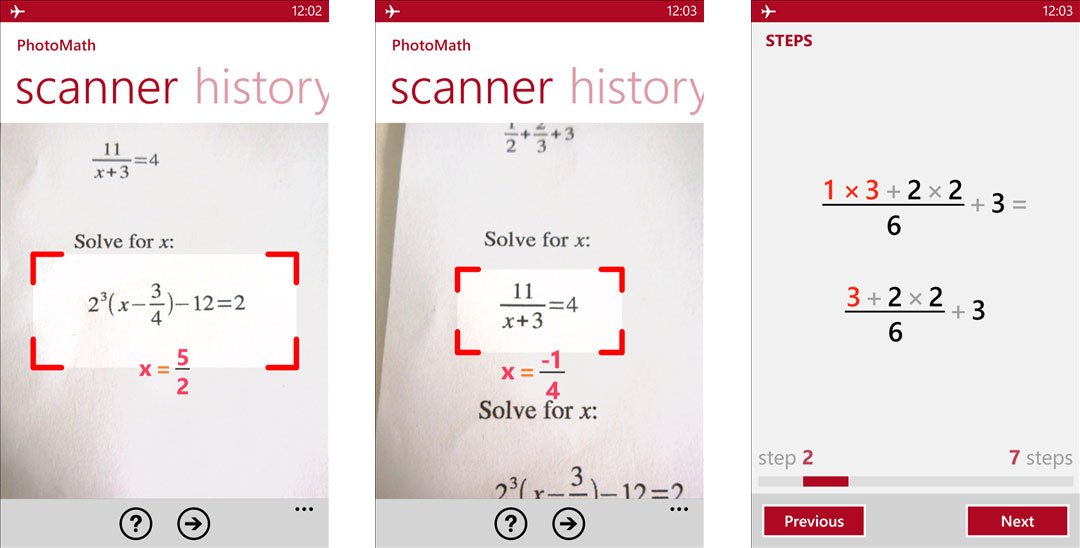
A few weeks ago, a company began marketing an app called PhotoMath. The claim was that taking a picture of a math problem will produce not only the answer, but the steps to get there.

Mixed reviews have since come out about this app. Some state that it works best with a stationary camera.  Others talk about how when it scans something like "4.  3x+2=8" it will look at the problem as "4.3x+2=8."  The majority of the reviews agree that this is very close, but not quite a finished product.  I predict that in the next year, it will be.

When I wrote about cell phone use in my class, the statement that seemed to resonate with other educators was "If you are asking questions that can be Googled, you're asking the wrong questions."

PhotoMath is a perfect example of this statement.  As technology improves, the ability to do mental calculation will become less necessary.  As teachers, we need to recognize this and teach our students accordingly.  Researchers and statisticians have understood this for a long time.  Data can be put into a spreadsheet and crunched however you want.

The skills that we SHOULD be focusing on are interpretation and analysis.  Yes, Excel can find you the standard deviation of a data set, but it can't tell you what it means in the context of the exercise.  Yes, PhotoMath (once perfected) will be able to solve for X (or more) in equations, but it won't be able to interpret that value.

I preach this doctrine, but I'll admit that I don't follow it nearly enough.  It's hard work to get kids to interpret problems, especially when they have very rarely been asked to do so before.

I would like to do it more often, but for reasons of energy, creativity or (more likely) laziness, I don't.


Today I did.

The incredible Jami Packer came to observe my classes today!  I couldn't let her drive all the way up here just to watch my kids do worksheets.  In light of a successful activity that I did a few weeks ago in conjunction with my ultimate goals for my students, I decided to do another gallery walk.
Seriously, I love have people observe my classes. Especially visitors who understand my vision.

This time, instead of basic calculation, I gave each group five word problems.  They were on a variety of applications and all five required different skills to complete.  They were allowed to work alone or in the group with which they were sitting.  They could work on the problems in whatever order they wanted.

With very few exceptions, they worked incredibly well for the entire class!  Almost no one got through all 5 problems, but what they did do was quite good and I was very proud of them.

During 8th period, a girl realized that she needed to subtract unlike fractions for the problem and couldn't remember how.

Instead of shutting down and giving up, or sitting there whining about how she needed help, she looked up a tutorial on YouTube.  She used her phone as a **gasp** LEARNING TOOL!!!
Mahalo Math
8th period worked very well on this task too.  An interesting side effect of doing it twice was that several kids used the problems taped up in 1st period as guides for their own work.  I didn't see anyone copying, but I did see several kids using strategies that were already posted.  My plan for next week is to use the posted work to talk about common errors and misconceptions.

I want my students to be proud of their work.  I'm modeling this by also being proud of their work.


Related Posts Plugin for WordPress, Blogger...