Tuesday, October 4, 2016

Day 29: So...Now What?

I'm incredibly frustrated.

Many of my students lack the numeracy and mathematical skills that I consider requisite for my courses.  It's difficult for me to understand the origins of these difficulties because they seem so incredibly varied.

In previous years, the analogy I've used is that given puzzle pieces, my students would have difficulty putting the puzzle together.  This year, for many, but by no means all, I'm not sure if they understand that there is a puzzle to be put together from these oddly shaped chunks of cardboard.

For example:
I am framing basic numerical operations in ways that allow us to think about them in physical terms.

2 + 3: How much do I have if I put 2 and 3 together 
5 - 2: How much do I have if I start with 5 and take away 2 
4 * 3: How much do I have if I have 3 groups of 4 (or 4 groups of 3
12 / 2: How many groups of 2 can I make out of 12

In Math 7, I put a problem on the board and, standing at their own section of the white board, each students write the language that we're using and then shows how they completed it.

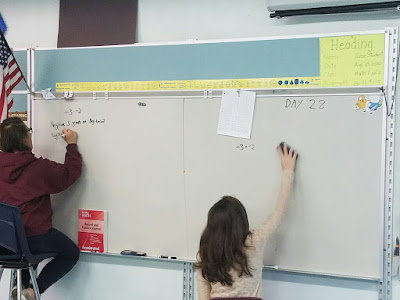
I wrote "24 divided by 6."

90% of the students correctly wrote "How many groups of 6 can I make out of 24?"  The last few wrote it as "groups of 24 out of 6" which I chalk up to lack of practice as a group.

Almost everyone put down 24 circles or squares on the board and put them into groups.

A few, however, instead of making groups of 6, drew 3 groups of 8.  When I asked about it, the students said that they were able to make a rectangle (8x3), which is what they saw in the example.  This is a fantastic observation for finding factors, but it wasn't the activity that we were doing.

I also want to be clear that I don't think these deficits are the result of lack of effort.  For the most part, they are jumping in full force and doing what I ask of them.  So far, I'm not seeing much correlation between effort and understanding.

This makes a certain amount of sense to me since the approach I'm emphasizing could be described in a business meeting cat poster as "Work smarter, not harder."  It's not as much about the effort as much as it about making connections between ideas.

I also want to be clear that I don't find fault with their previous teachers.  I've been speaking to the other teachers in my wing and they don't understand what's going on either.  This year seems to be an anomaly.  Whether that's true or not doesn't change that I need to do something,

Could it be an issue with my presentation?

Absolutely!

I know that I'm doing something that's not only new to them, but also fairly new to me.  I know that there will be growing pains on both sides.  I trust the process and I know that I'm not going to quit.

I desperately hope that the same can be said for my students.  I'm trying to make as many personal connections with them as I can.  I know that I'm a new teacher, with new experiences, teaching new kids in ways they've never seen.  I need to build up the trust from them.

If they trust me, they will go with me to the ends of the earth.

Maybe.

Monday, October 3, 2016

Day 28: Course Correction

When a politician is running for re-election, the most common phrase you hear is "you don't change horses midstream."

I've always thought that this was a stupid analogy.  You don't change horses, not because it's foolish, but because it's impossible.  They don't have pit stops at the Kentucky Derby where you re-shod the shoes, check the flank pressure or clean the blinders.

In addition to this, every other sport that I can think of has exactly the opposite approach.  When a pitcher or kicker gets tired, you trade them out.  Golfers change clubs for almost every shot.

We make changes whenever we needs to, if it's possible.  Those who don't adapt are doomed to die.

In teaching, especially those of us who teach multiple sections of the same course, rarely teach the same topic in the same way.  We notice mistakes that we made the first time, examine student misconceptions and tweak the lesson for the next time we teach it.

Or, in some case, we toss out the lesson completely and start over.


After 2nd period (Pre-Algebra), I through out my lesson and started over.  I wasn't pleased with either the presentation or the reception.  On top of that, it occurred to me that it wasn't moving the class in the direction that I wanted to be moving.

Our next topic in Pre-Algebra is approximations of irrational numbers.  My thought was to start with approximations of rational numbers, specifically comparing rational numbers.  I'm putting heavy focus on area models because they make sense and help students develop a better understanding of the reasoning behind fraction manipulation.

In addition to this, the elementary classes have been working with area models and the vertical consistency is important.

My presentation in 2nd period was alright, but it wasn't as consistent with what I want to be doing moving forward.  I worry about such course corrections between classes because I don't like having one period be an entire class behind because of my mistake.  Unfortunately, that's part of the reality of what we do.

More than that, I don't want 2 classes to miss out on a superior lesson simply because I didn't think of it soon enough for the first class.

If it's better for the kids, switch clubs, pull into the pit stop, get a relief pitcher, send in the second string and switch horses midstream.

Friday, September 30, 2016

Day 27: Reassessments

After a week of students looking at their skill scores and practicing various problems, today was reassessment.  Any student who earned less than 4 on a skill on the quiz last week was able to reassess that skill, if they chose to.

I went around the room, asking who wished to reassess which skill and handed out the papers accordingly.

In one class, the scores all came up and I was incredibly impressed.  In another, every reassessment score was either the same as previous demonstrated, or lower.

I will be interested to see what happens with the rest of the classes.  I won't be doing reassessments every week.  After speaking with some other teachers, I've decided it will probably be two more times by the end of the marking period and maybe once every three weeks after that.

I'm ready to move on.  I need to make a conscious effort to spiral back and cover the material that many of the kids still need to work on.

Yesterday, I presented to the faculty of the whole district about what I'm doing with the Standards-Based Grading and reassessments.  I feel as though I rambled a bit, but several other faculty members told me that they enjoyed it and would like to speak to me about it further.

This week has been odd, with assemblies, fire drills, meetings and trainings.  I'm tired.

I'm thankful that I was able to spend some quality time with my department today. I am working with a truly fantastic faculty.

I wish you all a great weekend!


Thursday, September 29, 2016

Day 26: A Lunchtime Anecdote

The following conversation was relayed by a colleague of mine, having overheard it in her class.

"Mr. Aion doesn't teach!"
"He TOTALLY does! He just doesn't teach like other teachers.  He makes you think for yourself."
"Yeah, but I don't want to think!"


I think this is what I want.  I don't want students talking about me as much as talking about education.  I want my students thinking about the best way to learn.  I know that my teaching style and the fact that I lean heavily on inquiry-based lessons and these are VERY much outside of the experience of most students and parents.

"You're supposed to be teaching us" is often code for "you're supposed to be standing in front of the room and lecturing."  Education research clearly demonstrates that lectures are not the most effective form of knowledge acquisition.  Lecture does well enough if your goal is to know facts, but that's not my goal.  I want my students to have skills and to be able to think.

I want my students to be able to think.

The biggest complaint that teachers get when they are working through a new type of pedagogy is "he's/she's not teaching us."

Another interesting aspect of this is how students are trained to think about the call and response nature of education.  They think they know what I'm going to ask before I ask it.  They are almost always wrong.  This is leading to some extensive frustration from me as I have to repeatedly say "Stop. Listen to the question I'm asking."

We have been talking about the language of multiplication and division in Math 7.  I've been working with framing multiplication as "5 times 3 means 3 groups of 5."  This was a deliberate choice so that talking about division can be framed as "15 divided by 3 asks us how many groups of 3 are there in 15."

So I wrote 15 divided by 3 on the board and immediately hands went up.

"Put your hands down, please. I haven't asked my question yet."
**hands go down**
"How..."
"5!!"
"I appreciate your enthusiasm, but that's not what I'm asking.  How would we read this question, using the specific language that we've been talking about?"
"5!!"
"That isn't what I asked. I know that you know the answer. Listen to my question. How do we read this in terms of the language of groups?"
"15 divided by 3 is 5!"


I love that I have some students who understand what I'm doing and are able to explain it to their classmates.  I have great hope that more will come around.

It's a process, for them and for me.

Wednesday, September 28, 2016

Day 25: "YOU Should Wear It!"

I'm starting to create my reassessment quizzes for my students.  I've never been great at either organization or planning ahead, so this is a new experience for me.  My plan is to have a separate page for each skill so kids can take only what they plan to reassess.

I'm discovering that finding, or writing questions for specific skills can be a bit tricky.  I'm having difficulty with the wording and struggling with how to determine proficiency in several cases.

I don't want to be checking calculation, but rather conceptual understanding, which is tricky.


I'm also not sure what to be doing with my Integrated Math class.  They've been working on statistics and surveys over the last few weeks, but now that chapter is at an end.  Our culminating activity was that students designed, distributed and analyzed their own surveys.  There was an interesting variety of topics and presentations.

One group surveyed the students and asked their opinions and experiences on the school dress code.


The juxtaposition between the last two graphs was, by far, the most interesting to me and not at all surprising.


"Yeah, uniforms are a GREAT idea...for someone else!"

Other topics included video game preference, animal preference and correlation between favorite music and favorite medium of art.


The population of this class is an interesting mix of kids who have not traditionally done well in math and those who have, but didn't want to take Calculus this year...

The next chapter in the book is about properties of real numbers.  The same topic that I'm covering with my 7th graders.  It's WAY too basic a topic for this class, but without a curriculum, I'm not sure what to do.

There's incredible freedom knowing that I can do whatever I want, but it's also pretty terrifying.  I could run it like a genius hour class, but I'm not sure how.  I could use it as a math refresher course, picking interesting topics from the book, but I'm not sure how that would work either.  I'm going to have them do programming for the next week or two until I figure out a more encompassing theme.

I need to figure it out.

Tuesday, September 27, 2016

Day 24: Vinculum

I think that the low scores on the quiz on Friday, combined with progress reports yesterday and the long conversation about reassessing skills were all strongly correlated with the student's willingness to pay attention today.

In any event, they were very attentive and we had some pretty great discussions.  In Math 7, we started the section on multiplication of integers and framing in terms of repeated addition.  Standard of Mathematical Practice 2 asks students to think about numbers in many ways.  So we did.

We came up with 10 ways to represent multiplication.

I spent the entire period on 2 examples because I wanted to emphasize the language that we will be using going forward.

Being able to think about multiplication as "3 groups of 2" makes the transition to division much easier, especially division of fractions, using phrases such as "How many groups of 1/2 are there in 3?"

In Pre-Algebra, we looked at specific examples from the quiz and talked about the common mistakes that I saw in assessing.  The two major problems with long division were putting the decimal in the wrong place and having the vinculum (the repeater bar) cover either too much, or not enough.
I know fancy words!

When we discussed converting repeating decimals back into fractions, I showed the algebraic method, but we talked more about strategies that we could use to estimate and then find the answer.


It's a process, but I can feel that we're moving in the right direction.  I had a parent contact our superintendent in a fury over what was happening in my class.  After writing directly to the parent, she thanked me for my thoughts and expressed appreciation for my methods.

It was a good day.

I hope to put a vinculum over this feeling.

Monday, September 26, 2016

Day 23: "I Got A 77%!"

Standards-Based Grading is new to my students as well as to me.  After their first SBG quiz on Friday, I spent considerable amount of time putting the data into a nice spreadsheet, adding features and making it easy to understand.

Before I handed the quizzes back today, I went over the sheet and explained what we were looking at.  I asked them to tell me what stood out to them.

This version automatically converts the various skill scores into the 100% scale for easy transfer to our traditional report cards.  It also, through the chart on the side, gives us an easier way to quickly see which skills are weak in all of the sections of a class.

Through trial and error, I discovered that it was better to go over this chart before I gave the quizzes back.

I reminded them that this is merely a snapshot of one moment in time.  Any skill can be reassessed as many times as necessary.  I also expressed my pleasure that no one earned a 4 on every skill.  Everyone has some growing to do and that's fantastic!

Now we have this information. What do we do with it?

Today was #MistakeMonday and I incorporated that into our task.  Instead of having students write about a mistake they made last week, I had them write about their quizzes.

I had them take out a clean piece of paper and make 3 columns.  The first column was labeled "Skill #" with the second labeled "What Kind Of Mistake" and the labeled "Plan for Reassessment."

For each skill, the students were asked to identify whether the mistake they made was a careless error, a conceptual misunderstanding, or something else.  I explained the differences between these by putting the following two equations up on the board:

3+4=8

3+4=34

We had a brief discussion about why each one was wrong and, most likely, why that mistake was made.

In the last column, the student was asked to lay out a plan to improve on the skill before they reassessed.  That plan could include staying for extra help, doing more practice problems, working with friends, watching online videos, etc..

My plan is to offer reassessment on Fridays.  After a student has shown me that they have made an effort to improve their ability, they can reassess whatever skill they want, replacing the old score with the new.  I showed them an example in the spreadsheet of how the new score changes the overall average and leaves no record of the first score.

In one class, I had to field the same questions over and over from students who are used to getting straight A's and were not used to being able to correct their mistakes.

Another reason I love SBG as much as I do is because it allows students to make mistakes with no penalty and encourages them to learn and grow from those mistakes.


So I handed back the quizzes and students were both confused and upset.  On a quiz with 4 skills, there were 4 scores.  One student looked very sad and I asked her what was wrong.

"I got a 77%. That's really bad!"

I looked at her quiz.  Her scores were 3, 3, 3, 1.

This means that she knew what she was doing on 3 of the 4 sections and completed them VERY well.  None of that mattered, however, as she was focused on the 1 and the converted percentage.  I spoke with her about her strengths and celebrating those before focusing on weaknesses.

It didn't seem to sink in.

I know this will take a while, but I think it's worthwhile.

Some of my nerdier colleagues are SUPER excited and keep coming to my room to ogle my spreadsheets. I hope they buy me dinner first.
Related Posts Plugin for WordPress, Blogger...