Monday, May 12, 2014

Day 156: The Last Mile Sucks!


I've been running (mostly) regularly for almost 2 years now.  My runs can be broken down into the thoughts I have based on the percentage of my run that I've completed.  It has nothing to do with the distance that I plan to run.  It usually goes something like this:

1% Completed: "What a nice day! I know I'm only planning to do 3 miles today, but I may do 6! I feel great!"

10%: "Hmm... This doesn't feel awesome.  I was hoping to do more, but I may only do what I planned and run a little extra tomorrow."

25%: "My knee and ankle are a bit twingey.  I should be pacing myself a bit more."

33%: "Chirst! Do I have to do THAT two more times??"

50%: "If I just finish this lap, I should be good.  It wasn't as far as I was planning, but I don't want to hurt myself."

75%: "COME ON, YOU LAZY F*#@!! YOU RAN A HALF-MARATHON LAST YEAR! ARE YOU TELLING ME YOU CAN'T EVEN FINISH THIS MILE??"

85%: "If I give up now, no one would know... No one would ever... Oh crap! I post my runs to Twitter and Facebook..."

95%: "Almost! Almost! One foot in front of the other! Sprint to the end to boost your pace just a bit!"

100%: "I can do one more! I'm behind in my #500in2014 anyway! What's one more mile?"

101%: "Nope."

Today makes 86% completion of this school year.  I am finding myself having exactly the same feelings and thoughts.

My room is hot, my kids are sweaty and loud, my energy is low.

I desperately want to phone it in.  I can feel myself asking easier questions than I would have 3 months ago.  I'm finding it easier to justify letting my kids off the hook more and more, although for very different reasons.

In geometry, I've been pushing them full-steam for months without letting up.  We've been doing activities and projects, having discussions and debates.  I am so proud of everything they've done.

As a result, I'm justifying my current lack of push by saying "They deserve a break."  This is true, but they'll get their break over the summer.  I hope they won't take it as a break.  I hope they use it to push themselves, discovering new things, playing with new software, asking new questions.

In pre-algebra, I've been pushing them full-steam for months without letting up.  I can't, however, see any progress or even evidence that I've been pushing.  I think they are better off than they were at the beginning of the year, but I don't think it's been a year's worth of growth and I certainly don't think the kids this year have grown as much as my students in previous years.  I find this VERY distressing since I believe fully in the power of what I've been doing this year.


The other analogy that comes to mind is that of Sisyphus.

In geometry, I had a VERY heavy boulder.  It took an insane amount of energy to get it rolling, but once it did, it rolled downhill under it own power.  I was there to keep it moving in the right direction and to give it a push when it got to a bump or a ditch.

In pre-algebra, the boulder feels much lighter, but it is going uphill.  There was slick patches on the hill where my feet keep slipping and I've lost my grip on the boulder several times.

I think there is a great value in both of these.  They both require a ton of energy and I wouldn't claim that one is better than the other, except to say that I think I'm better at the former than the latter.  Fixing that will take practice.


The analogy of Sisyphus falls apart in June when I pass my "boulder" to the next teacher and hope that I have given it enough guidance.

But knowing the end is near might actually make it harder.  It's so close.  How many teachers look at the clock and say "There's only about 5 minutes left.  Just hang out until the bell rings"?  If the school year were a 40-minute class, we would be in the last 5 minutes.


So today I started playing around with GeoGebra a bit more.  I found a very cool applet that deals with exploring quadrilaterals and the geometry class was able to talk about the properties of those shapes.  I had them make conjectures about lines of symmetry and various angles.

Our discussion led to an interesting question: What do we mean by the "center" of an object?

When we were dealing with triangles, we had incenters, circumcenters and orthocenters and they were almost never the same point.  What do we mean by center?

We left it open and I goofed around a bit more on GeoGebra, experimenting with different tools.

In pre-algebra, I used the program to introduce the concept of parallel lines and the various properties of the angles that are created by having those lines crossed by a transversal.  I was pleased with the lesson itself, starting with a single line and building up one angle or ray at a time, until we got to a parallelogram.

The students were less than impressed, and many passed out, but it may have been due to the fact that the room was 82 degrees.

Once I realized I had lost most of them, I started cruising around on GeoGebraTube to find something fun and stumbled on a pendulum wave motion applet.  The kids asked how it was done and I created a VERY simplistic version of it, illustrating simple harmonic motion of a point.  They were impressed.

I have reserved the laptop cart for tomorrow, so I'm hoping to get the kids onto GeoGebra to play around a bit themselves.

Now, I have to run and then, hopefully, go to sleep.


Friday, May 9, 2014

Day 155: "What Animal Am I?"


Today was Junior Achievement Day.  For the majority of the day, volunteers from Public Allies came to speak with our students.  The 7th grade students heard about personal finance and the 8th graders heard about personal branding.

The guy who spoke with my homeroom was excellent.  He talked to the kids as though they were actually people and they responded in kind.

Near the beginning of his presentation, he was asking them about the personal brands that certain celebrities have cultivated for themselves.  He asked about Beyonce, Jay-Z and Diddy and what the kids thought of when he said their names.

What struck me was how vehemently I had the thought "Those are the wrong examples for this crowd.  You should have gone with The Arcade Fire or David Tennant or Link."

I started thinking more deeply about how important it is for us to know our students.  We can't teach them if we don't build relationships and we can't build relationships if we don't know them.

Part of the exercise involved pair of students describing each other in positive ways.  They were also asked to write two positive words that a teacher or parents would use to describe them.  It was VERY difficult to come up with unique adjectives to describe my students, but I took it seriously and took the time to do it right.

The next question was harder.

"Mr. Aion, what animal best describes me?"

Teacher Tip: If you want to answer this question honestly and well, you sure as hell had better know not only your students, but a myriad of animals.

I spent several minutes staring at each kid, mentally categorizing what I knew about them and pairing it with traits of a specific animal.  I knew that whatever I answered was going to be analyzed, especially if the students didn't like that animal, so I wanted it to be right.

I REALLY didn't want to pick obvious animals like "you would be a cat because you are independent and slightly lazy."  Instead, I put serious effort into finding the right animal for each student.

"You would be a goose.  You surround yourself with people who have similar interests, but you're also self-reliant.  You are also fiercely territorial, looking friendly and cute until someone encroaches on your space."

"You are a beaver.  You are creative and industrious, constructing meaning from your surroundings. You're quiet when around those who are different, but very chatty with those who feel the same as you."

"You would be a bloodhound.  You are loyal and friendly with an investigative streak that doesn't let you give up until you've come to the end of your inquiry."


Some students were easy to identify.

"You would be a cartoon monkey scientist.  You're a bit twitchy and weird, often making people around you uncomfortable, but you're scary smart and often your intelligence takes you places that people don't expect."


I wasn't able to identify good animals for all of my students and that upsets me.  I don't know all of my students as well as I would like.

To how many of your students could you give a good answer to this question?

How well do you know them?

Thursday, May 8, 2014

Day 154: Explorations


Then pen that I use for my Promethean Board has been shorting out lately.  What this means is that certain parts of the board work just fine while on others, I have to push VERY hard to a response.  This essentially makes my board from an interactive whiteboard into a giant projection screen in the middle of my writing space.

In geometry, I wanted us to explore quadrilaterals but I wanted to do so on a grid to illustrate the points I wanted to make.  I don't have a dry erase grid and trying to create one by hand would have made a bigger issue.

So I improvised!

Why, yes! I DID tape a dry erase board to my Promethean board! And it was glorious!

It looked even cooler when the screensaver for my laptop came on.

It turned out that my geometry kids spent the day bullying our tech guy into getting me a new pen, which I now have and it works great!

I was very pleased with how this impromptu lesson went.  I started by asking them what they knew about rectangles and triangles.  After listing several attributes, we eventually got where I wanted: area.

At this point, I put a parallelogram on the board and asked how we might find the area of that.  We had a very interesting discussion about splitting it into two triangles and a rectangle, finding the areas of each of those and combining all of those.

They quickly discovered that, in a parallelogram, the two triangles that they created by drawing altitudes were congruent to each other.  We talked about what that meant and what we could do with it.  Eventually, someone suggested that we move one triangle to match up with the other and make a rectangle.

I used this as an opportunity to discuss why the formula for area of a triangle is related to the formula for the area of a rectangle.  I let them choose variable names for the lengths of the various sides, so it looked like a jumbled mess, but it was all part of the plan (sort of.)

Once we combined the areas of the triangles and the rectangle, messed around with the variables and made it pretty, they were able to see that the formula for the area of a parallelogram was the same as that for a rectangle.

"What about other quadrilaterals?"

I drew a trapezoid on the board, purposely drawing one that was not isosceles.  When we started looking at it, they tried the same tactic as before, but quickly found that since the triangles on the side weren't congruent, they needed to do something else.  We talked about it for a bit and looked at a few different ideas.

One student suggested that, since we can find the area of the rectangle in the middle, we pull that out and put the two side triangles together.  The base of that triangle would be the length of the bottom of the trapezoid minus the length of the top.

We did some algebraic manipulation and ended up with the standard formula for the the area of a trapezoid.  We also talked about how, since we couldn't move one triangle to the other side, we could cut each triangle in half vertically and flip the missing piece up to the top to make a rectangle.

My favorite part of this lesson, the part of which I am most proud, is when a student asked me "What are we looking for? Where are we trying to go?" and my reply was "I have no idea. We are just exploring!"

Formulas are great, but they are even better when the kids come up with them on their own.  If they can't create new ones, the next best thing is to have them discover why we use the existing ones.

One of my favorite activities to do in Algebra 2 is to use the method for completing the square to derive the quadratic formula.  I love seeing and having students see how math is interconnected.  Too often, we fail to create or illuminate those bridges and, as a result, students think that math is just random formulas with no real origins.

Any sufficiently advanced mathematics is indistinguishable from magic.  Part of the job of a math teacher is to pull back the curtain.


By the time the pre-algebra kids got to my room, the temperature had jumped to 82 degrees and everyone was pretty subdued.  They took a chapter test and worked on front-loading vocabulary for the next chapter.

By the time class ended, it was 85.

Wednesday, May 7, 2014

Day 153: Reviews and Proofs


I have a ton of grading that I have to do and I am reminded how much easier this job was when I was doing it poorly.  When I only used multiple choice tests and checked homework only for completion, grading was a snap!

This whole "wanting to be a better teacher" thing sure is exhausting.

We spent geometry going over the sheets that I gave them yesterday.  The students really struggled with the first page, on which they were given a quadrilateral with certain properties and asked to determine if it had to be a parallelogram.

I liked this page because it required a ton of lateral thinking and students needed to be able to justify their reasoning.

Almost everyone was able to come up with counterexamples when they existed, but the reasoning for the proofs was much more difficult.  I purposely did not work out the problems ahead of time because I think it's important for the students to see the way I think as a process rather than a finished product.

It was immediately obvious that this is a tactic that they are not used to.  I saw several eyes glaze over until I was done asking myself questions, pens poised to write the answers instead of the ideas that lead to it.

Most of them, however, seemed to really enjoy the puzzle that is a geometric proof.  I think that by emphasizing formal proof structure, we take away the fun that can exist in proofs.  They are, essentially, a puzzle with each piece leading to the next.  There is no set path that a student must take, but they do have to justify each step.

I think there is great freedom and beauty in it, but with very few exceptions, I may have been the only on the room to think so.  I've also found that when it's something they don't think they should know, they work MUCH harder to figure it out.  I can understand this as the simpler concepts should "just come" to us and if they don't, it's harder to motivate ourselves to work on them.  "It'll just come to me later."


In pre-algebra, we went over the practice test from yesterday in the hopes of getting them prepared for the actual test tomorrow.  I had students putting their work and answers up on the board to try to get them more active, but several refused and the ones who did, were rudely talked over or even heckled by their classmates.

I truly feel as though we've made much less progress this year than we have in previous year, and don't just mean about content.  At this point last year and the year before, my students were not nearly as rude to each other or to me.

One of the major problems with changing styles or routines in educations is that it's VERY hard to tell if it's the procedure that doesn't work, or the specific dynamic of the students in the room.

I try to make them understand what I'm attempting to do and why, but with this year's pre-algebra classes, I feel as though I have missed the mark by a mile.  I hate to think that they need Old-Teacher Justin while the geometry class needs New-Teacher Justin because it feels like giving up.

In period 8/9, there were three specific students out and it made all the difference.  The rest of the class, though boisterous, worked VERY well on the review, asking good questions and volunteering to show the class what they did.  I'm always amazed at how the addition or subtraction of one or two students can completely change a class dynamic.


I'm also quite tired of having to tamp down the urge to start each of these blog posts with "I'm so tired."  I'm starting to think that the recharge that I need isn't just emotional, but physical as well.  I've been going full-steam this year and haven't really given myself a chance to recover.

No matter how awesome and dynamic your lessons are for Monday and Tuesday, there is still a Wednesday.

Tuesday, May 6, 2014

Day 152: Forging Ahead


Warning: The final picture in this post contains profanity.

With only about a month left, we won't be able to hit all of the topics that I want to hit.  As a result of that, I came up with an idea last night and implemented it today.

Our text books (Glencoe) provide a ton of worksheets that range in difficulty for all manner of teacher-directed learning as well as student-directed.  I use the Study Guide, Practice and Word Problems to put together workbooks for the pre-algebra classes and we use for classwork and reference.  They are good for practice and reference, but not much else.

What they DO have in each section is an "Enrichment" page that takes the basic idea from the chapter and asks students to apply those concepts to something practical. The newest chapter in Geometry is about quadrilaterals and I figured with all of the work we've been doing with triangles and logical thought, this would be a good place to make them stretch their brains.

I selected four pages of Enrichment from a chapter that we haven't talked about.  They could do any three and use any reference they wanted, but I needed to see what they did.

The four tasks that they could choose from were:

  1. Test for Parallelograms: Students were asked to draw a quadrilateral with certain criteria and asked to determine if it was enough to claim that the shape was a parallelogram.
  2. Counting Squares and Rectangles: Students were given multiple shapes with intersecting lines and asked to find the total number of squares and/or rectangles.
  3. Quadrilaterals in Construction: Students were asked to identify different types of triangles and quadrilaterals in building rafters, find dimensions of windows and doors and the length of tape needed to seal a box.
  4. Coordinate Proofs: Students were given a diagram and asked to prove various things about the quadrilateral based on the arbitrary coordinates given.
 Instead of starting with practice and moving to the application, I started with the application to see what they can figure out.  I would MUCH rather have them figure out the complicated stuff than simply repeat the easy stuff back to me.

Also, I will provide remediation for those who aren't ready for the complex stuff.  This way, the advanced kids can keep moving and the ones who need help can get it.


We also finished the chapter in pre-algebra.  I have been giving them pre-tests the day or two before to help them assess what they know and what they need to study.  I'm not sure that it's achieving those goals.  It seems more than students are using it to find out what they will get on their tests the next day.

What I want to be happening: "Oh man! I got a 60% on the practice test. I'll make sure to study the ones I missed tonight!"

What IS happening: "Oh man! I got a 60% on the practice test. That's good enough."


I have a student (well, several who do this, but this one in particular) is always at the center of the problems in my class.  Most of the time it's because he was away from his seat, minding other people's business and not keeping his hands to himself.  As a direct result of his actions, other students are usually hitting him or yelling at him.

I can't seem to get him to understand that if he would just leave other people alone, he wouldn't be getting in trouble.  He constantly feels like the victim, as though he played no part in anything around him and trouble just finds him.

I expect this from a toddler, but I don't know how to address it in a young adult who refuses to engage in a conversation about it.


I found another piece of graffiti today that was directed at me.  I've decided now that I will be adding to the student graffiti rather than getting angry with them.  I rather enjoy the addition that I made today.


Monday, May 5, 2014

Day 151: Making Them Trust Each Other


This weekend, I was invited to spend the day with Jen Silverman and Jim Doherty learning how to use GeoGebra.  It was a fantastic experience and, to be honest, I did it less for the program knowledge and more to spend time with Jen and Jim, both of whom are amazing!
Mathematical duckface!

It was a bit of a hike for me, but worth it for three notable reasons.  First, I took my daughters to visit with my mom and her partner outside of Philadelphia.  Second, I got to spend time with Jen and Jim and learn a ton of information about how to utilize the amazing tech tool that is GeoGebra.

Third, during the VERY large number of hours I spent in the car, I was listening to NPR podcasts.  In one of them, RadioLab out of WNYC (which, if you are not listening to, you are making a HUGE mistake.)  This particular episode talked about a British game show called Golden Balls, where contestants, in the final round, engage in a sort of Prisoner's Dilemma for the prize money.

The basic premise is this:

The final two contestants are each given a choice.  They may choose to split the pot of prize money 50/50 or they can choose to steal from their opponent.  If they both pick to split it, they split it and everyone is happy.

If, however, one person picks to split and one to steal, the person who chose to steal gets everything while the other person gets nothing.


I spent a large part of the weekend thinking about how I could do this in my classes.  When I met an old friend of mine at a diner on Saturday night, we talked about it for almost an hour and ended up writing a lesson plan on diner napkins.

Because that's what teachers do.

We devised several versions of the game with varying degrees of information for the players.  I had them chose split or steal without knowing who they were playing against, knowing their opponent, and being able to talk to their opponent.  I had 1 students go into the hall while we picked their opponent from the class, creating imperfect information.

Then we did a tournament!

I gave every student 20 M&Ms and drew two student names from a jug.  They played the game and we kept track of the results on the white board.  Anyone who hadn't been eliminated at the end of round one could either cash out or play for more.

In Geometry, we were only able to play one tournament because we had deeper conversations about the critical thinking aspect of determining what someone else is going to do.

In period 4/5, we were able to do 2 tournaments.  In the first, there was only one group that successfully split the pot in the first round.  All of the others either stole from their opponent, or both chose steal and were both eliminated.

In the second tournament, the majority of the class made it to round 2 by successfully splitting the pot.  We had a brief talk about how cooperation, while it may seem worse for and not in your best interest, was the only way to get the optimal solution. In round 2, it became clear that almost everyone was splitting again and everyone cashed out at the end of the round.

In period 8/9, two kids simply refused to play at all, claiming that making the folded papers saying "split" and "steal" was too much work.  The class in general was also MUCH more chaotic.  They seemed more interested in throwing M&Ms at each other than eating them.


The conversations that happened while students were trying to figure out what they should pick were very interesting.  There was lots of "I PROMISE that I'll pick split" and "I don't think I can trust you to pick split."

One student came into the round saying "I don't care what you do. I'm picking steal.  I don't like chocolate and I don't like you. If I can't have some candy that I want, I don't want you to have some either."

General observations:

The geometry kids made deal based on logic and weren't angry when they cheated each other.

Period 4/5 made deals based on personality and friendship and if they got cheated, were more sad and disappointed.  One students did say to another "Look, we're both the same color. If we both pick steal, then this white guy is gonna take all of our stuff."

Period 8/9 made deals based on purely selfish reasons.  More students were eliminated by both trying to steal than anything else.  Even running the tournament for a 3rd time, kids continued to try to cheat each other and were eliminated.  When this happened, they got furious at each other, yelling about what a cheater the other person was when they had picked exactly the same thing.  Many students accused their opponent of ruining it for both of them, even though both students had made the same decisions.

In both pre-algebra classes, I will be surprised if I get the reflections back tomorrow from more than half a dozen students total.  As I've said before, I don't seem to have much problem engaging them in the lessons, but the follow-through is non-existent.
This was not enough...


My deepest thanks go out to Jedidiah Butler for making my data sheet look pretty!


I am incredibly disappointed that once again, I've tried something fun and interesting and my pre-algebra kids, not all, but many and the same ones, were indifferent.  It's getting harder and harder not to count the remaining days and say "Whatever. We have less than 30 days left. Give them worksheets and take it easy."


I am tired.  This was a great lesson for the geometry kids and half of the pre-algebra kids and I will bask in the glow of that.

But tomorrow, I have to write another blog post and draw another picture and find another way to engage my students for an hour and a half each.  It's exhausting.

Several people have asked me if I'm going to keep this blog up next year.  I would like to and, hopefully, after everything I do this summer, I'll have my energy back.  I don't know if it will be the same form, but I think writing has been very valuable for me.

The drawings, however, I think I'm done with, at least on a daily basis.  I'm finding myself more stressed about the pictures than about my lessons and that's REALLY backwards since the majority of my students don't care about them beyond a passing "huh."


Also, I found out that when I was out on Friday, there was a 20 minute span of time when my period 8/9 was left alone without a teacher.  This wasn't the fault of the covering teacher because no one told her she was supposed to be covering.

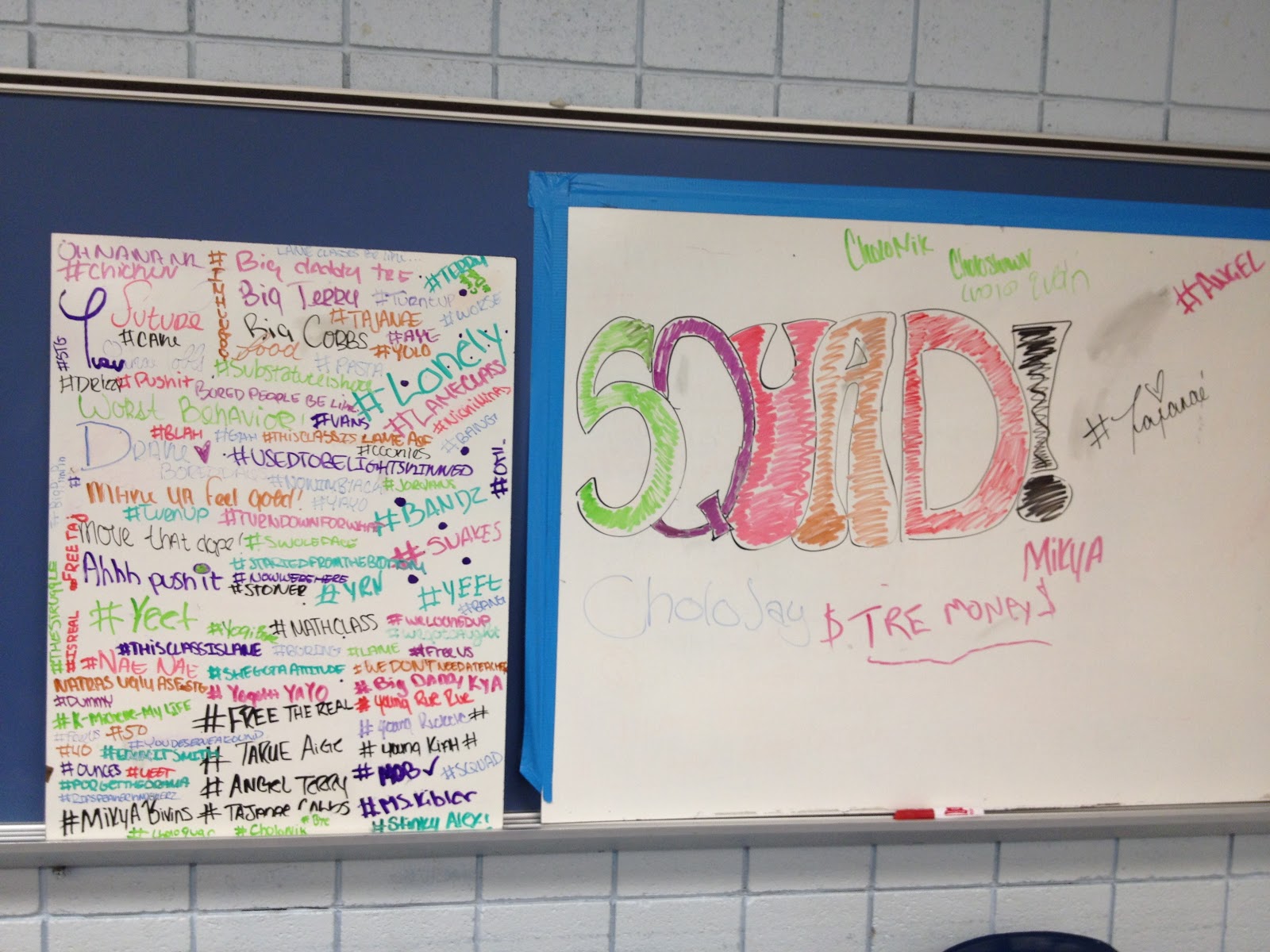
So this morning, in addition to many missing and scattered marker, about a dozen missing mini dry erase boards and my room in shambles, I found this:
I figured that if I brought this up at all to my class, I would end up screaming at them for using/losing my markers without permission and it would lead to a bad discussion.  So I erased it and pretended I never saw it.

Thursday, May 1, 2014

Day 149: Arguing With Myself


70% of my geometry class went on a field trip today and, for some reason, many of my other students were missing as well.  With that many kids out, I didn't want to start anything new.  On top of that, I'd been hammering them all pretty hard recently in terms of content and critical thinking, so I thought I would give us all a break.

Before they left, I handed out the Chapter 7 test to Geometry.  They are now used to my assignments of "write a solution guide" but I asked for questions  and they had none.  With the remaining students, we talked briefly about how parallax and triangulation are used to determine the distances to far stars with measurements taken every 6 months.

I wish I had developed something for this part of the lesson, rather than just a side note at the end (an end note?) but I am not a good planner.  The first two parts of the lesson, however, were awesome!

In pre-algebra, We are nearing the end of the chapter and are now working with simple interest.  With so many kids missing, I took the opportunity to assign some practice work and was able to give attention to individual students in the class.

As frustrating as I find that class, there are a ton of a really great kids in it.  We don't do a good enough job of teaching them how to set long term goals and rise above peer pressure.  Individually, they are awesome kids.  As soon as you put them in a group, they have to perform, showing off and generally acting like the jerks that they aren't.


After yesterday's incident with the whiteboard, I was tempted to erase it before the kids came in for period 8/9.  I had a moment (several hours long) where I wrestled with what to do.  I had my own version of angel and devil sitting on my shoulders.  In this case, it was Old-Teacher Justin and New-Teacher Justin who were vying for my attention.

Old-Teacher Justin: "Those disrespectful miscreants! You work so hard to create new pictures and questions every day.  You try so hard to develop interesting and engaging lessons and they don't care!  They are lazy and rude and don't care how much effort you put into the class.  They are disrespectful to your property and think you should be spoon feeding them everything!  Erase it! Leaving it up will show them that it's ok to behave in the fashion the way they do."

New-Teacher Justin: "Don't be absurd! You KNOW that's just your frustration and annoyance coming through.  It wasn't a class effort that smudged your board, it was one individual.  Just because you don't know WHICH individual doesn't mean that you should punish the entire class.  In addition to that, it's a dry-erase board.  It is, by definition, impermanent.  A student smudging it just means it was going to get erased an hour or so earlier than it otherwise would have.  Being angry at the class is petty and unbecoming of a teacher.  You are striving to be better and letting this one go is a step in the right direction."

Old-Teacher Justin: "All of that may be true, but so what? If you punish the class, the message will be clear: treat other people's property respectfully!  A group punishment will encourage the kids to police each other."

New-Teacher Justin: "Their job is to be 13 and 14.  Not to 'police' each other.  Group punishments only show them that adults are unfair.  It further creates an 'us versus them' mentality.  They struggle with so many things, both academic and not, why would you want to add to it?"

Old-Teacher Justin: "I'm preparing them for the harsh realities of  ... reality."

New-Teacher Justin: "No. You aren't. You're showing them that they can't ever win or get ahead.  Worse than that, you're coming up with BS excuses to justify your own actions, which are happening out of anger rather than out of concern.  You're a bully masquerading as an educator."

It was this last sentence that decided the argument.  I can be stern.  I can be strict.  I can be harsh.

But I NEVER want to be a bully again.

I can be angry.  I can be frustrated.  I can be so annoyed that I want to scream and cry and tear my hair out.

But I never want to be a bully.


New-Teacher Justin won the argument today.  He won't always win, but this year he's been winning more often than not.
Related Posts Plugin for WordPress, Blogger...