Wednesday, February 12, 2014

Day 100: Sharks, Scale Factors and The Void

I fixed the spelling, I just forgot to take a new picture


What?? Of course I didn't spend the first 35 minutes of geometry class giving an impromptu stand-up comedy act about supervillains ordering their supplies.  It would be absurd to think that my level of comfort with those and my level of confidence in their ability to be on task when I need them to be would allow me to simply talk about the hidden tab on Overstock.com where a plumber from New Jersey might accidentally stumble and spend the money that he had allocated for a seahorse shower curtain on a pair of trained timber wolves who come equipped with lasers and rocket packs.

If I DID have that confidence, then the students would have justified that confidence by immediately getting to work on their parks, asking deep and insightful questions.

In period 4/5 of pre-algebra, we went through the lesson on scale factors that I did yesterday with period 8/9.  I tried to follow the thought I had yesterday about distraction and did my best to teach, ignoring distractions unless they were directly stopping me from teaching, or my students from learning.

The result was fascinating.

The room seemed completely chaotic.  Students who were engaged were out of their seats, walking around the room arguing about how many blocks long and wide it was.  I picked two or three students who seem to have tremendous trouble staying in their seats and had them do most of the movement.

The discussion today was louder and more active.  They also came to the conclusions I wanted much faster, so we moved a little further into it.  I realized about halfway through the double period that we were at the same point as the previous day and I made a decision.  I didn't feel as though they would be able to productively work on their parks, so we continued making the scale drawing of the class.

I asked them about rearranging the desks.  How we should do it so we could fit 31 desks in the room with everyone able to see the board?  We did experiments to find out how many blocks we would have to leave open behind each desk in order to have enough room to sit.

"We should put it in a U shape!"
So we did (on the board).
"How many desks is that?"
"18."
"So, we need more. Where are we going to put them?"

We draw the desks on the board, moving them several times to optimize the amount of space needed.  It may have gotten away from me because then we actually moved the desks.  It was a group effort and, once all of the desks were where they should have been, according to the scale drawing, the students sat in various seats to make sure they had enough room.

I kind of hate it.  I kind of hate it a whole bunch.

But they worked very hard on it and so I will keep an open mind.  We will try this seating arrangement for a while.


Then period 8/9 came in.  They spent the first 5 minutes complaining about the new seating.  Then, when asked to continue working on their projects, they didn't.  One group did, and one person from each of 2 other groups did.  The rest of the students didn't work on anything, or pretended to work, but clearly were not.  The few who were working asked me questions about scale as though what we did yesterday was completely disconnected.

I had hoped that giving each person in the group a specific list of jobs would guide their work but instead, what I'm seeing is students claiming "that's not my job and I can't do mine until they do theirs."

One group, in a fit of play fighting, tore up their rough draft and the folder I gave them to hold onto their work.  Then insisted that they weren't going to start over.

One thing I did not consider when assigning a project where everyone has a specific role is the absurdly high levels of absenteeism.  I don't just mean that there are some kids absent all the time, although there are.  I am missing at least 4 kids from class every day and they are usually a different 4.

One group had a member suspended for fighting and the rest refused to do his part of the project.

Several students almost starting fighting in my class because they were making up nasty songs about other students, who didn't appreciate it.


After how well class went yesterday, today feels like a betrayal.  It feels as though, with the exception of  five students, the rest are saying "That was yesterday.  What have you done for me lately?"

On one hand, I understand that they are 13, 14 and immature.  They are easily distracted and quickly forget many things.  On the other hand, I think that I shouldn't HAVE to make every day SUPER fun.  Not all days will be super fun and the students need to learn that sometimes, they just have to buckle down and do the work.  The "work" in this case is CREATING A PARK!

I feel as thought I should have built up some brownie points.  I dream of "We did a fun activity and lesson yesterday.  I can't wait to apply it today!"


As Max told me yesterday, kids are the same all over the place.  I would think that we should be able to crowd source our lessons and behavior plans and find SOMETHING that works.  Someone out there has to know how to get kids to interested in their lessons.

I know it's not me.

But I will keep looking.

I am, however, reassured by the fact that a teacher whom I consider very rational and reasonable is also having difficulty this week.  We attribute it to the fact that since we came back from Winter Break, we have yet to have a single full week with a regular schedule.

But it's difficult to continue doing activities when you can picture the kids working hard on mundane worksheets.

I may make and sell cardboard cutouts of Max Ray for people to put in the backs of their classrooms.  I'll make a million dollars.

Tuesday, February 11, 2014

Day 99: My Day With Max Ray


As I watched my geometry students taking the PSSA ELA: Writing Field Test this morning, I couldn't help but notice how my normally amazing, energetic, engaged, interested, curious students looked as if they had taken leave of their bodies and gone off wander the aether while their corporeal forms remained for the mundane task of "properly shading bubbles."

Now, more than ever, I am of the belief that assessments need to be active and valuable.  This is neither.  On top of that, these students won't know their scores for at least 6 months, if ever.  They will receive no feedback beyond a raw number (not even a percentage) and will have no idea WHAT they got wrong or how to improve it.

I could go off about my thoughts on standardized testing, but I think it would only make me sad.

And then the day went WAY up!

First, I decided that, while my students were finishing up their standardized tests, that I would draw one of them.


Then, the indomitable Max Ray came to observe my classes!
We had to take the picture in front of "the famous board" to prove that we "weren't just in some bar."

The geometry students welcomed him with open arms and then got right to work on their park projects.  I think that there are a few groups with such a high level of comfort in their own skills that they ran away with their ideas.

One group wants their "park" to be a 2-story fun zone which includes a paintball course and a laser tag arena.

When the Math 8 class came in (Pd. 4/5) I gave a brief introduction, reminded them of what they were supposed to be working on, and then let them go.  While this wasn't a disaster, there were several problems.

My goals for this project, while I don't think they were too lofty, clearly needed a bit more background.  I spent much of the period working with one or two groups trying to explain the concept of scale factors without saying "for every 10 feet in real life, use 1 block of grid paper."  I want students to discover these on their own, but they were getting frustrated and so was I.

In addition, there were several students who claimed to be finished with "their part" of the project, but a quick inspection proved that to be untrue.  I felt that I spent the period going back and forth, putting out fires and redirecting.

But I didn't get angry or sad.  Just having Max in the room, his small, warm smile as though enjoying a joke with himself, not unkindly, gave me the reassurance I needed to believe that this was actually part of the process.  Not just for them, but for me.  He never appeared to be disapproving or critical of my interactions or strategies and that helped me to remain positive and unflustered with the kids.

After class, we had lunch, I showed him around the school and we talked about the lesson.  We discussed various ways to help them understand not just how to make a scale drawing, but WHY you would want a scale drawing.  What happened in period 8/9 was entirely the brainchild of Max with slight tweakings by me based on the personalities, strengths and weaknesses of my students.


When the students entered the class, I told the students that I was thinking of rearranging the desks, but my inherent laziness meant that I didn't want to start moving desks around until I knew where I wanted them.  I asked what I should do and the students suggested that I draw a picture.

I asked one of my more active (disruptive) students to hold a desk up to the Promethean board while I traced it.  Then, since I have 31 desks in my room, I began copying the traced desk.  After 2 copies, I was out of room on the board.

I asked my students what I could do and, of course, they suggested that I shrink the outline.  I asked them how much to shrink it and a discussion began about how big the board was compared to the room and so, how big the desks should be.

"The board is square. Is the room square?  How big should I make the drawing of the room on the board?"

There was lots of "a little bigger, no longer, no wider."

"The room is basically in lines, right? What might be a good way to make sure out drawing is on lines?"
"You could put in on a grid."
"That seems like a good idea! Do we have a way of saying how many blocks wide and long the room should be? Should I just pick them randomly?"
"You should use the blocks on the wall."

At this point, I cheered loudly inside and shot a happy glance at Max.  During our pre-class discussion, I told him that I had confidence that someone would get us to exactly this point.

"I think that's a good idea. So, how many block wide and long will the classroom be?"

The students counted, told me and I changed slides to where I had already prepared a scale outline of the room.

"So, would you agree that this is the room drawn to the scale that you told me?  Then how do I know how big to make the desks in this picture?"

At this point, a student moved her desk to the wall and measured it using the tiles.
"The desks are 2 by 3, so you should shrink the trace down to that."

Once I did, they felt that the outlines were too small.  At Max's suggestion, we looked at the side of the room and, using the 2x3 desks in the picture, saw that we could fit exactly 7 desks in a line against the way.  We then verified the truth of this by moving 7 desks onto the wall.  The kids were astounded and finally agreed that, while they looked small in the picture, they were the right size.

We then started adding several items from around the room to our scale drawing including the iPad cart, the cabinet and the "heater thing against the wall."  I had the students tell me where those objects were in relation to the corners and they used the ceiling tiles to find the corresponding spots on walls that didn't have windows.

85% of the students were engaged and participating.

Did I mention that during this entire time, there were 3 students who never stopped talking and laughing loudly?  For the most part I ignored them, asking them quietly a few times to stop talking and changing the seat of one of the students.

After the class, Max and I had a talk about those students in relation to the others.  He told me that my engaged students, while perhaps distracted, were not derailed by the ones who were talking.  And interesting thought struck me that had not before today.

Just because I am distracted in my teaching does not mean that my students are distracted in their learning.  They were able to tune out the annoying kids and I had never noticed that.  I assumed that because someone was distracting me, that it detracted from the educational environment.  This was clearly not the case today.

I wonder how much learning time has been wasted by my wanting to squash distracting behavior for the benefit of others rather than simply teaching.


In any event, it turned out to be an amazing lesson and I'll be doing it with Pd 4/5 tomorrow.

I cannot express how happy I was to have Max come and observe me and my classes today.  We had several talks about how students are the same everywhere.  That conversation made me think that sharing success is important, but sharing failure is vital.

We (teachers) need to know that others are having the same struggles.  We need to know that others are dealing with the same difficulties, so that we can talk about them and find a solution.

More!!  I WANT MORE PEOPLE TO OBSERVE!!!  COME TO MY CLASSROOM, INTERNETS!!!

Monday, February 10, 2014

Day 98: YOU ASKED FOR THIS!!!


Half of my geometry class was gone for some unknown school function, so we went over the test a bit with the remaining students.  Then we talked about the school musical, which most of them were in, and the Olympics.


Since tomorrow, our students are taking the PSSA Writing Field Test (A test to test the test...) we have been instructed that we had to read the Code of Conduct to the students 3 times.

Today, I did a dramatic reading.  I'm sad that I had not taken my pipe...

For the pre-algebra classes, I signed out the iPads for the whole week so that students would be able to look up dimensions of the various items at their parks.  Two of the six groups were working VERY hard and paying close attention during the explanation of scale.  The rest had, at most, one person doing what I asked.

I spent the period walking around, trying to get students back on task.  When I saw them struggling with a concept, I sat and tried to work with them.  They are supposed to be doing a scale drawing of their park, birds-eye-view, with the dimensions of the various park items.  One group was drawing a side on view with no scale or proportion at all.  I had spoken to them previously about how this was not what was required of them.  They ignored my direction and continued doing what they wanted.  When I sat with them, they refused to even acknowledge that I was there.  They sat quietly, staring at the table or floor, waiting patiently for me to go away.

So I obliged them.

After 3 minutes of asking them questions and receiving no answer, I decided my time was better spent helping a different group.

The iPads were very useful for about half the students.  They looked up dimensions of basketball courts, volleyball courts, slides, swings, etc.  What they did with them afterwards, I couldn't say.  One group was keeping track of the equipment and attempting to draw things to scale.  The rest were either arguing about the shapes of the stepping stones that they wanted, or just sketching items on their graph paper with no thought to scale or relative size.  The baseball field was smaller than the basketball court.

They wanted us to do projects, but I'm starting to get the distinct impression that what they meant was "free time."

I have one group who seems interested and the rest...

I take that back.  Most of the groups seem interested.  They want to design the parks and come up with cool stuff to put in them.  What they DON'T want to do is the math that's associated with the reality of designing a park.

I spoke with my principal about my frustration.  She told me that she liked the idea very much and to keep working it.  Have I mentioned lately how much I like and respect my building principal?  Not because she tells me what I want to hear, but because she's a realist about the challenges that we face and the effort that we put forth to meet those challenges.

I had to take iPads away from several kids because they simply refused to stop playing games on them.  Then they got resentful that they weren't allowed to "work" with the iPads.

We do a terrible job of teaching digital responsibility and I have no idea how to fix it.

In period 8/9, I spent much more time at the beginning explaining the concept of scale, hoping that doing so before they got revved up might keep their attention.  It worked to a certain extent.  I also went over what was and was not an appropriate way to use the iPads.

"You are to use the iPads to look up information that you need, such as the dimensions of the items you want in your park.  What are you NOT to be doing on the iPads?"
"Games, music, shoes."
"Excellent! Thank you!"

I also had a list of items that they were to have completed by the end of class:
  • Name, logo and slogan of the park
  • Scale chosen
  • Rough sketch with dimensions
  • List of items needed
 They started to lose the thread of it near the end, but overall, they did MUCH better than period 4/5.  I attribute this partially to the make-up and chemistry of the class, but more to the fact that I laid out clear expectations, goals and guidelines before the activity started.

Lesson from today: Set up clear expectations, goals and guidelines.

One group did this! Then promptly left it in the room...

Friday, February 7, 2014

Day 97: Giving Them What They Want


The geometry class took their chapter test today.  After, I gave them the park project (see below) and an intro, I told them the story of how the dinosaurs became extinct.  Seriously, if you don't know it, you should check it out.  It's the most amazing and horrifying thing I've heard in a long time.

All of my classes got the same Park Project, but I was really nervous about giving it to the pre-algebra kids.  It wasn't that I didn't think they could do it, but as I've said before, motivating them to take an active role in their education has been something with which I struggle.

Earlier in the week, I sat down and had a candid conversation with them.  I told them that there were certain things we had to cover, but the manner in which we did could change.  I asked not WHAT they wanted to learn, but HOW they wanted to learn it.

Both classes said that they wanted to do hands-on projects.

So I found one and modified it for my purposes.
After our warm-up from Estimation180 and a quick talk about graph interpretation, I introduced them to the project.  I set it up that I was the owner of an engineering firm and they worked for me.  We were asked to develop a proposal for a local park.

Each student selected a role on their team with specific tasks.  Today, however, they were working with the group to discuss what they wanted their park to include and roughly what it would look like.

The first class ran away with it!! Most of the groups spent the next hour arguing with each other about what would make their park the coolest and how much they should spend.  I'm desperately hoping that I can keep that enthusiasm through the work next week.  I will be trying to get the iPad cart so they can look up dimensions of basketball courts, playground equipment, etc.


The second class didn't do as well with the initial work.  Several people tried to complete a weeks worth of assignment in 20 minutes.

"Here's the logo and slogan. I checked off three things. Can I skip the summary?"

I'm hoping that the team competitive aspect of this project will push them a little bit harder than they want to go.

Next week, we will work together to develop a scoring rubric.

Thursday, February 6, 2014

Day 96: Humble Pie a la Mode


A colleague left a comment on yesterday's post stating that he was impressed with my calm at hearing from the students that they wanted to do the activities that we've been doing all along, but which they refused.

I have to say that I am IMPRESSED by whatever inner reserves of calm you were able to tap into there. After all of the activities you've described, to have them tell you that they would like some activities must have been maddening. Good on you for patiently listening. Maybe there will be some buy in if they feel that things are happening based on their suggestions rather than based on your ideas.

I completely understand this sentiment and it's something that I've been struggling with as a teacher and as a parent.  This was my reply:

I will freely admit that I was screaming inside my head. "WE'VE BEEN DOING THESE KINDS OF THINGS AND YOU HAVE REFUSED!!!"

Then I thought about the high school principal. He and I do not see eye to eye on many things, including preferred management style and educational philosophy.

He proposed some ideas a few years ago when I was at the high school and I immediately shut them out as nonsense. In the years since, I have changed the way I think about my job and education in general. I have had to come to shocking, and upsetting, realization that the place I have come to is the place that he was preaching.

Having come from him, I was not receptive to it and probably still wouldn't be. Since I was able to make that journey, come to those conclusions on my own, it is more real for me.

I am a proud and egotistical guy. I like showing off how great I am. In this case, somehow, I was able to put that aside and say to myself "They are going where I want them to go. Why do I care if it was the path I suggested and they ignored?"

It puts me in mind of my daughter. If I pick out clothes for her, she'll refuse to wear them. So I put them back in the drawer and walk away. She picks exactly the same clothes, but the choice and decision had to be hers.

It's a hard thing to do and I'm not great at it, but I am getting better.


It's VERY hard for me to separate the personal from the professional.  The number of times that I have agreed with people I don't like can be counted on one hand.  Two of those times were in the past year.

Coming to these conclusions doesn't make me like those people any more, but it helps me to see that just because I don't like someone doesn't mean they don't have valuable things to contribute.

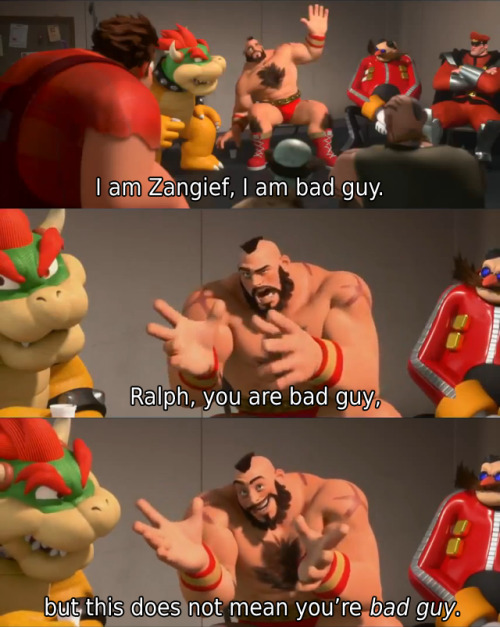
I think too often we have the subconscious idea that everyone can be put into good guy/bad guy terms.  Interestingly, and obviously, we always view ourselves as the "good guys" and, by definition, anyone who disagrees with us is a "bad guy," even if only for a little while.  By doing so, we dismiss them and their opinions and value entirely.

If only life were that easy.  If only the bad guys all walked around in dark robes that hid their terrible dental work and facial varicose veins.  If only, when cracking the whip over their hordes of dirty, hungry orphan laborers, we were able to see their cracked, unkempt fingernails and hear their harsh cackle.  If only, after stubbing out their cigar on the backs of their litter-carriers, they steepled their fingers and claimed they were going to be late for their meeting to subvert freedom, collect all of the world's resources and sit upon a pile of gold.

But this doesn't happen.  They look just like us.  The good guys do too.  This is because everyone is a bad guy.  And everyone is a good guy.  People don't fall into the black and white worlds of Harry Potter or Frodo Baggins.  Everyone is grey.


More than anything else, I think this is important for a teacher to know.  We will never like every one of our students.  We don't have to.  It's not our job to be their friends or to like them.

It is, however, our job to find their value and to help them find it for themselves.

As far as classes went, geometry had a game day since half of the students were out for a field trip. 

Our discussion of rate of change in pre-algebra was constantly derailed by students asking questions that I had just answered, followed by those students being yelled at by kids who were paying attention for not paying attention.

"Now you try this and we'll go over it in a minute" was met with "I'll just wait."

At some point, the responsibility for learning is on them, right?  At some point?

As per my previous thoughts about value, I will continue to try to reach them through individual and group contacts.

My enthusiasm for the subject is waning.  As a result, so is theirs, which causes me more frustration which erodes my enthusiasm even further.

I need to find a way to escape this vicious cycle and inject some more energy into my class.


Did I mention that I have a student who throws erasers at my whiteboard picture for fun?

Wednesday, February 5, 2014

Day 95: A Short, Good Day

The coloring is a little scary...


Another 2-hour delay.  Classes are shorter and half of the kids don't come, both things combined make for a very enjoyable day.  When I only have half the kids in my 4/5, that class goes SO much better.  It doesn't even matter who the missing kids are.  Just having fewer bodies in the room makes all the difference.

Class size matters.

All of my geometry kids were present, for about 6 minutes.  Then everyone associated with the upcoming musical was excused for an all-day practice and I was down by half in there also.  Luckily, I was able to give out the practice test before they bolted.

Pre-algebra today was rowdy, but productive.  We were talking about ratios, rates and rate of change.  I went back about 10 pages in the workbook and picked out several problems that I felt illustrated the concepts well.

We talked about sports have proportional scoring schemes (almost all except football and basketball) and why Dunkin Donuts will sell you one for $.59 but a dozen only costs $5.99.  They stuck with me for almost the entire (shortened) period and I'm very grateful for that.

Period 8/9 didn't have the same attention, but quickly perked up when I started talking about Kennywood, museums and membership fees.

"Why would anyone pay so much just to be a member?"
"Let's explore that!"

There are days that are very good.

I THINK I've finished up the 5-7 day project that I'll be foisting on all of my classes.

They will be designing a park in groups of 3-4, creating a budget, a promotional campaign and presenting it to the rest of the class.

I will happily take suggestions on how to improve it.

Tuesday, February 4, 2014

Day 94: A Candid Discussion With Students


My post yesterday received some comments that made me think that I came off as implying that I was using the behavior rubric to "fix the black kids."  This was not my intention at all, but I can see how it appeared that way.

In geometry, we quickly went over the guided notes from the previous section followed by an activity about finding the center of gravity for a triangular toy and playing with straws to verify the triangle inequality theorem.  I'll admit that I was more checked out of this lesson than I should have been.


I've started working on a 5-10 day project that all three of my classes will do.  More details to come, but the basics are that students will be split into groups of 4, each student given a specific job with specific tasks and they will work together to design a park.  It's a modified version of a project provided by the Glencoe text book.

A buddy of mine even made me a logo to put on the project sheets, since I know nothing about graphic design.
It's good enough that I may have to start my own engineering firm!

After the conversation yesterday about the behavior rubric, I went home and typed it up.  At the suggestion of some colleagues on Twitter, I changed the scale from 0-3 to "4th Grade," "6th Grade," "8th Grade" and "High School" implying the behavior expected at each grade level.  I spent some time explaining it to my 4/5 while they paid very close attention.  I asked them if they (the ones who weren't here yesterday) felt that it was fair and they all said yes.

I began my lesson.

They began talking over me.

I asked what grade level behavior they felt that they were exhibiting and they truthfully replied with either 6th or 4th.

Then they continued talking over me.


My 8/9 told me yesterday that I need to "use my words" and talk about what is upsetting me so they know what they're doing wrong.  So I sat down and calmly explained to them that I didn't know how to help them.  I ran through the list of things that I had done (groups instead of rows, guided notes, workbooks, given pencils, student-created behavior rubric, having them lead discussions, etc. etc. etc.) and that I was out of ideas.

"I need your help.  This isn't a sarcastic statement to say 'I need you to stop being jerks.'  I actually need your help.  I want to teach.  I want you to learn.  Clearly, I haven't figured out what you need in order to make that happen, so I'm asking you straight out.  How can I make this class more interesting? What kinds of activities would you do?  What kinds of things do you want to learn?"

I listened earnestly to their statements, biting back the urge to reply to any suggestion with "we DID that! You refused!"

But I nodded and wrote down what they said.

The main things they wanted to do was play games and do projects.  I expressed my concern that the last few projects we did were never turned in.  I THINK I did this in a way that was inquisitive and not accusatory.  They gave me some suggestions on how to improve that, such as setting a more structured timetable and more hands-on projects ("with popsicle sticks and stuff!") rather than surveys and calculation.  I think they made some very good points.

I was very impressed with the discussion that we were able to have, and I hope that it was due, at least in part, to the fact that I entertained every suggestion they offered.

In the end, we decided that I would break up the content for the rest of the marking period into topics.  Students will work in groups of two or three, using the iPads, textbooks or computers, to become experts in an upcoming topic.  They will then develop a lesson and activity to teach the rest of the class.  I plan to work very closely with them to help them through and to ensure that they aren't teaching anything incorrectly.

I think our conversation today really helped some of the students to see that I am actually trying to do well by them.  A few who normally are spaced out stayed after to talk.  I'd say that's a step in the right direction.
Related Posts Plugin for WordPress, Blogger...