Friday, June 17, 2022

That's A Wrap!

And wraps are sandwiches...


Today is the last day of the 2021-2022 school year.


It is also my last day as a classroom teacher.  I figured that in the spirit of what this blog used to be, I should reflect on my time in the classroom.


Here are some of my numbers:

First year: 2004

Total Years in the Classroom: 15

Number of States: 2

Number of School Districts: 4

Grades Taught: 8, 9, 10, 11, 12

Classes Taught: Math 8, Algebra 1, Geometry, Algebra 2, Physics, Astronomy

Approximate Number of Students: 1,400

National or Regional Presentations: 17 (and  2 more this summer)


This has been a strange journey for me. During my first few years, I thought I was brilliant. I knew how to solve all of the problems and they were, of course, remarkably simple-minded solutions. 

I even made a podcast in my first two years to showcase my ideas.

Listening back now is ... cringeworthy.

Numerous people over the years have told me that I didn't have the temperament to be a teacher and when I think about that, two things immediately come to mind.

1) All of the people were college professors.

2) They weren't wrong.


As an educator (an hopefully, as a human), I know that I have grown remarkably over the years. I found, and helped build, an incredible community of educators from around the world who have pushed my thinking on education in directions I could not have anticipated. I have traveled to places I'd never been to and made friends with people who have changed my life and opened up the world to me. I have been assisted, and pushed, and pushed back on, by people who genuinely cared about my growth.

This blog contains the work. It has almost 2 million words of reflection, documenting my journey


I think that the last few years have shown me that I CAN be the leader and mentor that I thought I was during my initial classroom experiences. 


I have found a team of colleagues that I want to work with and some of the best teachers I have ever known, many of whom are in very beginnings of their careers.


And I'm leaving the classroom behind.

Peace out, my guy!

There are many reasons for this, including the way the education system is run, the way teachers are treated, the way students are treated, etc.. I've spoken to many people about thoughts on the current state of education and doing so again here would be unnecessary. I do, however, want to make two points VERY clear:

1) I am, in no way, shape or form, leaving the classroom because of students or student behavior. Behavior is communication. Students who are "poorly behaved" are communicating that their needs are not being met and that is the responsibility of the adults and the systems with whom they are associated. Students are students. Their needs have changed and we have not changed enough to provide them with what they need.

2) It's time.

If I'm being honest with myself, which is the entire purpose of this blog, it's actually past time.

I mostly became a teacher for the wrong reasons, proving my college professors right (but still rude) and I powered through because I THOUGHT I was doing well. I was not.

I almost left in 2012. It was only through sheer happenstance that, right when I needed it, I found an incredible group of educators who helped me to find a legitimate reason for teaching. They showed me through example and inspiration what this job COULD be. They opened their arms to me and changed my life and outlook SO much, that when I returned to the classroom after that summer, my coworkers didn't recognize who I was.

The conference (Twitter Math Camp) that I attended that summer, and everyone associated with it, bought me a decade more in front of my students. They helped me to see what kind of teacher I wanted to be and what kind of father as well.

I should have left again in 2019 when I found myself wanting to let go of my steering wheel during my commute and letting my car drift into oncoming traffic. I thought, as the time, that was just my current placement, but in retrospect, it was not.

I didn't leave because momentum is a hell of a thing. It's so much easier to continue doing the thing you're doing, even if you don't like it, than it is to switch to something else. The "sunk cost fallacy" has taken much of my time and energy. Changing to something else was a daunting task and I didn't want to put the energy into it. As someone whose favorite album is August and Everything After, the appropriate line playing in my head was "maybe this year will be better than the last."

I also didn't leave because I was scared. I am a teacher in my heart and my soul. It is my identity and my persona. When people ask about professions, we don't say "I teach." We say "I am a teacher," which is a difference that is grammatically subtle, but emotionally monumental.

Also, the allure of a few weeks off each year is a VERY strong incentive. Although, I am not at all a beach guy...

Ew...sand in my everywhere...


So now it's time!


While I am not a high school football star, hanging around the building wearing my letterman jacket at 25, I do plan to remain active in the educator community.  I will continue to fight for my students, for my (former) colleagues, and for education in general. I will continue to lift up voices that need lifting and advocating for those who need advocates. While I will no longer be a teacher in profession, I will always be a teacher in my heart.

Alright, enough of that. If this gets any sweeter, Wilford Brimley is going to show up.


I am excited and nervous for the road ahead, but I am not sad about the change. With the things I have learned and the people I have met, I couldn't possibly regret my time.


I may continue to write, but for now, this is Justin Aion, math teacher, signing off.


Wraps are sandwiches. Fight me.


Monday, May 18, 2020

Alignment Charts and Imposters

I love alignment charts! As someone who plays Dungeons & Dragons, and various other RPGs, I find it comforting to be able to slot people, items, characters, movies, etc. into alignment charts.

For those of you unfamiliar with the concept, let me give you a brief run-down:

An alignment chart is a 3-by-3 grid of personality traits, with the "good and evil" spectrum on one axis and the "lawful and chaotic"spectrum on the other. How a character is played, and the actions they take, are often determined by where they fall on this chart.


While this was developed and used mostly in role-playing games, a quick google search can pull up an alignment chart for almost any topic you could want.

Are you into Star Wars?


Are you a fan of Arrested Development?


What about The Wire?


Perhaps something more erudite?


Alignment charts are incredibly flexible and can be modified to make visually interesting and fun points on any topic.


Not all charts need to be on the lawful/chaotic and good/evil scale to get their point across. One close to my own heart uses other concepts:


I could spend hours going down alignment chart rabbit holes and arguing about the merits of placement, although Captain America is ALWAYS lawful good and the Joker is ALWAYS chaotic evil.  For the record, I am shopping cart chaotic neutral.

There are some pretty great alignment charts that have been made for school-related topics as well. This one is one of my favorites:

While we as teachers understand that students are complex and ever-changing, if asked to do so, I think most teachers would be able to place most students on an alignment chart with "motivated/lazy" as one axis and "smart/obtuse" on the other.

Now, I know that this is unfair. Student intelligence and motivation is a MASSIVELY complex spectrum. Where a student falls on this chart for a particular class/assignment/teacher/day, changes all the time.

I think a fantastic post could be written about each entry on that chart, but this isn't why I bring it up. I've been thinking a considerable amount about the kids who would typically fall into the Smart-Lazy block.

I would argue that this group of students causes the most frustration for teachers and every teacher has experienced it. This is the student who either aces all of the tests, but refuses to participate in class because "this is dumb" or the kid who has incredible insights but refuses to complete assignments.

The most obvious example of this for me, have been the students who answer all of my questions right in class, ask great ones of their own, but when it comes time to do an assignment or assessment, they turn it in blank, claiming they don't know any of the material.

I have found myself asking "Why would they do that? Why would they choose to fail something at which they could easily excel?"

I think it's because they DO get to choose.

When that score comes back as a failure, it's not because they were dumb or couldn't do the work. It's because they made the choice to get that grade. It's not the grade they wanted, but they had power and ability to make that choice.

Before we start in on "but if they knew what they were doing, they would have succeeded" we need to remember two important things:

1) Every student has a horror story about a teacher who lowered a grade for terrible reason. Every couple of weeks there is a new massive thread on Twitter about this exact topic. Feel free to peruse the thread below for some horrendous examples:
2) They probably didn't think they would have succeeded if they had put in the effort. Imposter syndrome is real.


All of this has come to the forefront for me in the last few weeks.

I have been searching for new employment. I have applied to schools, both public and private, as well as education-related companies. I have had several interviews and call-backs in which I was asked to complete a task, such as write a lesson or unit plan, or complete some other job-related task.

In every single case, my knee jerk reaction has been the following:
I mean, they can't tell me I'm not good enough for the job if I pull my application first, right?  RIGHT???

This is the professional version of:


I have been teaching with varying degrees of success since 2004. I began my teaching career with all of the confidence of a mediocre white man. I had never taught before, never done student teaching and hadn't taken education classes.

I thought I was the best teacher in the school and looked down on anyone who said otherwise. I was garbage.

As I gained more experience in the classroom, was (rightly so) knocked off my pedestal more and more, and interacted with more teachers who actually are brilliant, I began to realize just how far I had to go to become the teacher I thought I was when I started.

"The more you know, the more you realize you don't know." -Aristotle


I still fall victim to the Dunning-Kruger effect. I talk the talk. I have the swagger!

As soon as I'm asked to actually produce something, however, no matter how solidly that task lies within my area of expertise, I am suddenly overwhelmed with the feeling that I am an imposter.

My administrative observations over the last several years have been quite good. There is always room for improvement, but on aggregate, it appears as though those who observe my classes like what they see. I have students from almost a decade back who still contact me and tell me how much they enjoyed my class.

Every time an administrator walks into my class, my gut reaction is "Oh crap! They found out that I'm a fraud!"

Imposter syndrome is a real thing.

As I ask my students "You got this right every time in class, why would you think you couldn't do it now?" I need to spend more time asking myself these same questions. As an adult who is being asked to do something that I've spent my entire professional life doing, I still need to be reminded that I can do that thing!

As a teacher, I need to do a much better job of recognizing imposter syndrome in my students for what it actually is, and reacting and supporting them appropriately.


All the while I was writing this post, I kept thinking "I want to cap this off with an alignment chart" which was immediately followed by "I have no idea how to make one."

So I made one anyway, because of COURSE I can make one. It's not pretty, but it gets the point across. I left a spot blank because I want to hear what other people would put in there (and because I have no clue what would fit)

Half the fun of an alignment chart is the discussions it promotes.


Thursday, May 23, 2019

For Want Of A Nail...

One of the things that they don't tell you in education programs (or maybe they do and I just wasn't listening) is that there are no simple answers.

"Mr. Aion, can I have a pencil?"

How do I answer this?

If I say "no" then I'm communicating my expectations that students come prepared for class.  I am reinforcing my desire to have them think about what they need before they attend.

If I say "yes" then I'm communicating my belief that pencils are important enough that I have them, but the lack thereof shouldn't be a barrier to learning.

But there are no simple answers.

When I say no, what happens inside the head of the student? Do they understand that I'm emphasizing the need to be prepared? Do they think "this is a natural consequence of my inability or unwillingness to bring one of my own"? "This is bad and without a writing implement, I can still participate in class, but will be further behind because I can't take notes or focus my thoughts through a written medium."

This totally happens!

Or do they sit there with their arms crossed, refusing to participate in class? "Fine. Then I guess I won't learn today."  Without a pencil, will they sit there quietly, or are they more likely to distract those around them?

Does it teach them responsibility, or does it reinforce their own preconceptions that school sucks and hates them?


When I say yes, what happens inside their heads? Do they feel grateful that I have the empathy to understand that sometimes kids forget things and need help? Are they thankful that someone was there to meet their needs this time and will do their best to remember a pencil tomorrow?

Do they see that my willingness to give them something they obviously need is an indication that my priorities are my content and not their organization?

Does it teach them empathy, solidify the student/teacher bond, or does it reinforce their preconceptions that they don't need to be responsible for their learning and someone will always pick up their slack?


But there are no simple answers.

Why did the student ask me for a pencil?

Did they forget their pencil at home? Did they leave it in their last class? Have they looked in their bag to see if they have one, or did they assume not? Did they start the day with a pencil and lent it to someone who didn't give it back, or did they lose it when they threw it at a kid in the hallway? Do they not have a pencil because they are disorganized, or because they come from a home that is shattered and dangerous and "make sure I have a pencil for class" isn't even a blip on the trauma radar?

Do they need help learning organizational skills, or do they need to speak with a counselor about being removed from an abusive home?

Or did they simply misplace their pencil?

There are no simple answers.


A pencil is such a small thing. It costs me nothing to give one to a student, but what does it cost the student? What preconceived notions of theirs are reinforced or shattered, either consciously or unconsciously? What habits am I building or enforcing? Does it show them a safety net will always be there, or does it demonstrate empathy and understanding that they will internalize?

What about the other students? What do THEY learn when I say yes or no? Do they see me as firm but fair, someone they can approach if they have needs, either big or small? Do they see me holding their classmates accountable for their choices and habits? Do they understand why I gave a pencil to student A without blinking an eye, but gave student B a quick talking to about preparation?

Do they see a stupid man dying on a stupid hill?

If I give, or don't give, pencil to 100 students, there will be 100 different reactions.


When I look at my students, or own children, I wonder about pebbles.  I wonder which pebbles can be safely added or dislodged from the mountains that are their lives.

I wonder which pebbles will make that mountain increasingly precarious until one day, a minor disturbance upsets the entire groups, causing an avalanche that leaves the mountain an irreparable ruin.

I recognize that people are not mountains.  People grow, shrink and change.  Avalanches in people are a part of being alive and can be repaired.

I recognize that I am not going to ruin a child by giving, or not giving, a pencil when asked for one.


Teaching is exhausting. Wanting to be a good teacher, even more so. We make these calculations every time a student asks a question, makes a request or gives a comment.  Which walls are we building? Which walls are we breaking down? Which walls do we leave alone because we lack the tools to have any impact?

Which walls do we simply ignore for the sake of our own sanity?


I know that I am too close to this year to give adequate or accurate reflection, but I will say this:

I don't feel good about how it went.

Then I ask my students what they think and their answers remind me that, while I have a lot to learn and long road to walk, I haven't caused any avalanches.  In some cases, I helped to build bridges and give a hand when needed.

Overall, I suppose I'm doing alright.


I suppose I should keep investing in pencils.

Friday, December 21, 2018

Teacher as DM

Today was the last day of school before break. The students signed up for activities throughout the school. Some watched movies, some made gingerbread houses, some had a Madden tournament and some played soccer.

I offered up my room for board and cards games. I also offered to run a D&D session for some students. I capped it at 6 because any more than that gets WAY too unruly and the time between turns is too long.

Four out of the six had never played D&D before, so we had a quick primer on the rules and mechanics. I impressed upon them that they were adventuring together and we would all be telling a story as a group.

Right from the start, it was obvious that a few of the kids were going to have difficulty working with a group. Even before the first encounter, they had their characters tripping each other and pulling pranks.

The first encounter began with a sheep coming up to them with a scroll of Speaks with Animals, claiming to be a wizard that was transformed by a rival. A half-orc shows up with some wolves to take the sheep back.
One of the students straight up tackles the half-orc while another student was trying to negotiate.

"Ok, so I guess we are fighting."

The do fairly well in the fight, except that two kids seem to have difficulty understanding the concept of "turns" and have to be constantly reminded about how that works.

It quickly became apparent that half of the party was super into the game, was trying to play strategically and seriously, but ended up spending most of their time trying to either undo the damage cause by, or rein in the actions of, the other half.

The story I had planned was designed to be a 2-3 hour adventure for a 4-person party of second level adventurers. We had a 6-person of third level, so it should have gone smoothly.

It did not.

One of the things that I love about D&D is how consequences of actions, either joking or serious, happen right away. Allow me to give some examples.

The party went into a small tavern to gain some information. The fighter stabbed his sword into the table, thinking it would be funny, and the whole party got kicked out.

While introducing themselves to a paranoid wizard who constructed his house by magically growing trees and vines into the shape he wanted, the paladin draws his weapons and glares at the wizard, immediately getting them thrown out and told to never return.

After returning to the town to decide what to do next, the same paladin gets bored and decides to "raid the local farms." His deity sees that the paladin has broken his sacred oath to protect the poor and downtrodden, and cuts said paladin off from all magical sources.

After coming up with a plan, the party returns to the wizards house to find it fortified and with a guard out front waiting for them.

"We apologize for our rudeness before, but we seek the aid of Master Noke in a matter of great import" is what the rogue was trying to say when the ranger fired an arrow over his shoulder, hitting the guard.

The ranger is then punched into unconsciousness by the guard who then retreats back into the house.

The rest of the party refuses to heal the ranger, who has now started two fights that could probably have been avoided. In the ensuing fight, everyone is brought to the brink of death. The fighter is knocked out and the rest of the party says "NOPE!"

They leave him to bleed out of the floor of the house, hightail it into the forest, head off to Neverwinter and forget about the whole thing.

At the end of the session, I spoke privately to the kids who seemed to be taking it seriously and let them know that most games don't go this way. We talked a bit about how to find a group of players that fit your gaming style and what to do when your party doesn't.

The paladin and ranger told me how much fun they had and asked if we could play again. I told the they would have to ask the rest of the party, who clearly told them no.

We had a brief discussion about "reading a room" and recognizing them their actions don't only have an effect on them, but on those around them. The party was a bit overpowered for this adventure and it was supposed to be a softball, but the way they played made it an impossible task.

Because of who I am and what I do, this struck me as the PERFECT microcosm.

I went into this session with a vague idea of how it was going to go and had planned accordingly. Several students derailed the plans, but I was able to roll with it and tried to get stuff back on track. Their actions made everything more difficult, not only for them, but for the other students as well.

What I found so interesting about it was how much enjoyment those students derived from the chaos they created.

As a Dungeon Master, my only goal is to make sure that my players have a good time. I don't think I accomplished that goal today for the simple reason that the players each had their own goals, many of which were contradictory to each other. The enjoyment of one student was counter to the enjoyment of others.

This is not to say that some of these students were right and others were wrong. The beauty of D&D is that you can play it however you want and still have a great time. The problem is that these disparate play styles probably shouldn't be in the same group.

But in a classroom, we don't get to choose our party members. The goals are often set either by the teacher, the school board, the state or the nature of the class itself. Yes, we can change the flavor of the discussion, but the mission or quest is still the same.

How do we have this discussion in a way that gets all needs met? How do we get students to understand that their style of play makes it hard for others to enjoy the same tasks? How do we help students get to the end of the quest and feel as though they have accomplished something great, rather than just survived it?

I don't know.

I do know that I will continue to offer to DM for students who wish to play and doing my best to ensure they have fun.

Adventure on!


Monday, October 15, 2018

Day 32: For No Reason

The kids were great today.

My lessons went fairly well.

I had a pretty wonderful weekend, playing Dungeons and Dragons with my friends and my kids. We went apple picking and I did well in my axe-throwing league yesterday.


I didn't have a great day.

I have no rational explanation for it.

I could talk about how the geometry kids asked if we could finish working on the Gold and the Tiger and then just guessed which door to open rather than figuring it out.  I could talk about how I'm nervous for the Math Team competition on Wednesday because I've had no permission slips turned in yet. I could talk about how I haven't been sleeping as much as I should.  I could talk about how gross and grey the weather is today.  I could talk about how my runs for the last few days haven't been great and how that's frustrating. I could talk about how I need to write both of my presentations for NCTM at the end of the month.

I could talk about how it's apparently National Grouch Day and I'm just celebrating.

The reality is that sometimes people just feel bad for no real reason.  Today is one of those days.  Anxiety is not fun.

Friday, October 12, 2018

Day 31: Dom and Randy

Once upon a time, two men were hired to work at a factory run by Func Enterprises

After several weeks of extensive training, Dom was given the assignment of sorting the raw materials and placing them on the appropriate intake belt of the factory.  Those materials then traveled through the factory and were lovingly and expertly crafted into the various products made by Func.  After passing through quality control, where they were checked to make sure they were up to the latest industry standards, the products were sent to Randy to be packaged and shipped out to customers all over the world.

Dom and Randy were both very good at their jobs and were both blessed with an innate curiosity.  Neither man was content to simply and unquestioningly do his job.  Instead, both men became interested in the inner workings of the factory.

In addition to the manufacturing process itself, Dom was deeply interested in the kinds of products that Randy packed based on what he delivered.  Similarly, Randy was curious what kinds of raw materials went into the products that he was shipping.

Sometimes, Randy was able to tell exactly which materials Dom delivered just by the products that came through.  Similarly, on occasion, Dom would know exactly which products Randy would receive based only on what he dropped onto the intake belts.


When Dom knows exactly what Randy is going to get at the other end, the relationship is a function.


When Dom doesn't know what Randy is getting, it's not a function.


When Dom knows what Randy is getting AND Randy knows exactly what Dom put in, not only is it a function, but it is a 1-to-1 function.

Eventually, both Dom and Randy moved on to careers in the lucrative field of illustrating mathematical concepts and within 6 months were able to retire to an island with white sand beaches, but neither man forgot the humble function backgrounds from which they came.

Thursday, October 11, 2018

Day 30: Bribery, Please

My seminar was, once again, very well attended! Clearly, I've hit on something with the invitations and skill specific sessions.  I thanked the kids for coming again and I'm thinking about having a snack for them in the future, although at random intervals so I'm not bribing kids to come to tutoring.

Now, if they want to bribe me...


I put a paper outside of my door inside a plastic sheet protector so I can write the schedule on it and have it be available when I'm not.

While I'm not feeling great about the progress that the classes are making through the curriculum, I am feeling very good about how well they are understanding it.  The last few days have been intense and they've been asking great questions.

The algebra 2 kids were given a practice paper for rules of exponents and flew through it. The geometry kids took to the discussion of conditional statements very well and already began arguing in a more logical fashion.

I'm excited to have them be eaten by tigers tomorrow.

Wednesday, October 10, 2018

Day 29: Truth Tables

Truth tables can be kind of dull, especially when your class is mostly asleep. The second class seemed to really like figuring them out, as did the third class.  Perhaps they were slightly more interested when I told them that being able to determine the truth value of a compound statement would keep them from being eaten by tigers.


I think the plan is to make an answer sheet where kids have to make their decisions in pen and the one/ones who survive the longest will get some sort of prize.  If I had a button maker, or had planned better, I would make a survivor button.

"My classmates were eaten by tigers and all I got was this stupid button!"

I'm very excited to work on conditional statements with them. If I had reliable access to computers for all 25 kids in my big class, we would also do basic programming.


The Algebra 2 kids have been working on rules of exponents and we spent yesterday and today looking at why the shortcuts work. I'm struggling a bit with the course sequence, but it will work itself out.


I'm having more and more students come to me for extra help. Most of them are either on my roster this year, or have been before, but not all. I have several kids who I never had in class who still come to me for help.  I take this as a good sign.

Tuesday, October 9, 2018

Day 28: You Are Cordially Invited

After the assessments in Algebra 2 on Friday and various conversations with other teachers and administrators on how we can increase understanding and achievement, I'm trying something new.

My district has a seminar period at the end of each day from 2:30-3:00.  I have always made myself available during this time (except when I have meetings) for students to come in for extra help.  We aren't able to mandate that a student attend seminar, so I've been looking for ways to get kids to attend.

Since I am unable/unwilling to force students to attend extra help sessions, I invited them!

I have scheduled Skill Sessions after school on specific days and invited the students who are struggling with those skills to attend.  All students who need to, or wish to, work on Skill 3 (I can write a linear equation of a line that is parallel or perpendicular to a given line) are cordially invited to attend seminar from 2:30-3 today in my room.  Those wishing to work on Skill 4 (I can write and apply direct variation equations and proportions) should attend our session on Thursday.

All students are welcome at any time to work on any skill they wish, but the designated skills will be the primary focus on the announced days.  I plan to do a remediation lesson and run through some practice problems.

I'm also thinking that in order for a student to reassess a skill, they will need to attend at least 1 session.

I handed out the invitations today and 4 kids showed up to seminar! We did a mini lesson and some practice and I thanked them for coming to spend time with me. 


I was going to write about the specific lessons that I covered today, but I have pushed those a bit out of my mind for the moment and am thinking about how to improve these study sessions!

Friday, October 5, 2018

Day 27: Grading...Ugh...

The assessments went well for the students who have been working with fidelity.  A few told me that they were confused, so I asked them what they had done to prepare.  They admitted not much.  I'm hoping that I can leverage these experience into helping them develop habits to succeed, if they choose to do so.

I am not going to judge their choices or their priorities, but if they wish to be successful in my class, I can help them with that.

By and large, the most common mistakes that I saw were careless ones.  Students wrote "4 - 3 = 2" and similar transgressions.

While these are irksome, I'm not overly concerned about it.  I don't honestly believe that they think the statement is true.  I think it infinitely more likely that they didn't check their work, moved too quickly or something similar.  Using standards based grading allows me to assign grades and feedback in a more comprehensive way.

In the section assessing the skill of solving absolute value inequalities, one student got the wrong answer for most of the problems, but still passed the section because the mistake were calculation-based.  The work and thinking were clearly displayed, meaning that I was able to see that this student knew exactly what they were doing conceptually, but were careless with signs.

Two students showing the same wrong answers may get different scores based on how they obtained those answers.  I understand there are arguments against this approach, most of which boil down to "in the real world, you're either right or wrong."

Setting aside the fact that I don't think that's always true, you can't argue about the "real world" and yet only allow students one opportunity to show understanding of a memorized topic.  In the "real world" people get multiple opportunities to work on, improve and modify their products.  In the "real world" people have resources at their fingertips, such as the internet.

I began writing a multi-paragraph rant here about the appropriateness of modern education in the scope of preparing kids for the "real world" and decided against it.

I have lots of assignments to grade, my ax-throwing league starts up again this weekend, the book I'm reading is starting to get great and I still have to run today.

Thursday, October 4, 2018

Day 26: Blank Notebooks

Tomorrow, there will be another assessment and the first major graded assignment for the Algebra 2 class.  I am...nervous.

We've been hitting the material fairly hard and I know they are plenty capable, but I'm still nervous.  The kinds of questions and the pace of work that has been happening in class over the past few days leads me to believe that there are some gaps in understanding, particularly when it comes to properties of linear equations, such as slope and the y-intercept.

I have my class open before school, at lunch and during our Seminar period, which is the last 30 minutes of the day set aside for tutoring or activities.  My duty period during the school day is also tutoring when most kids have lunch.

I can't say that I've seen too many kids coming for extra help and this worries me.

The review packet was handed out on Tuesday and we've been working on it in class since then. It's due in class tomorrow and I think that the students who needed the practice the most put it off until tonight when they'll be unable to ask me questions.

Since I have the older kids this year than I have in years past, I'm being a bit more "rigorous" about my assessments and assignments.  After our first assessment, many of the kids who wanted to reassess were shocked at how much work was going to be required before they could do so.  They have to make corrections on their test and then do some more practice problems.

I am a brutal taskmaster, I know.

I don't want to be grading effort or habits, so I'm trying to find a way to incorporate those things into my assessments while putting the emphasis on the content.

I don't want to collect and grade homework unless I can give them meaningful feedback on it, but that may also have to change.  I do like the idea of having a selection of homework that's all due together, rather than spacing it out, but would spacing it out make them more likely to do it?

Does that even matter?  How do I make the homework meaningful when attempts are frequently not even made?  How do we teach them the habits they need to have the outcomes they want?

What outcomes DO they want, besides "pass the class"?  Should I set up a "mandatory seminar schedule"?


Tomorrow, before the assessments, I will be reminding them of all of the tutoring time I have available.

"The day before a test, I expect my room to be full."

I am hearing similar concerns voiced by other teachers, so perhaps we need to be working together to find a way to address this.


Tuesday, October 2, 2018

Day 24: The Sidewalk Is Wet, Therefore...

We began our discussion of logic in geometry today.  I want my students to be in the habit of backing up their claims with logic and reasoning, but that doesn't seem to be a priority in many math classes.  As I have written about before, I believe there is too much emphasis on "answer getting" and not enough on WHY the answer is what it is.

The chapter on logic and reasoning in Geometry is, by far, my favorite.

For the last several weeks, I have frequently said that an justification I won't accept as a reason is "'cause it looks like one!"  When I emphasize this point, I say that line in a faux British peasant accent and, much to my despair at the involvement of today's youth in the cultural zeitgeist, only one student has understood my reference.

Today, I began class with this following clip:


Afterwards, we had a brief discussion about how the argument and line of reasoning presented here has the flavor of logic, but is drastically missing internal consistencies.  I know. I'm so much fun!

We talked about how making a statement that can be shown to be false through a counterexample usually wrecks whatever conclusions come after.  Witches are made of wood because wood burns and so do witches, except we were able to list several other things that burn that are not wood and also not witches.

"If I look out the window and see it's raining, what conclusions can I make about the sidewalk?"
"That it will be wet."
"Great! Now, if I see that the sidewalk is wet, can I conclude that it was raining?"
"Not necessarily. Someone could have sprayed a hose, or dumped water or peed."
"Yes! Yes! Gross!"

After this, I introduced them to the idea of logical statements and conclusions through the use of THIS clip (which I also had to explain because "kids today"):

What are the implications of the question she asked? Would you have asked something else?

I may not be good at most things, but by glob am I good at improving their geek cred!


The Algebra 2 kids have another assessment coming on Friday so this week is a time for "review everything we've done so far and work on practice to solidify concepts."

I handed out the work I wanted them to do, then watched a student take 7 minutes to get a piece of paper from their binder, sharper a pencil, clean the edges of the paper turn the binder upside-down, get another paper, change pencils and then ask for help.

I've written before about the importance of starting a task and moving through it at a certain pace.  I run into these same issues with my own children when I want them to clean their rooms or pick up their toys.

"Dad, this is taking forever!!"
"Of COURSE it's taking forever. In the past 10 minutes, you have danced with your sock, wandered aimlessly through the kitchen and sang to the cat. You haven't started yet."

With 40 minute periods, I'm really feeling the effects of the speed at which many of my students work.

I need to figure out how to fix it.

Monday, October 1, 2018

Day 23: Changes Horses

Each one of my geometry classes had a different homework assignment today.

Over the next day or two, we will be transitioning from the basics of points, line and planes, into more formal methods of logic and proof.  One of the problems from their homework last night was a perfect segue to this.

"Given the following coordinates for points A, B and C, determine if these points are collinear"

I like this question a whole bunch as it allows me to illustrate that the phrase "it looks like it" doesn't really belong in mathematical debate.

We went through the idea of logical statement in a very informal way, with my tweaking their language as we went.

Me: What does it mean for 3 points to be collinear?
S: They are on the same line.
Me: That's true. More technically, it means there is some line that contains all three points. So what would we need to do to show that they are collinear?
S: If we found that line, we could show they are all on it.
Me: That's interesting. How do you think we could find that line?
S: ....
Me: How many lines are there that contain any two points?
S: Just 1.
Me: So, if we find a line that contains two points...
S: We see if the third one is on that line.

The first class seemed to a bit more practice with the actual calculations so their assignment for this evening was to do so.  I set the other two groups to looking at the ideas of conjectures and what conclusions can be drawn from certain statements.

In looking forwards, I'm debating whether or not to do The Lady and The Tiger (modified to remove the misogynistic overtones of women as prizes).

The last time I did it, it went VERY well and the kids were pretty excited.

Thursday, September 27, 2018

Day 21: Self-Control

I think I'm keeping myself under better control.

As I've written about repeatedly, I have a tendency to get distracted by something interesting in class and go WAY off topic. Sometimes this is a valuable learning experience and sometimes I use the excuse that I'm building a space where students want to be.

Today I was much more deliberate about staying on topic as we were taking notes. I was deliberate about deriving the distance formula from the Pythagorean Theorem.  I deliberately chose specific examples to build up to linear inequalities.

As someone who teaches in a much more informal style, this was difficult for me.  I enjoyed it, but I finished the day having accomplished almost none of the other things I wanted to do and I was completely exhausted.

"Justin, aren't teachers SUPPOSED to plan out their lessons in great detail?" you ask.

"That's an excellent point, but I think there's something you're forgetting."


Wednesday, September 26, 2018

Day 20: The Power of Duran Duran

One of the first things that a student said to me this morning was "can we do board work today?"

"Heck yes!"

I had planned to have them doing some practice problems, but saw no reason why they couldn't be done on the white boards, so we did!

After going over a few questions on the homework, I had them pick spots on the boards around the room and gave them some problems to work on.  My instructions were:

Do as many as you can
If you finish a problem and feel good about it, move on to the next
You don't need to check in with me unless you have questions
Recap my markers when you're done
They did an amazingly good job with three of these four.  The kids who were pretty solid on the material were able to talk about their different methods of solving inequalities, discussing where the shading should go and pushing each other to justify answer.  The kids who were struggling a bit were able to ask for help and get the attention they needed.  Since I was roaming around the room, the ones who needed help but didn't (couldn't) ask for it were still able to get their needs met as I was able to see them struggling much more clearly.

I also realized that we needed some music, so I played an '80's Britpop playlist in the background while they worked.

I know how regularly I say "I should get the kids up at the board more" but I really should get the kids up at the board more.

Sadly, I can't REALLY do it in my one geometry class since there simply isn't enough room.

The geometry classes in general are starting to really move along. It's taken me a while to figure out what they need in terms of pedagogy and I'm sure it will take more time to get where I want to be, but we're moving in the right direction and I'm really pleased.


I've been making a conscious effort to keep a smile on my face and greet the students by name and at the door as much as I can. I stand in the hall between classes and say good morning to everyone who walks by.  Former students have been coming by for extra help before and after school and during their study halls.  I am feeling pretty good about my place in the community for the students.

Teaching isn't just about content transfer, but about building a community of learners.  I hope that I am doing what I can to build that positive and trusting environment.

Tonight, I am attending a school board meeting to receive a grant for ZomeTools.  I'm pretty pumped about it, but I'm worried that I won't get home for my 9 pm bedtime.

I suppose we all make sacrifices for our students.

Tuesday, September 25, 2018

Day 19: Reluctance to Experiment

I have many areas of weakness as an educator.

I don't deny this fact.  It's something that I attempt to work on each day, partially through my interactions with students discussing their needs and partially through the self-reflection that is this blog.

One of my major areas of weakness seems to be understanding the gaps in prior knowledge for my students and modifying my lessons accordingly.

I find that I spend an inordinate amount of time on back-filling skills and concepts and I am attempting to analyze exactly why.

I think that much of it comes from the normal attrition of skills that happens over time. While we are several weeks into school at this point, many kids are still in summer mode.  Today, two separate students asked me specific questions about the homework and then didn't realize when we went over their questions.

It can be a bit disheartening.

In addition to this, I'm very much struggling with my morning classes simply because of the time.  Research on circadian rhythms has shown that adolescents needs up to 9 hours of sleep each night. It also discusses how those adolescent biological clocks don't let them get to sleep before 10 or 11.  This research has suggested that delayed start times for schools would lead to increased engagement.

My 11th and 12th graders are asleep well into my 3rd period.  In addition to this, the make-up of my roster just happened to work out where the most low-key kids are enrolled in my morning classes.  Even when I see them later in the day, they are always very chill.

My more boisterous students just happened to be enrolled in my afternoon classes.

This quirk of rosters makes for a bit of a roller coaster day, leaving me exhausted at the end.


So, what I am doing about the lack of background knowledge?

I've started being MUCH more deliberate about the examples and problems that we do in class.  Many of my students are not used to independent style learning, which means that when I hand them an assignment or task and say "go! Let me know if you need anything" that many of them shut down.  This shut down comes from either the lack of understanding of expectations during this time, or the unfamiliarity with what to do when they get stuck.

"How you doing? It's been 20 minutes and I see you're on number 2."
"Yeah, I didn't what to do, so I just stopped."

I found that the major stumbling block in the geometry classes is a solid understanding of the visuals of what we are trying to find.  The skill of translating phrases into pictures in order to understand what's happened in the problem is a difficult one.

I fear that I've been relying too much on the "here you go" approach without respecting how uncomfortable many of the students are with the experimentation that comes with problem solving.

"I didn't know what to do."
"What do you THINK you do?"
"I don't know."
"Ok. Try something."
"Like what?"
"Like anything. Throw some numbers around and see what happens?"
"I don't know what to try."
"So you've said, Dear Liza."


I'm not sure how to overcome this discomfort. Our warm-ups have helped a bit, as has my emphasis on asking kids to explain their thinking and validating those thoughts.


In middle school classes, you sort of expect a certain amount of hand-holding. It takes much of the year for me to teach my students to take risks with their mathematics.  It's very frustrating to be having to do the same thing with the older kids.

With that said, there are a ton of students who are great at the experimentation.

I need to find ways to keep them challenged and engaged while I help the rest get over their fears.

Monday, September 24, 2018

Day 18: Wrong is Wrong, Right? Wrong!

It was, overall, a pretty good day. I handed back assessments, showed my colorful grade book to the students and had them Notice/Wonder about it.  They identified which skills we needed to readdress as a class, and which needed to be covered on an individual basis.

I reminded them again how reassessments would work and what they needed to do in order to take them.

I also talked about importance of showing their work using one of the examples on the assessment.

There were a large number of students who gave the answer to this question as "3."  With no context, this could have a been a random number, conjured from the ether by sacrificing a protractor, inscribing a ouija board on a coordinate place and asking the spirit of Pythagoras for the answer.

This wrong answer provides me with no clue as to the thinking or understanding of the student.  Under the current grading system, this answer would earn a 5. It shows an acknowledgement of the problem, but with no demonstration of the concepts that were covered in class.

Unless, they showed me how they arrived at this wrong answer.  This would make the answer any less wrong

Unless it DOES make it less wrong.  While 3 isn't the answer the question I asked, it IS the answer to an intermediary question, that being "what is the value of x?"

Showing how they arrived at the answer of "3" tells me two VERY crucial pieces of information:

1) Whether the kid actually knew what was going on, or if they had stumbled upon the number.

2) That I need to make sure I address the issue of answering the question that I'm asking.


While the original answer would have received a score of "5," the second answer, with the demonstration of thinking would receive an 8 or 9, indicating mastery of the skill for which I was testing (I can use the Segment Addition Postulate to describe how segment lengths relate to each other) but also recognizing that the work wasn't perfect yet.

With this being the first exposure to Standards Based Assessments for many of my students, I wanted to take the time to demonstrate what I am looking for and explain why I'm being picky about what I want.


All too often, we hear complaints from students claiming that they studied, but what they studied wasn't on the test.  There aren't "tests" like these in real life (except in academia, which is, arguably, not real life). So if we are going to insist on testing in this fashion, rather than having practical exams, then we need to make sure that we are assessing the skills and habits that we are teaching and emphasizing in class.

School is confusing enough without having arbitrary goals going unexamined and unexplained.

I may be wrong, but I don't think it's too much trouble to explain to students not only what we want and expect from them, but why we expect it.

Friday, September 21, 2018

Day 17: Assessment Drawings

All of my students too assessments today. A very few seemed to struggle, but the vast majority did an amazing job! The mistakes that were made seemed primarily to be ones of calculation rather than concept.

I was very careful to ensure that my grading aligned with the skills I was assessing.

I explained this to the students before the test and reminded them that if they show their work, then I'm able to see where they went wrong and that could be the difference between "You don't know what you're doing," which is a score of 5, and "You got this, but need to check your calculations" which is a score of 8 or 9.

I made sure to leave feedback where appropriate and did my best to interpret their meaning as well as their answers.

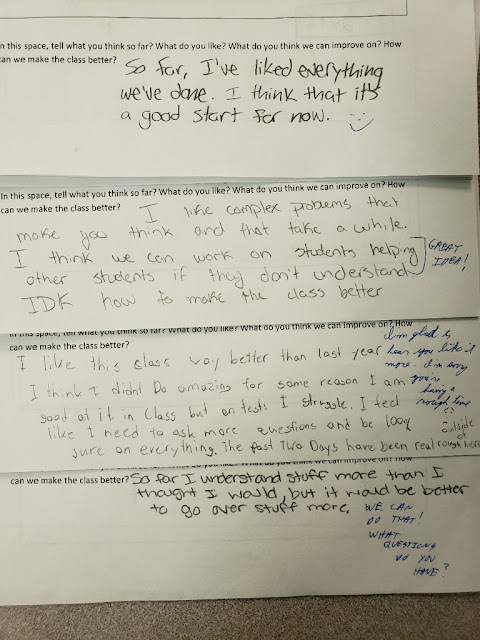
Even better, I added something at the end of each test. In the blank space at the end, I asked students how they thought the class was going, or to draw me something interesting.

I was not at all disappointed and will be doing that again for every assessment.


I don't mean to brag, but my students are pretty awesome.

That's a lie.

I totally mean to brag.

Thursday, September 20, 2018

Day 16: Students Are Better Than Clippy

Tomorrow is the first Standards-Based assessment that many of my students will take.  The job of class today was to remind them how the process goes, what the assessment will look like, how they will be scored and then give them the remainder of the time to practice and ask questions.

They utilized the time incredibly well and several stayed after school to work together.

I, on the other hand, had a wildly unproductive day as I spent most of it trying to get the formatting of my assessments the way that I want them.

Reason number 49,244,036 why I love Twitter:


Turns out, the answer was "Yes! They COULD answer some questions for me."

But, in true Microsoft style, they answered questions I didn't ask, such as how to place a picture in Word when using a MAC. They linked me to a generic FAQ site that was 90% unrelated to my query.

So it turns out that Clippy is alive and well! He is now running the Microsoft social media account.

I promise that I didn't scream profanity in a room full of students.
Related Posts Plugin for WordPress, Blogger...